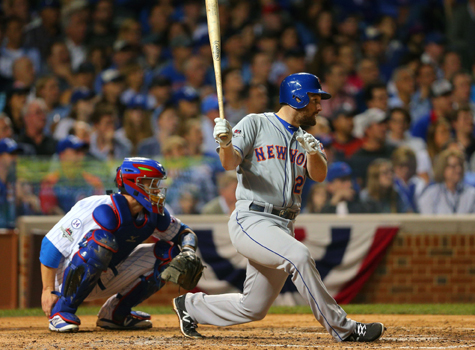
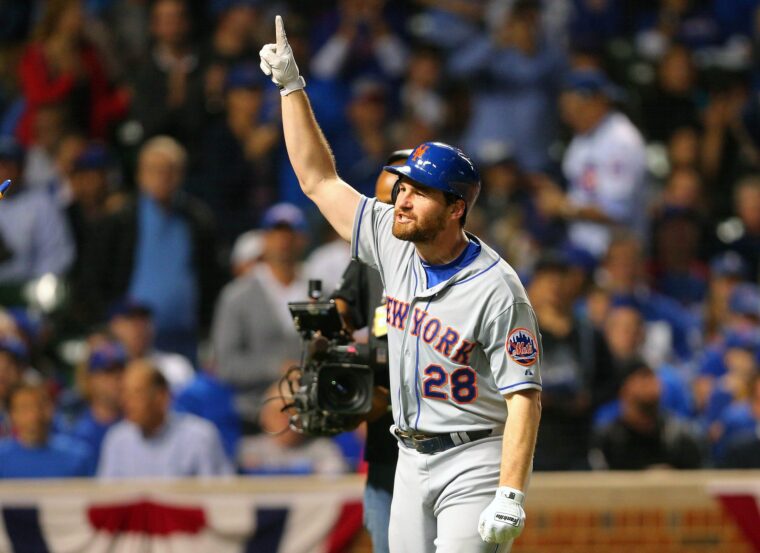
One of the most exciting parts of the New York Mets’ run to the 2015 World Series was watching second basemen Daniel Murphy morph from himself into a Ruthian figure. Seriously, though, it seemed like he was hitting home runs every night throughout the NLDS and NLCS against the Los Angeles Dodgers and Chicago Cubs, respectively.
As we are well aware, his first taste of Fall Classic action didn’t go how he would’ve liked. The five-game series against the Kansas City Royals included some defensive miscues and a .150/.320/.150 line with no homers and no RBI through 25 plate appearances. However, the Mets wouldn’t have captured the National League pennant without his contributions during the first two rounds of playoff action. Even with a tough World Series performance, he managed to slash .328/.391/.724 with seven homers and 11 RBI through 64 postseason plate appearances.
Murphy had long been a productive big league batter up to that point in his career, but hadn’t yet experienced anything quite like this. While the 14 homers he hit in the regular season that year were a single-season career-high mark, it was eye-opening to hit half that number in just a matter of weeks.
It’s hard to predict production that was so white hot, but his numbers during the final couple months of the regular season gave us a little foreshadowing of what was to come.
Building Momentum
From a season-long perspective, it was business as usual for Murphy, with a few improvements at the dish. His strikeout rate dipped down to a career-best 7.1%, which helped lead to a .281/.322/.449 line with those 14 home runs. Like the dingers, Murphy’s .449 slugging percentage was a new personal best at that point.
Those slight improvements didn’t bring much change to his overall value, with his 109 wRC+ and 2.2 fWAR falling well within his range of outcomes. Breaking down his performance by month shows the kind of trajectory he was on heading into the postseason, though.
Here’s a look at how different areas of his batted-ball profile changed throughout 2015:
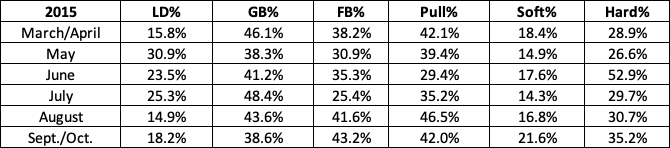
Of those 14 homers he hit in 538 plate appearances, eight of them came into the final two months (199 plate appearances). Although he did post a .333 ISO in June, he only suited up for five games. The results in August and September were more legit, as his ISO settled in at .217 and .258, respectively.
The Crescendo
The 2015 postseason was Murphy’s first taste of October baseball, and man, he didn’t waste any time getting himself acclimated to the new atmosphere. He started off things with a bang by putting together a 10-game hitting streak, which also included six straight games with a home run, spanning from NLDS Game 4 to NLCS Game 4.
The caliber of pitchers he took deep was also quite impressive: Clayton Kershaw (twice), Zack Greinke, Jon Lester, Jake Arrieta, Kyle Hendricks, and Fernando Rodney.
The following highlight video will hopefully take you on as fun of a ride down memory lane as it took me:
Between this ridiculous stretch and what Yoenis Cespedes did upon arriving in August from the Detroit Tigers that season, we were lucky enough to witness some of the best single-player offensive outbursts in franchise history.
Sustained into the Future
The last couple years haven’t exactly gone according to plan for Murphy, but his two years with the Washington Nationals immediately following this performance was more of the same (as we saw up close and personal, unfortunately). He accumulated 10.0 fWAR in just two seasons (5.6 in ‘16, 4.4 in ‘17) after accumulating 13.6 in seven seasons with New York.
This incredible run of success included consecutive seasons of 20-plus homers, 85-plus runs scored, and 90-plus RBI, along with a cumulative line of .334/.387/.569 and a 144 wRC+ in 1,175 plate appearances. While his 24.8% line-drive rate was higher than what we saw in 2015, the rest of his batted-ball profile checks out, especially with a 40.4% fly-ball rate and 36.9% hard-hit rate.
Heck, this run even brought two All-Star Game appearances, two Silver Sluggers, and one second-place finish in NL MVP voting (in 2016). He also led the league in doubles both years (47 in ‘16 and 43 in ‘17).
In true Mets fashion, we’ll be left wondering what could’ve been if New York decided to bring him back instead of watching him sign with the Nats. It’s a decision that former general manager Sandy Alderson has vocalized that he’d also like to have back. He’s not the only one in that camp, but we at least had that incredible postseason run to watch to also hopefully take our minds of watching him endlessly torment the Mets as an opposing player ever since.