
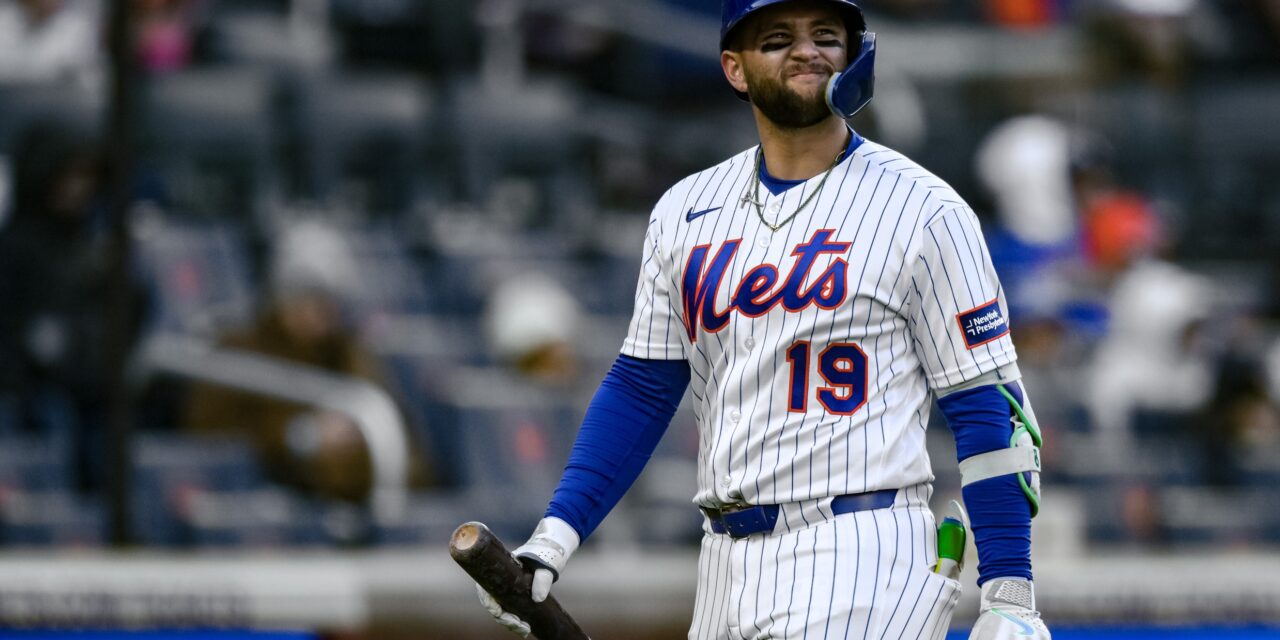
The term “snakebitten” is often used in sports to describe a team, or player, plagued by extreme bad luck or simply not getting the results they may have been deserved. Ironically enough, against the team named the Diamondbacks, the New York Mets’ offense found themselves “snakebit” in their 2-1 loss in Arizona at Chase Field Saturday night.
In that Saturday affair, the Mets were credited 14 hard-hit balls, 11 of which came against Diamondbacks’ starting pitcher Merrill Kelly. Kelly entered the night with a 9.95 ERA and had not been able to cross the five inning threshold in each of his four starts on the year. Somehow, the veteran gave up 11 balls hit at 95 mph or greater, which has been at the root of his woes (22nd percentile hard-hit rate, 1st percentile barrel rate) and 9.95 ERA this season, but, was able to survive it and get through seven innings of three-hit, one-run ball.
Everyone in the New York lineup, outside of Francisco Alvarez, was credited with a hard-hit ball and six of the nine had two. The Mets put 21 balls in play on Saturday; eight of them both went 349 feet or further and 100 mph or faster. Despite this, New York only had three hits and a single run. That is the definition of not exactly getting the results you are deserved.
Exit velocities and expected statistics are just that, and ultimately do not matter in the present if they are not turning into hits. However, one thing that has been proven time in and time out is expected statistics are a great predictor of future outcomes or successes. Especially when done over and over again. Unfortunately, that did not translate for the Mets on Saturday, and, has not been overall this season.
Entering Saturday, the Mets’ offense ranked near the bottom of the league in several tangible offensive categories:
- Batting average: 28th
- Slugging percentage: 30th
- Weighted on-base percentage: 29th
However, when you look at the expected statistics, the Mets’ offense, still not ranking elite by any means, are rated much better:
- Expected batting average: 16th
- Expected slugging percentage: 14th
- Expected weighted on-base percentage: 25th
Following along with the theme of the team’s offense underperforming, several individual Met hitters are vastly underperforming their expected statistics. Among 251 qualified hitters, here are the numbers of Mets inside the top-55 in terms of most “unlucky” in a specific statistic:
- Difference between batting average and expected batting average: 4
- Difference between slugging and expected slugging percentage: 5
- Difference between weighted on-base percentage and expected weighted on-base percentage: 4
As you can see, several Mets are at the top of the leaderboards when it comes to underperforming their expected outcomes. On the surface, four-to-five players does not seem like a lot, but that is half of your everyday lineup not getting the results they “deserve.” If the Mets offense was just closer to league average, as the expected statistics say they should be, paired with the deserved strong pitching results they’ve been getting, the team would be nowhere near nine games under .500.
The good news is as the laws of averages say, if, both, as a team and individually, the Mets keep underperforming their relatively decent-to-strong expected statistics, you are bound to see some positive regression. At nine games under .500 New York needs that positive regression fast. And, unfortunately for them, especially if they start seeing their expected numbers fade, it is nowhere near a given they will see that hoped better performances at the plate.