Things have not gone well for the Mets, that is not a secret. They are 40-57 and in second-to-last place in the National League. But that does not mean everything this year has gone wrong. In a season where it is very easy to focus on the negative – and trust me, we have done that plenty – let’s take a look at some of the positives.
The Young Core is Forming
Since Steve Cohen bought the Mets, he was clear that this strategy of short-term, high AAV stopgap contracts was a short-term strategy to try to be competitive while rebuilding the farm system. This directive shaped the moves former general manager Billy Eppler made and has continued under president of baseball operations David Stearns. We are finally seeing that long-term plan come into focus.
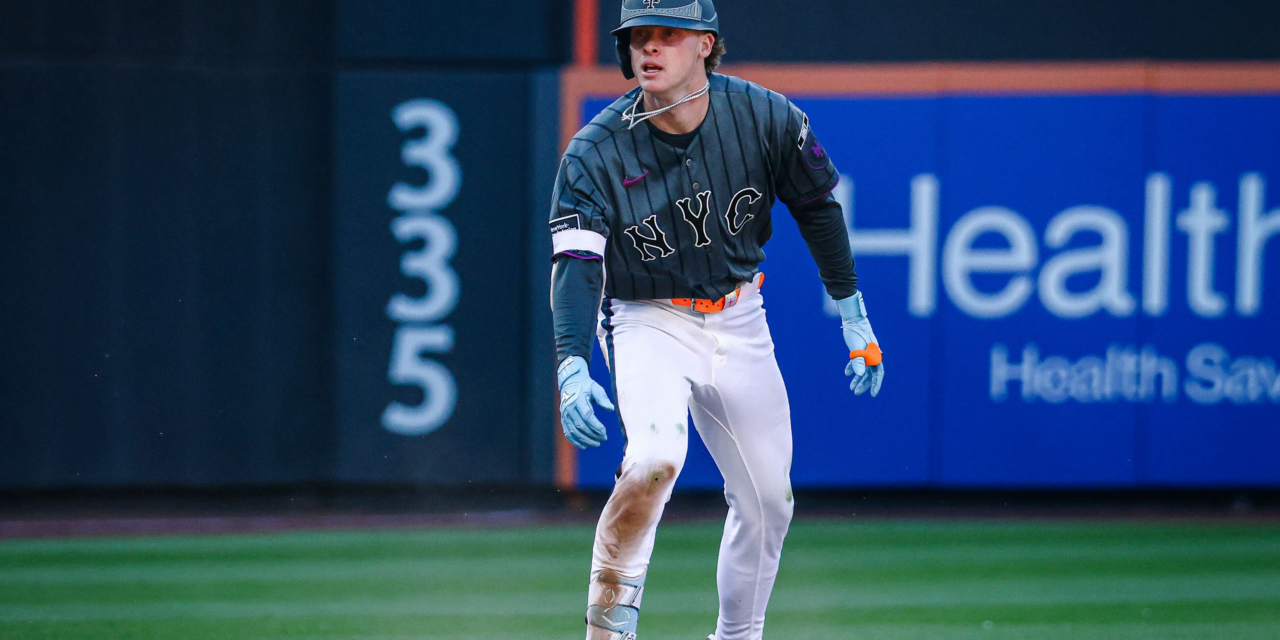
A.J. Ewing
A.J. Ewing may be the most exciting player of the young core. He’s a plus defender in center (with potential at second) who brings plus pitch recognition, contact skills, plate discipline, and an overall plus hit tool that should produce strong batting averages and OBPs. He’s incredibly fast and, once he translates that speed into stolen bases at the big league level, projects as a plus baserunner.
The most intriguing development is his power. Ewing always posted good exit velocities in the minors but couldn’t optimize his swing for power until this year. In Double-A, he began working on an “A swing” to turn on pitches he can drive, and he’s already hit seven homers in 57 MLB games, more than his 2025 and 2026 minor league totals combined. His exit velocities sit around league average, but his hard-hit rate ranks in the 71st percentile, and this month his 105.1 mph 90% exit velocity ranks in the 60th percentile.
He looks like a future plus leadoff hitter: high OBP, steady stolen bases, and fifteen-plus home runs down the road.
Carson Benge
Like many rookies, Carson Benge struggled early, slashing .189/.247/.278 through April. Since a swing change in early May, he’s hitting .289/.353/.445, right in line with the player he projected to be atop preseason top 100 lists.
Benge already has eleven homers with above-average power metrics across the board. Since the start of May, his 87.9% zone contact rate ranks in the 68th percentile, and he’s dropped his whiff rate vs. velocity from 26.9% to 22.9%. He can still be a bit passive at times, but the contact and power combo points to a future .280 hitter with 25+ home run upside. Offensively, he resembles prime Brandon Nimmo, with an 85/100 similarity score on Rob Orr’s app. Other comps I have heard are Marlins Christian Yelich or Michael Conforto with better defense.
Defensively, he’s a step below Ewing in center but still above average there, and a plus-plus right fielder thanks to a cannon arm. A former two-way player, he’s thrown as hard as 94.6 mph this season. He’s also a strong runner, already swiping 15 bags.
Nolan McLean
Calling a 3.52 ERA through 19 starts a “slow start” tells you Nolan McLean is special. Few pitchers match his feel for spin: his 3317 rpm curveball (peaking at 3567 rpm) is the game’s highest-average curveball spin rate, well clear of runner-up Connor Prielipp at 3198. His sweeper isn’t far behind at 3012 rpm, topping out at 3387.
He backs the spin with stuff, a 96.1 mph fastball (peak 98.4) that’s above average. He’s running a 24.6% whiff rate, 30.1% chase rate, limits hard contact, generates grounders, and his 27.8% strikeout rate sits in the 88th percentile, all while averaging near six innings a start.
McLean does everything you’d want from a future frontline starter, and there may be more growth coming. Just a year ago in Triple-A, he struggled badly against lefties (20% strikeout rate, 13.1% walk rate, 83.8% zone-contact rate). Then last July/August he lowered his arm angle, reshaped his curveball into a primary weapon, added horizontal break to his sweeper, tweaked his fastball shapes, and refined his changeup, the transformation that produced the pitcher we see now. Making that much change that fast suggests the ceiling here is still rising.
Christian Scott
When Christian Scott debuted in 2024, he was ranked as the 88th-best prospect in baseball by Baseball Prospectus. He started strong before stumbling, landing on the IL, and undergoing Tommy John surgery, missing all of 2025. Back in 2026, he’s forced his way onto the roster quickly and looked even better than that ranking suggested, posting a 3.17 ERA and 1.30 WHIP.
Scott returned throwing harder, now 95.4 mph, and attacks the top of the zone with it for a 26.2% whiff rate, helped by good movement off his low arm angle. His sweeper may be his best pitch, darting like a frisbee for a 34.5% whiff rate. He dominates righties already and should improve against lefties as he gets more comfortable with his new splitter/changeup. Scott looks like a strong mid-rotation starter carving out his spot fast.
Other Young Players To Watch
Zach Thornton has three big league appearances, two good, one not. He will have to earn a spot as a rotation regular in the future but should at least seem to have carved out a role for the time being, coming off back-to-back strong starts. None of his pitches grade as plus, and most are not above average, and while he commands them well, not at the level of a true command-over-stuff guy like Chris Bassitt. He did make an interesting adjustment last two starts, leaning much more on his cutter (his best pitch) and less on his below-average four-seamer. If he adds velocity, he could profile like a David Peterson type.
Nick Morabito struggled in his call-up but has bounced back strong in Triple-A since, highlighted by a great June and a meaningful change: pulling the ball in the air more (11.2% to 13.5%). This helped lead to nine extra-base hits without sacrificing contact. His outfield defense is solid, though probably not enough in center to offset the bat. He looks like a fit as a bench outfielder replacing Tyrone Taylor.
Jonah Tong has had a mixed season while tinkering with release points and pitch shapes. His stuff plays better than his inflated ERA suggests; he’s developed a cutter and slurve, possibly a sinker, still shows great feel for spin, and has added velocity. He’s still generating above-average whiffs, and the hope is the second half brings the right adjustments. The ERA invites panic, but this reads as a talented young pitcher working through changes, and he’s earned patience given his prospect pedigree. He’s also still young enough that he could spend all of 2027 tinkering and still join the major league staff younger than Nolan McLean is right now.
Getting Struggling Players on Track
The Mets started slow, quickly hit by injuries, but the real culprit was widespread early underperformance. Lindor had his usual slow start before heating up and then getting hurt. Semien started slow, got hot, then faded while apparently playing through injury before landing on the IL. Some, like Brett Baty and Mark Vientos, still haven’t turned it around. But several players did: Carson Benge, Sean Manaea, Devin Williams, Luke Weaver, and Bo Bichette.
Benge has been a different player since May, and it’s not just results; it’s his swing. An offseason swing change with his college coach may have fueled his early struggles against velocity; a May adjustment fixed it. He went from a 21-degree open stance and 8-degree opposite-field attack direction to just 6 degrees open and 2 degrees opposite-field, moving his intercept point from 2.1 inches in front of the plate to 6.1 inches. That’s stopped his barrel from “casting” and coming in late behind his hands.
Manaea couldn’t crack 89 mph through April after a late, disrupted start to his throwing program. After working with pitching coaches to diagnose it, he’s averaged 91.1 mph since early May, with a 3.74 ERA, 3.73 FIP, and 1.19 WHIP across 53 innings pitched.
Williams had an 8.00 ERA and 2.33 WHIP through late April. He has stumbled again recently, aided by bad defense behind him, but has been much better overall. A setup adjustment on April 26 with the pitching coaches turned things around from his dire start: since then he has a 3.28 ERA, 1.38 WHIP, with eleven saves against two blown saves. Weaver has been even better; he has 25 straight scoreless innings after ending April at a 6.00 ERA and 1.16 WHIP. He did give up one unearned run from the ghost runner against the Braves but secured his first save of the season.
Bichette was slashing .219/.275/.308/.583 through May with a career-high chase rate. Since June, he’s hit .315/.342/.490, thanks to subtle stance and load changes that fixed his timing.
Prospects Taking a Step Forward
While some top prospects like Ryan Clifford and Jacob Reimer have struggled, many have taken a step forward.
Jonathan Santucci
Jonathan Santucci has looked very strong and has built upon the gains he made in 2025. He has continued to get better each month and went into the All-Star break off the back of two six-inning outings with a combined 18 strikeouts. His slider is his best pitch, and you’d have to expect that he will be in Syracuse before long. If he performs there, it is possible that he could get a look in the majors before the end of the year, similarly to Nolan McLean and Jonah Tong in 2025.
Mitch Voit
Mitch Voit struggled to start the season as he may have been battling an injury. He took some time off in May and since the end of that month has slashed .259/.391/.441/.832 with seven home runs and nineteen stolen bases in thirty-eight games. His underlying metrics back up this play, and if he continues this up, he should be in Double-A soon.
Jack Wenninger
Jack Wenninger has been a bit up and down and has some reliever concerns with his walk rate and issues maintaining velocity, but overall has had a strong season in Triple-A. He arguably had his best start of the season in July, throwing seven scoreless innings and striking out five. The most important part of his outing is that he was still hitting 95 miles per hour in the seventh. If he can continue to do that, it could significantly change his future outlook.
Randy Guzman
Randy Guzman has continued to show off his plus power tool, placing in the 99th percentile in both max exit velocity and 90% exit velocity. His contact rates are still well below average and he is not walking enough, but the power is among the best in the minors. He was placed on the injured list July 6 but should return soon.
Cam Tilly
Cam Tilly struggled early in the season but since the start of June has turned things around, pitching to a 1.00 ERA and 0.83 WHIP. He has good stuff, and if he adds more velocity as he gets older, he can shoot up through the Mets farm system. Unfortunately, he was put on the injured list on July 4.
Austin Channing, JT Benson, Dakota Hawkins, and Ryan Dollar
I grouped these prospects together because they are all undrafted free agents the Mets signed in recent years. Channing Austin has dominated in 2026 to a 1.81 ERA and 1.19 WHIP, and if he continues to perform well at Triple-A, he could be a dark horse future top 100 candidate. He is whiffing 32.8% of batters and is great at limiting hard contact. JT Benson has incredible power with plus exit velocities, which has led to his .904 OPS in High-A. Dakota Hawkings is the other bright spot in Brooklyn with his 3.35 ERA and 1.02 WHIP. Finally, reliever Ryan Dollar has multiple plus pitches and could be a fast riser in the Mets system.
Pop-Up Relievers
In the majors and in Triple-A, the Mets have seen a number of relievers take a step forward. Austin Warren, Joey Gerber and Daniel Duarte have all performed well in the majors in their roles. Their stuff has looked strong, and before his elbow injury, Austin Warren was making a case to solidify a spot in the 2027 bullpen.
In Syracuse, Nate Lavender has looked great with his post tommy john surgery velocity gains. He and reliever Jefry Yan could carve out roles as left-handed relievers in the bullpen if the Mets were to trade A.J. Minter and Brooks Raley. Ben Simon and has great stuff and is making a case to get run in the majors. Dan Hammer did get the call but was DFA’d before he got into a game. At the time of writing, we do not know if he has cleared waivers, but he has great stuff and has looked good in the farm, so he should ideally get some run at some point. Jonathan Pintaro saw his major league ERA get inflated by being used in a mop-up role, but he has multiple plus pitches and looks great in Syracuse. His pitch mix is similar to Michael King’s, just without the plus command.