The Mets’ path to a playoff spot continues to get more difficult by the day. While they do not have a ton of clear pieces to sell, any moves could open up more playing time for young players. Injuries and prospects in the minors forcing the team’s hand can do that as well.
We have already seen Carson Benge, A.J. Ewing, Nick Morabito and Zach Thornton debut this season. Who else could join them?
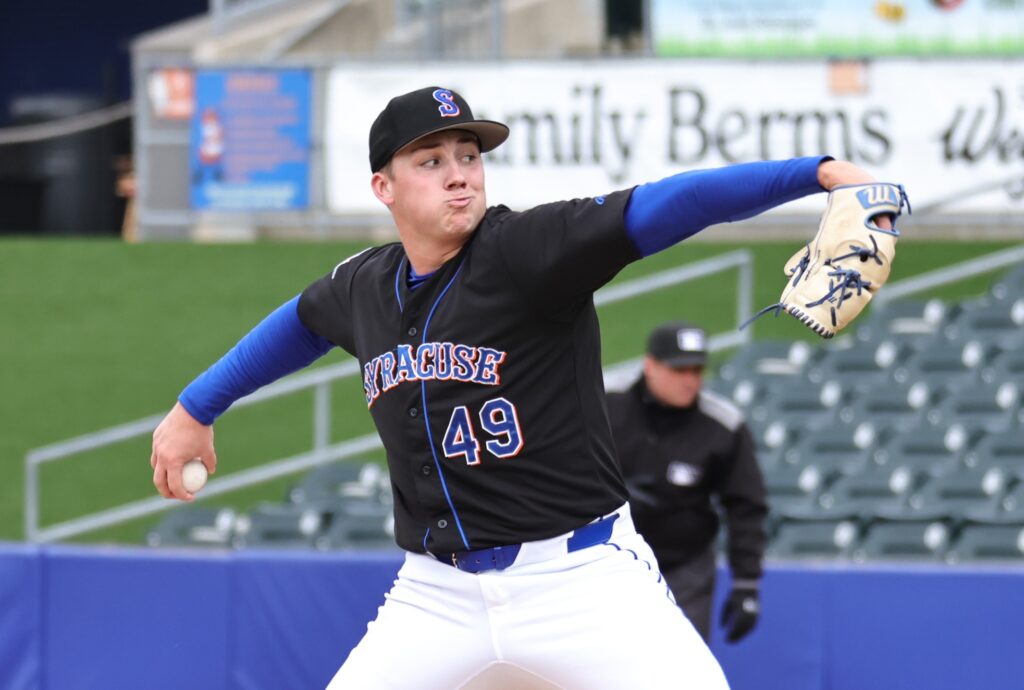
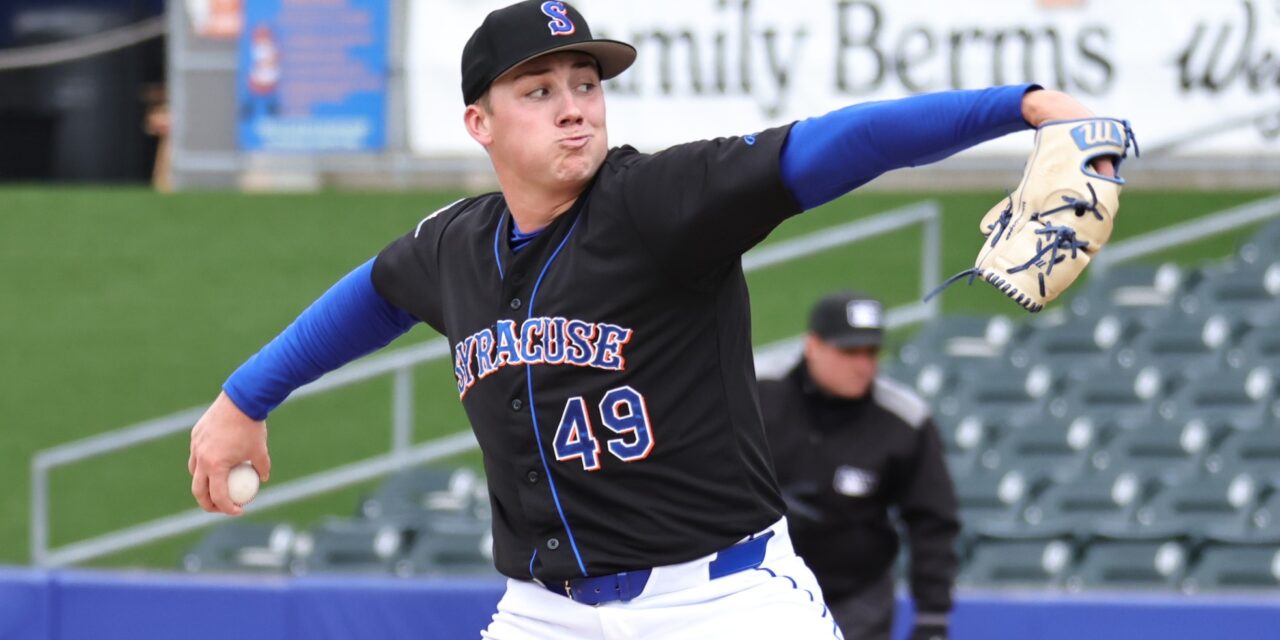
Jack Wenninger. Photo by Herm Card
Jack Wenninger
Some people were surprised to see that Thornton got the call before Jack Wenninger, but that shows how the Mets likely value Wenninger over Thornton. Now that he has been added to the 40-man roster, Thornton will have his first option burned once he spends 20 days in the minors this year. He has already been sent back down to Syracuse following his debut against the Washington Nationals last week. This move allows the Mets to call up and send down Thornton up to five times for spot starts or longer stretches in the majors (not including injury call-ups or doubleheaders). This was similar to how the Mets utilized Blade Tidwell in 2025 before trading him to San Francisco. In July of 2025, Stearns told SNY, “My preference is to not bring up a top prospect for a spot start”. So far, it seems they are treating Wenninger as one.
If Wenninger makes his debut in the majors this year, what role would it be in? The easy guess is to say as a starting pitcher because that is what he has been so far. If the Mets are truly out of the playoff race by the time he is called up, then you can afford to give him a long stretch where he can work through any adjustments without the pressure of a playoff race.
There are some current road blocks to Wenninger being able to be a successful starting pitcher in the majors. His first issue is his 13.9% walk rate. That is not a stat that is likely to improve against the more seasoned major league hitters.
His next issue is his velocity. Wenninger’s fastball shape is well below-average with a poor movement profile and a below-average vertical approach angle. He needs to throw it at least 95 miles per hour for it to really be effective. Unfortunately, he is struggling to maintain his velocity across innings.
A large part of keeping Wenninger in Triple-A is likely to continue to work on these issues. If he is unable to learn to maintain velocity, he could consider changing up his pitch mix. This is a similar issue Brandon Sproat had, which led to him attempting to convert to more of a contact suppression sinker ball pitcher. Wenninger has already developed a sinker and has seen mixed results. A move to the bullpen may also be in his future, where he can juice the velocity on a shorter pitch count. Most of the best relievers in the game started in the minors as starters.
Ryan Clifford
Ryan Clifford has not performed like a player primed for a call-up this year, but he is Rule 5 eligible in the offseason, and if the Mets are out of the playoff race, he could make sense as a September call-up since he will need to be added to the 40-man roster anyway.
His 75.19% zone-contact rate is in the 9th percentile, his 35.8% strikeout rate is among the worst in Triple-A, and his 32.5% whiff rate is in the 24th percentile. These are all quite a bit better than where they were a little over a week ago, so maybe he could be turning a corner. He does hit the ball very hard.
Clifford has had a weird season. His first week, he couldn’t make contact to save his life. The next two weeks, he looked like he found his footing and was the player we saw in 2025 with an 83.7% zone-contact rate (58th percentile) alongside his plus exit velocities and a whiff rate that was just below average. The remainder of April, he went back to a low-70s zone-contact rate fueled by his tendency to swing and miss.
Then came the first ten days of May, when he was back to an 83% zone-contact rate, an above-average whiff rate at 25.8%, a strikeout rate down to 25%, and results to match with a .995 OPS. But just like April, that turnaround was short-lived. His following eight games were the worst stretch of his season with whiff and strikeout rates near 40% and a zone-contact rate at 67.4%. Clifford, though, has hit three home runs in his last five games.
So what can we make of all this? It does seem clear he is not ready yet. But there are glimpses of the player we saw in 2025 that pushed him back onto Top 100 lists. If he can find some level of consistency in his contact rates, he could force his way into the majors, at least as largely a three-true-outcome platoon bat with 30-home run power. Hopefully we see a true turnaround and not just short bursts.
Jacob Reimer
Jacob Reimer may not have the most flashy slash line in Double-A at .223/.353/.396, but that is because his first couple of weeks were very rough.
In May, however, he is batting .261/.376/.478. He is pulling the ball at an incredible 25.8%, is walking 17/0% of the time, is only whiffing 22.6% of the time and his 80.8% zone-contact rate is above average. If he keeps this up, he could earn a promotion to Syracuse sooner rather than later and then would be only a short ride away from Queens.
He has primarily played third base this year, while mixing in some first base as well as time as the designated hitter. Reimer likely profiles better at first base than third base in the majors.
Reimer is not yet on the 40-man roster but is Rule 5 eligible in the offseason. Assuming no options are utilized this year if added, he would have all three entering 2027.
Reimer profiles as a player that can hit for average with plus plate discipline and 25+ home run power.
Ben Simon
Ben Simon was drafted in 2023 and was just called up to Triple-A. He throws a four-seam fastball, a slider, a sinker, a changeup, and a cutter. All of his pitches are above-average, but he rarely throws in the zone, relying heavily on generating chases. In Double-A that worked, running a 32.3% chase rate. If he can show that works against Triple-A hitters as well, he could earn a promotion to the majors.
So far, the results have been good. Across Double-A and Triple-A, he has a 2.41 ERA and 1.232 WHIP, though his 22.9% strikeout rate and 10.8% walk rate could be better. His 96 mph fastball would be one of the fastest in the Mets’ bullpen, and he has thrown as hard as 98 mph this year. He is not one of the organization’s most well-known prospects, but he could force his way into the bullpen if he continues to produce.
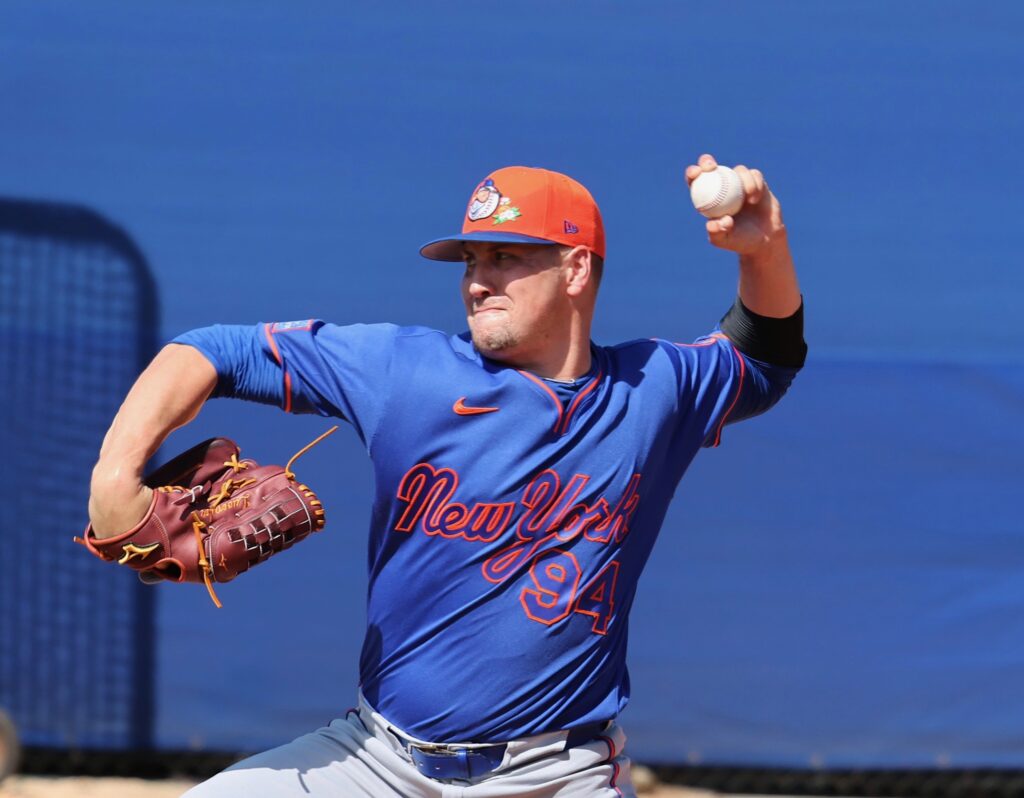
Photo by Ed Delany of Metsmerized
Nate Lavender
“If you throw 92 with some grit and some intention behind it, you’re gonna be alright,” Nate Lavender said, per SNY, in 2024.
Now right around two years removed from Tommy John surgery, Lavender has gone from throwing 89-92 mph to 91-94 mph. He is no longer throwing from his low 26-degree arm angle and is now throwing from a 40-degree arm angle. This has likely helped with the velocity and he is not generating 18.3 inches of induced vertical break. Alongside his plus extension, all of these factors make his fastball play up, helping to generate a 27.9% whiff rate in Triple-A.
His slider is coming in three miles per hour faster with more spin, and he managed not to lose too much horizontal break raising his arm angle, while his changeup is five miles per hour faster. His changeup is not particularly strong, but is perfectly fine as a different look to use against right-handed hitters.
Brooks Raley is likely one of the Mets’ best trade chips if they decide to sell, and Lavender could make sense as a left-handed arm in the bullpen. He was already grabbed in the Rule 5 draft once.
Ryan Lambert
During spring training, Ryan Lambert looked like he could be a big contributor in 2026. He hit 99 mph seven times across his 3 1/3 innings pitched and his slider ran a 50% whiff rate. Since going down to Triple-A, his velocity has not been the same. He is averaging almost a full mile per hour slower on the fastball, he is not hitting his top-end velocity at close to the same rate, and he has yet to hit 100 miles per hour. He is also struggling to find the zone and walking 18.3% of batters. He is striking out 35.2% of batters and running a 36% whiff rate, but almost all contact is in the air, leading to a 1.13 HR/9. A high walk rate and a high home run rate is not a good combo, and that has led to a 5.06 ERA.
If Lambert can turn these issues around, he could then make an impact in the majors.
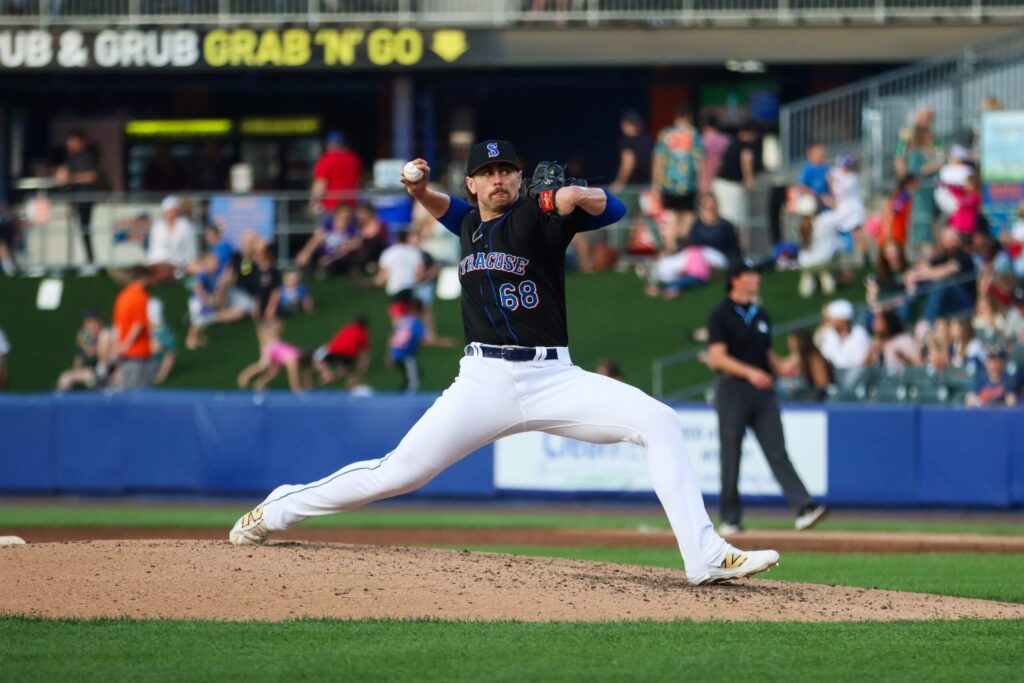
Dylan Ross. Photo by Kylie-Richelle
Dylan Ross
Dylan Ross is the other way the Mets could inject some velocity into their bullpen. Technically he did get his initial call-up already at the end of 2025 but did not pitch, so I am still counting him for this list.
His velocity was initially down coming off injury, but he has hit 99 miles per hour recently and his average velocity the last two weeks is right in line with were he was in 2025. Even with the increased induced vertical break he has shown this year, Ross’s fastball shape is not great, so the velocity is key. He has put up a 25.8% whiff rate on the pitch so far. But his slider and splitter are his true plus pitches. With their strong movement profiles, that is where the bulk of the swing and misses he gets comes from.
Ross’s issue, like Lambert’s, is that he walks far too many batters. 23.9% of them so far to be exact. Ross has run only a 39.1% ground ball rate and has a 1.93 HR/9 rate in Triple-A. Ross is already on the 40-man roster, so he is likely to come up at some point, even if it is just to throw two innings and go back to Syracuse.
Honorable Mentions
- Dan Hammer – Spent his career in the minors between Baltimore and Tampa and throws six plus-pitches. His issue is that he has no idea where they are going when he throws them, but so far you could describe him as “effectively wild”. At the least, he could be another churn reliever.
- Jonathan Santucci – One of the Mets’ top prospects, he has not put up the best results in Double-A this year after dominating in 2025. His command gains from last year do not seem present this year, so far but if he could get them back, he could skyrocket through the system.
- Chris Suero – Suero is Rule 5 eligible at the end of the season and is crushing the ball in Double-A. He looks to be more of a three-true-outcomes player, and it’s unclear where his future defensive home will be, but he could be an interesting guy off the bench with speed, power, and defensive versatility.