It’s been a while since the Mets have developed a homegrown left-handed pitcher. David Peterson is the most recent, and his Mets tenure just came to an end. Peterson’s time with the Mets was mixed. He had some good times—his second half of 2024 stands out for obvious reasons—but was generally an inconsistent pitcher in both results and availability.
Steven Matz and Jon Niese are the only other notable lefty starters the Mets have developed this millennium. Both were/are solid MLB starters, but that’s it. Three left-handed starting pitchers in 26-plus years is nothing to write home about.
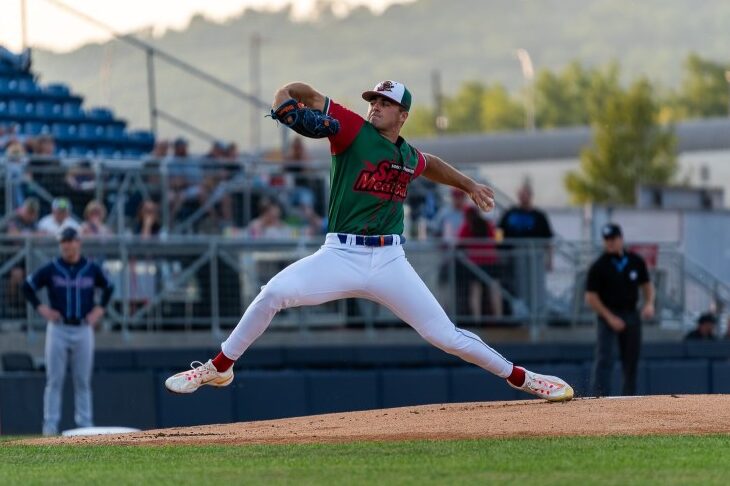
Jonathan Santucci. Photo by Binghamton Rumble Ponies
That could change soon. The Mets have four lefties in the minor leagues right now who could all be potential MLB pitchers. One already is. That’s still not some staggering number, but even if half of them become productive starters in the next few years, the Mets will have matched 2/3 of the lefties developed since 2000 in about 1/10 of the time.
Jonathan Santucci
The list has to start with Jonathan Santucci. Without a doubt, Santucci has the highest ceiling of the four. The way he’s throwing this year, he has a strong case for the best pitching prospect in the organization. Part of that is due to the regression of Jonah Tong and Jack Wenninger, but Santucci has also earned it.
His ERA is up a little bit, from 3.06 last year to 3.57 this year, but it’s not something I’m overly concerned about. The top priority for Santucci this season was developing his changeup and curveball, something he discussed recently. When new pitches are being worked on live in games, sometimes the overall numbers suffer.
Santucci has said he’s more comfortable with the pitches now, and while there’s no public pitch-tracking data at Double-A to confirm those pitches are performing better, his overall numbers suggest he’s correct. Over his first five starts, Santucci had a 5.57 ERA. Over his next four, his ERA was 4.05. Over his next and most recent eight, it’s 2.54. He also recently struck out a career-high 13 batters in 5 2/3 innings. While he was charged with four earned runs, he didn’t get hit hard; he just fell victim to some soft grounders that found holes and to poor defense behind him.
It’s plausible to think that his improved results have correlated with him getting more comfortable with his changeup and curveball. The same thinking can apply to his walk rate. It’s up from last year, but really only over his first five starts. It makes sense that a pitcher wouldn’t be able to perfectly locate two work-in-progress pitches right away. In that span, it was 19.1%. In 14 starts since, it’s 9.8%. Still up a tad from his 8.5% last year, but it’s pretty negligible.
Lastly, his groundball rate is 52.5%, up 5.7% from 2025. It’s an underratedly important stat for pitchers. It’s the 12th-best among minor leaguers with at least 80 innings pitched, and second-best among those with at least 90 innings pitched. He’s also the only minor league pitcher who has at least 80 innings pitched with a groundball rate over 50% and strikeout rate over 30%. A lot of times, groundballs can correlate with soft-tossers who pitch to contact. That’s not the case with Santucci.
This is a top 100 prospect. He’s not ranked that way yet, but he should be.
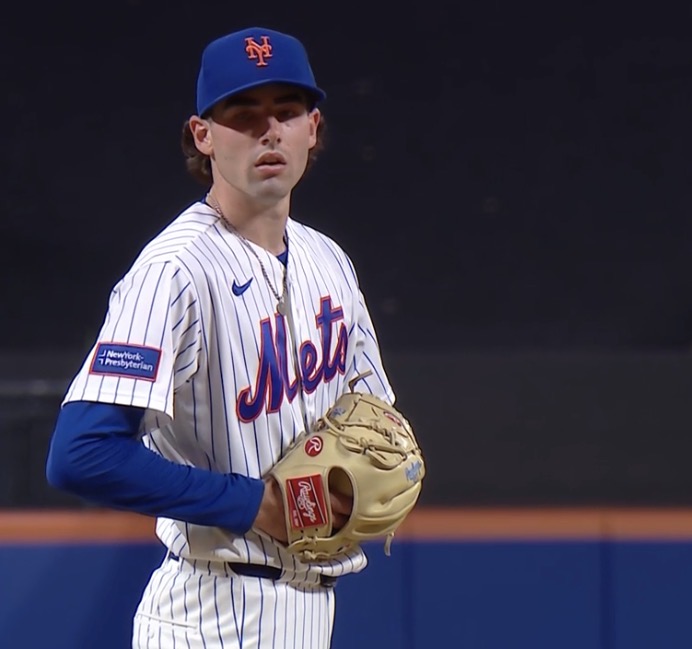
Zac Thornton vs. Braves
Zac Thornton
Next up is Zac Thornton, who Mets fans are starting to know well. He’s made four starts for the Mets so far this season, and it looks like he’s going to stick in the rotation. Thornton’s three most recent starts have been triumphs. On July 12, he threw seven shutout innings, five strikeouts and four baserunners—one of the best outings any Mets starter has had this season. On July 21, he threw six more shutout innings with two strikeouts and four baserunners. His 18-inning scoreless streak ended in the first inning of his most recent start, but he still went six innings and allowed just three runs against the Braves’ strong lineup.
At his best, Thornton is a high-floor, low-ceiling arm. His start against the Brewers is evidence of that. The six shutout innings were great, but he only punched out two and gave up some hard contact that just happened to find gloves. He doesn’t throw particularly hard or have standout stuff, but he does throw strikes. (Steve Gelbs on Monday detailed a story about how hard it was for Thornton to not throw strikes when learning to locate outside of the zone.) His Triple-A performance has been a bit up and down this year, but he’s been excellent in his last three big league starts. There’s a good chance he can stick long term as a back-of-the-rotation starter. Being a lefty helps.
Daviel Hurtado
Then there’s Daviel Hurtado, who is without a doubt the most exciting arm the Mets have in the lower levels of the minors. A 21-year-old who was promoted to High-A near the end of May, Hurtado looks like the real deal. His fastball already sits in the mid-90s and his slider in the high-80s, a deadly combination. He has a good curveball, too, and is working on a changeup. Give him some time to finish developing it, and it’s a full starter’s arsenal.
The results have been nuts. In 54 innings across Single-A and High-A, Hurtado has a 2.33 ERA with 58 strikeouts and just 12 walks. His WHIP is 0.83. That’s the fifth-best WHIP among 684 minor league pitchers with at least 50 innings pitched, trailing the likes of Kade Anderson and Ramon Marquez. A lefty who can throw hard and throw strikes? This is someone who should skyrocket up the organization’s top prospects list.
Nicolas Carreno
Lastly, there’s Nicolas Carreno. Another hard-thrower at High-A, Carreno is a little bit behind Hurtado in success, but he’s also almost a year and a half younger. He just turned 20 a month ago. While he’s been up and down so far in Brooklyn, he was dominant in St. Lucie, and his age buys him more than a few mulligans.
His arsenal—a four-seam, sinker and slider—isn’t as deep, but all three pitches are good. The slider is the standout, but both fastballs are strong in their own right. He’s far from a finished product, but there’s something here. The arsenal makes him the most likely of the group to eventually move to the bullpen, but for now, he’s being developed to start. It’s really as simple as he’s a 20-year-old lefty who throws in the mid-90s. That demands attention.
The Mets also just added another lefty, Shane Sdao, in the fourth round of the 2026 MLB Draft. He can run it up to 97 and command his five-pitch arsenal, so there’s considerable upside here.
Lefties are better. All other things being equal, a lefty will have more success than a righty. There has been a drought of lefties in the Mets’ farm system for decades, but the tide is starting to turn.