At the Mets’ end-of-season press conference, president of baseball operations David Stearns noted that, while in the early stages, Jorge Polanco‘s rehab was going “very well,” though he could not commit to Polanco being able to play 120 games at first base in 2027. “I think we need to wait and see where he is in spring training,” Stearns said.
“I know that when he’s healthy, this is a really good offensive player from both sides of the plate who could hit in the middle of a lineup.” Heading into 2026, Jorge Polanco was a career .263/.330/.442/.771 hitter, which was good for a 112 wRC+.
His 2026 season was marred by ankle bursitis, an injury he had never had before, as well as a wrist injury from a hit-by-pitch. These were injuries the Mets couldn’t have predicted, as they weren’t related to previous injuries throughout his career. For the 2026 season, the impacts were clear. Polanco struggled to a .148/.201/.230/.431 line, which was good for a 20 wRC+.
Polanco is making $20 million next year, and if he returns from injury healthy and ready to play, the Mets will likely give him every chance to play. Could Polanco, who will be 33 in 2027, bounce back and play to his career norms? Have there been other players who had a similarly disastrous season and then bounced back the following year?
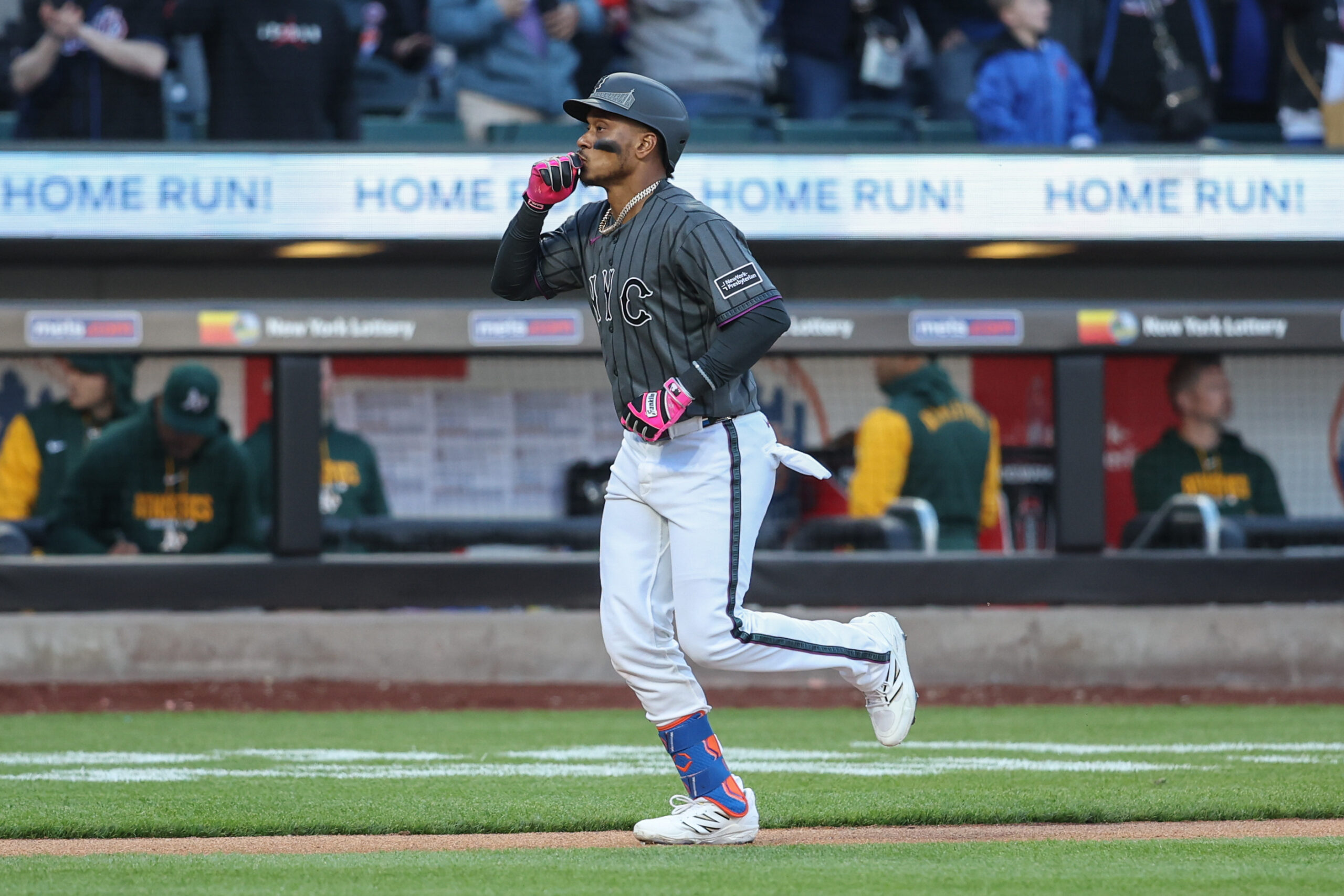
Wendell Cruz-Imagn Images
Who Are Some Comps?
To get the best comps, it’s important to look at players with similar careers to Polanco, who suffered a serious injury in the same injury they struggled with, and most importantly, bounced back the following year. These comps will be focused on players whose poor season came at a similar age-32 season, and within the past 45 years, starting in 1980.
Jermaine Dye
Jermaine Dye was 29 in 2003 when he slashed .172/.261/.253/.514, which was good for a 38 wRC+. Up to that point, he was a career .273/.335/.463/.797 hitter. In 2003, he struggled with knee issues and eventually got knee surgery. He followed up that 2003 season in 2004 slashing .265/.329/.464/.793, right in line with his career average. He ended up being a productive player through his age 35 season, after which he retired.
Ryan Raburn
As Fangraphs writer Jeff Sullivan wrote, Ryan Raburn was one of the most volatile hitters of the early to mid-2000s, and fits this discussion twice. In 2012, at age 31, Raburn slashed .171/.226/.254/.480 and followed that up the next year slashing .272/.357/.543/.901. Then in 2014 he slashed .200/.250/.297/.547 and followed that up by slashing .301/.393/.543/.936 in 2015. In 2014, he struggled with knee issues but bounced back the following season. Across his career, he was a .253/.316/.436/.752 hitter.
Lee Mazzilli
Going back to the 1980s, Lee Mazzilli, at age 33 in 1988, slashed .147/.227/.164/.391. He followed that up with a .206/.380/.389/.769 season, going from a 21 wRC+ to a 128 wRC+. Similar to Polanco, his 1988 season was marred by wrist issues after getting hit by a pitch. Across his career, he slashed .259/.359/.385/.744.
Trevor Story
Jumping back to the present, Trevor Story slashed .203/.250/.316/.566 in 2023. That season, he underwent elbow surgery and struggled with shoulder issues that would eventually require surgery. He had a good partial season in 2024, slashing .255/.340/.394/.733, and followed that up with a full season in 2025, slashing .263/.308/.433/.741. Across his career, Story is a .263/.325/.482/.808 hitter, though those numbers are boosted a bit by playing in Colorado for six years and come out to a 104 wRC+.
Tony Armas
Jumping back in time to 1987, at age 33, Tony Armas slashed .198/.205/.370/.575 while dealing with ankle, knee and leg issues that began the season prior. In 1988, he bounced back, slashing .272/.311/.443/.754 across 120 games and followed that up with another good partial season in 1989 before retiring. Across his career, he was a .252/.287/.453/.740 hitter.
Josh Harrison
The final hitter is back in the modern game, and it is 2019 Josh Harrison who, at age 31, slashed .175/.218/.263/.480.That season was marred by a torn hamstring that required surgery. He bounced back in the shortened 2020 season, slashing .278/.352/.418/.769, and carried that into 2021, slashing .279/.341/.400/.741 across 138 games. Across his career, he was a .270/.316/.396/.712 hitter.
Andruw Jones
Andruw Jones was a far better defender than Polanco, but offensively his 111 wRC+ through age 32 was not far off from Polanco’s career 109 wRC+ to date. In 2008, at age 31, he struggled with knee issues to a .158/.256/.249/.505 slash and rebounded the next year to a .214/.323/.459/.782 slash. He was even better in his age 33 and 34 seasons, putting up an .827 OPS and 121 wRC+ and an .851 OPS and 132 wRC+.
What’s the Prognosis?
If healthy, there is precedent to say that Polanco can bounce back in 2027, and even bounce back to his career norms. The caveat here is that none of them had the exact surgery Polanco had, though there is a history of players bouncing back from bursitis surgery, including Bryce Harper and David Ortiz.
Of course, nothing is guaranteed, and this is all speculative. Jason Bay is an example of a player who did not fully bounce back from his 2012 rib fracture, posting a 95 wRC+ in a partial season in 2013 and then retiring.
After his 2002 shoulder injury, Tony Clark put up 98 and 92 wRC+ seasons. He did have a huge 2005 season at age 33 but immediately fell back off. Dan Uggla, who had a down season in 2013, had a horrid 2014 season at age 34, hitting to a .442 OPS. He struggled again in 2015 to a .598 OPS and then retired.
Jorge Polanco has the offseason to rest and build his strength back up. Time will tell Polanco’s prognosis, and spring training should give good insight into what Polanco could look like in 2027.