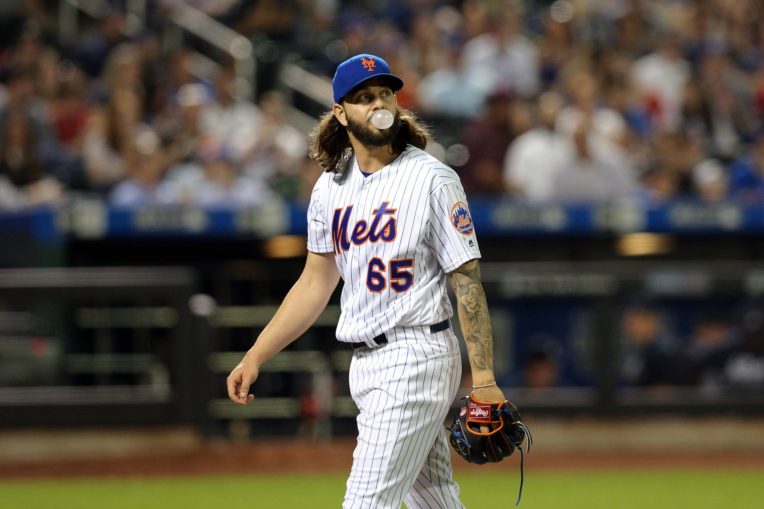

Robert Gsellman was a godsend in 2016. Not a real Jesus-like godsend, granted, but if you placed bets on the savior of the 2016 Mets season on the outset of the campaign, Gsellman wouldn’t have gotten favorable odds. However, when the dust settled and the Mets found themselves in the Wild Card game, it became pretty clear that they wouldn’t have gotten there without the rookie’s help.
After Jon Niese was removed from his August 23 start against the Cardinals, Gsellman was called in from the bullpen for his Major League debut, pitching 3.2 shutout frames and giving the Mets a chance to come back in the game. The right-hander quickly clinched a spot in the starting rotation, posting a 2.42/2.63 ERA/FIP over seven starts. With the rotation in shambles, Gsellman and Seth Lugo teamed up to form one of the more unexpected midseason saviors in recent team history.
After the season ended, people thought that Gsellman could be a Dude. Maybe not an ace-like Dude like Jacob deGrom, but an above-average Major League starter type Dude. Keith Law of ESPN supported this thinking, ranking Gsellman as the 76th highest prospect in baseball going into the 2017 campaign.
Fast forward to three years and Gsellman finds himself in a tricky spot. The Mets have essentially shoehorned him into a long-relief bullpen spot over the last few seasons, a role where he’s struggled in. Over the last couple of seasons, his 4.45 ERA ranks as the 28th worst among qualified relievers while his xFIP places him 31st.
But Baseball Savant is still a fan of him, high ERA be damned.
His fastball velocity, curveball spin, and exit velocity numbers all place him in the top 20 percentile. But despite limiting hard contact, the fact still remains Gsellman’s still giving up plenty of runs.
When batters are making contact, they’re not doing much against him in terms of exit velocity. He hasn’t allowed a gaudy launch angle either. His 2019 xwoBACON was .328, which was one of the best marks in the Majors.
A pitcher that limits hard contact should succeed. Right? Well, that still depends on a number of factors.
As a former starter, Gsellman still has a starter’s arsenal. He primarily throws a sinker and mixes in three other offspeed deliveries. His slider was his most effective pitch (.246 wOBA/.219 xwOBA), but the results on his curveball and change-up weren’t too shabby either. His curveball and change-up had a .342 wOBA/.331 xwOBA and a .302 wOBA/.286 xwOBA, respectively.
A trio of effective offspeed pitches doesn’t guarantee that a pitcher can develop into a relief ace, but it’s a good start. Let’s take a quick look at his primary pitch: his sinker.

Yikes. That’s ugly. Very Ugly. Not what you want from a player that could be a Dude.
His sinker has the velocity (94.1 mph). Its horizontal movement is 13% better than the league-average sinker. And although the vertical movement of the pitch has 19.2 inches of drop (8% worse than the league average), that one movement metric shouldn’t account for a .383 wOBA.
Taking a closer look at his sinker, it’s pretty clear what the issue is. Location.
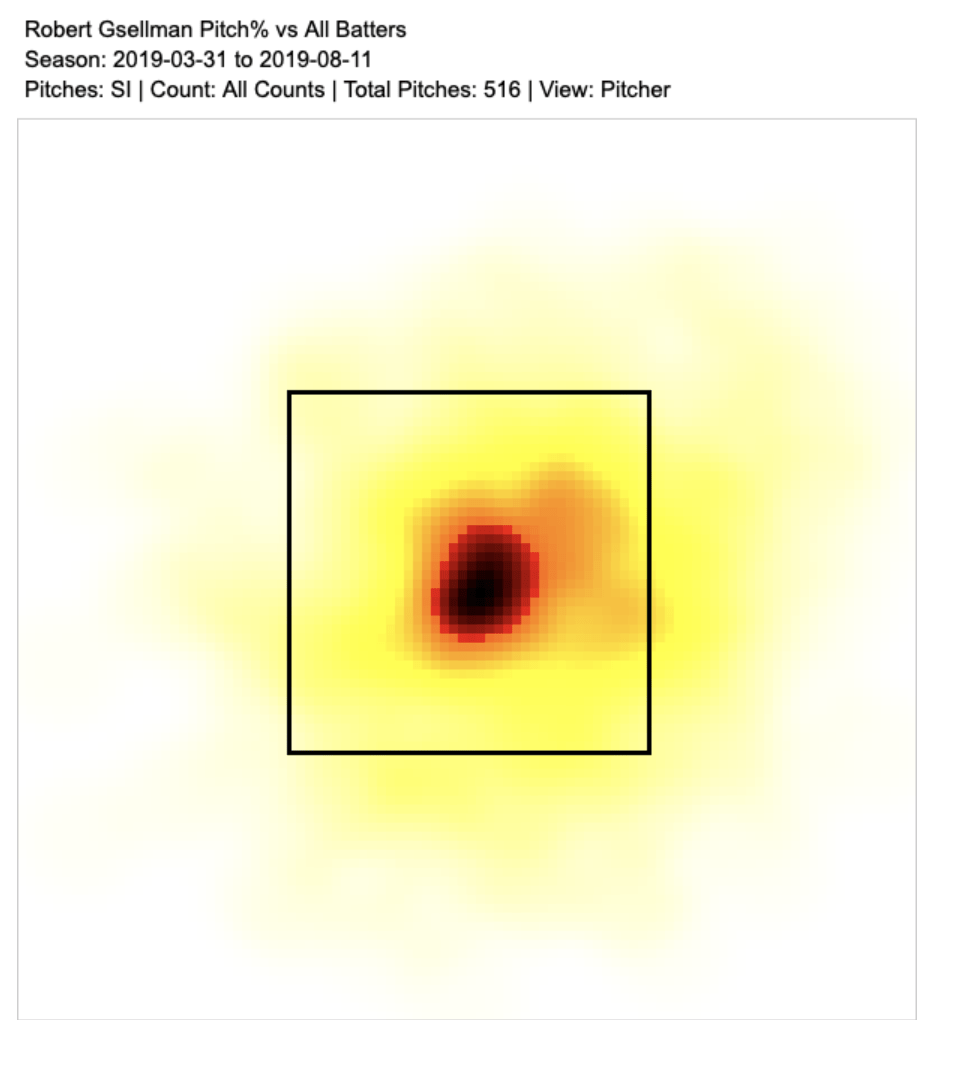
Athlete Logos released a Bingo graphic a few weeks ago that displayed a few phrases that Keith Hernandez has frequently said on SNY telecasts over the last few seasons. In a later (now-deleted) tweet, he added that a Keithism that he forgot to add was “right down the pepperoni”; a description that fits Gsellman’s problem to T.
Taking a look at the Gameday Zones of the plate and the corresponding wOBA values, I was able to pinpoint exactly which zones Gsellman struggled in.
His wOBA in Gameday’s Zone 5 on sinkers: .529 wOBA, sixth-worst in the Majors. For comparison, the MLB average was .444. For reference, Zone 5 is defined as the zone closest to the middle of the plate.
His Heart Zone production reflected his issues in Zone 5; he posted a brutal .442 wOBA there in 2019. Comparing that to the .281 wOBA allowed on sinkers in the Shadow Zone, it’s clear that Gsellman’s issues stemmed from poorly-located sinkers in the middle of the plate. A refresher on what the Heart and Shadow Zones can be found here.
His pitch usage for the Heart Zone was 54% sinkers, 43% breaking pitches, and 3% fastballs.
His corresponding wOBA on those pitches in the Zone: .442, .282, and .875. That .875 wOBA value came from one plate appearance so there’s no point analyzing data from such a small sample size.
So, that’s my conclusion. Robert Gsellman shouldn’t be throwing sinkers down the middle of the plate. But the thing, that’s a pretty bad conclusion. I wouldn’t be earning my $100,000 yearly salary from MMO if all I wrote was that throwing baseballs down the middle of the plate led to inflated ERAs. So instead of ending there, I decided to earn that paycheck and write a little bit more about Gsellman’s sinker.
Going through his pitch usage numbers, I noticed that he’s utilizing his sinker more when he’s behind in the count.
He’s using it as a get-me-over pitch. And that get-me-over pitch got absolutely walloped to the tune of .410 wOBA. It’s not exactly the results you want from a pitch thrown 49% of the time.
The Mets should really consider revamping Gsellman’s entire pitch sequencing approach. Instead of using his offspeed pitches to get ahead of hitters, they should experiment with the opposite and let the offspeed pitches build off the sinker’s success.
If we look at Gsellman’s pitch usage data from 2019, it’s clear that using his sinker when he’s behind hitters isn’t a winning formula. Instead, he should be focusing on throwing it when he’s ahead in the count.
So why isn’t Gsellman’s sinker enjoying the same success? It has to do with the physicalities of the pitch.
A sinker is aptly named; It works best when it “sinks” towards the bottom half of the plate. Jeurys Familia has used a nasty sinker to this effect. But when Gsellman’s found himself down in the count, his sinker has started to climb.
When Gsellman was ahead in the count, he located his sinker more towards the corners of the plate. However, as the count shifts towards the batter, it rose and moved left, right into the path of the batter’s swing. Fangraphs’s Heatmaps show us the movement of the delivery.
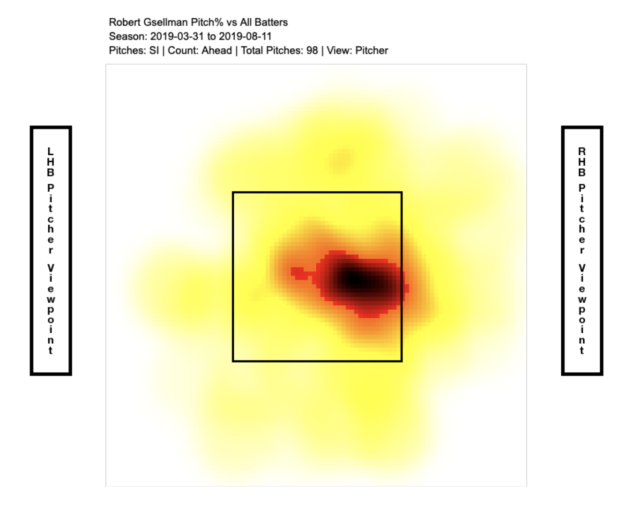
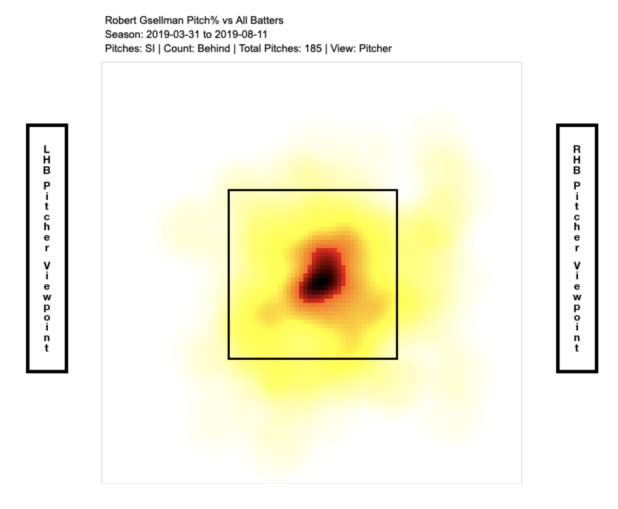
The second heatmap is reminiscent of the earliest one, which showed Gsellman’s overall sinker location. The xwOBA values on his sinker when he’s ahead and behind on the count are below.
xwOBA on sinkers when ahead in the count: .200
xwOBA on sinkers when behind in the count: .357
In order to turn around his fortunes and his ERA, better sequencing is a necessity. If you look at the spin axis of his pitches, it looks like he should focus on pairing his curveball and his sinker more. His curveball was already a pretty potent weapon, but with a few sequencing changes, Gsellman could upgrade it even more.
Spin Axis is a relatively new term in baseball. It attempts to quantify the pitch tunneling, an aspect of pitching that’s only been measured via the eye test before. Gsellman’s sinker had an average of 235 degrees last year while his curveball came in at 42.5 degrees.
A difference of 180 degrees between two pitches make them a logical set to pair them together. This PitchNinja GIF shows why.
Kumar Rocker, Fastball (called strike)/Slider (dirt/swing/miss), Stop GIF
"Just lay off the breaking ball in the dirt"
"It's not a strike!!!"It's not that easy, Chief. pic.twitter.com/zFOxq71ygS
— Rob Friedman (@PitchingNinja) February 7, 2020
Pitch tunneling is a proven and effective way to attack hitters. If two different pitches move together upon release, but break away from either each other on its way to the plate, it makes it just that much harder for the hitter to pick it up. Instead of relying on pure velocity, some pitchers are able to succeed by tunneling their pitches well together. Kyle Hendricks is a prime example of this. He doesn’t throw hard, but his pitches come out of his hand in a very similar manner.
Kyle Hendricks, 72mph Curveball and 88mph Fastball, Overlay. pic.twitter.com/BhRotsux0s
— Rob Friedman (@PitchingNinja) August 22, 2019
Gsellman has been one of the worst relief pitchers in the Majors over the last few seasons so it wouldn’t be shocking if his roster spot is a little bit warm. 2020 seems like a make-or-break for the 26-year-old. He can either join Seth Lugo as one of the vaunted members of the bullpen or risk losing his spot on the 26-man roster.
Robert Gsellman can be a good pitcher. I firmly believe that. But it all rests on how he can manipulate his sinker.
I hope I did more than enough to earn that paycheck.