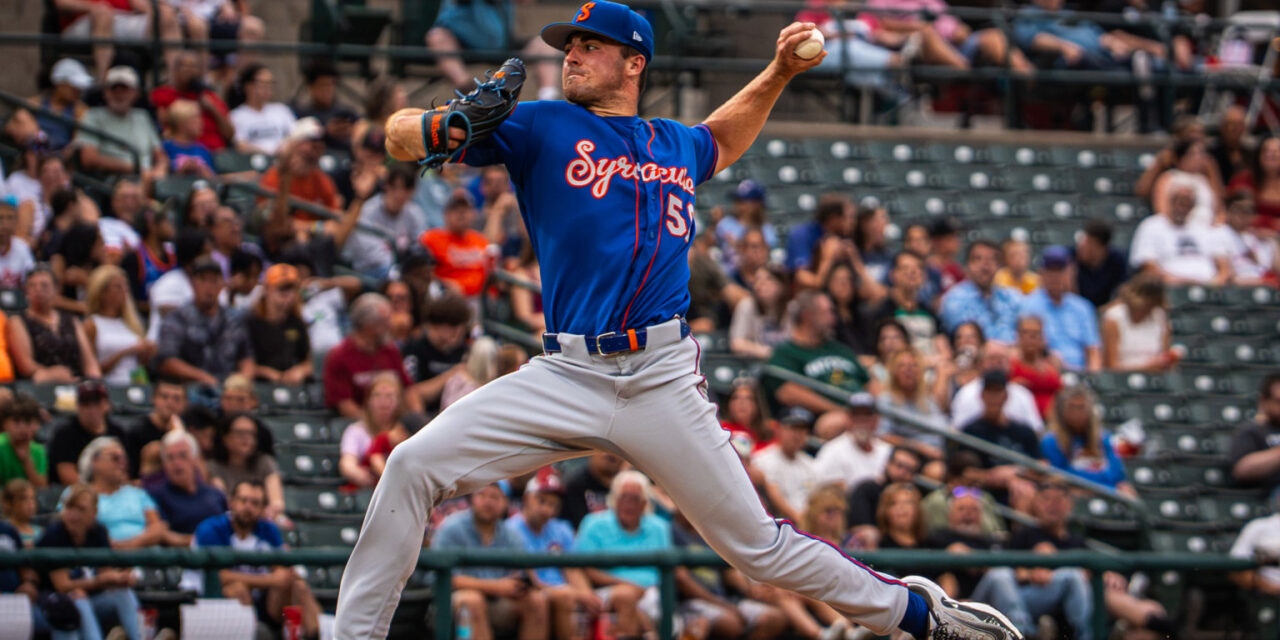
It was a much better year for Mets pitching prospects than it was for the hitters. Mets minor leaguers posted among the best Stuff+ in the sport, and one of the biggest contributors to that made this list.
Luke Gabrysh
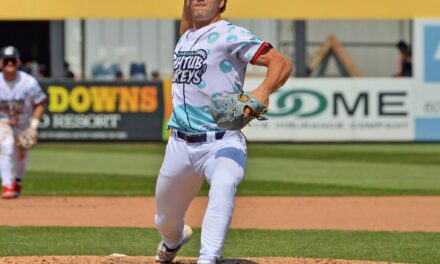
Don’t let the ERA fool you: Luke Gabrysh was a real get for the Mets at the trade deadline. Acquired as part of the return for Brooks Raley (who subsequently had a 7.94 ERA for the Phillies and was left off the postseason roster), Gabrysh had a pair of nice starts for High-A Brooklyn before getting roughed up a bit to end the year with Double-A Binghamton. He finished the year with a 5.30 ERA between both organizations, but the underlying numbers show a lot to be encouraged about.
He struck out 121 batters in 93 and 1/3 innings and paired that with a manageable walk rate. His 19.2% K-BB% ranked 48th of the 380 minor league pitchers to throw at least 90 innings in 2026, and it was the best mark among all Mets prospects. He’s also a Stuff+ darling, and was one of eight Mets pitchers to appear on Baseball America’s list of the top 150 Stuff+ arms in the minors. He was the only Mets starting pitcher on the list. He has the highest slider Stuff+ in all of minor league baseball.
Obviously, Gabrysh is not a finished product. No minor league pitcher—or for that matter, major league pitcher—is. But the building blocks are there to make him one of the most intriguing names to watch next season.
Daviel Hurtado
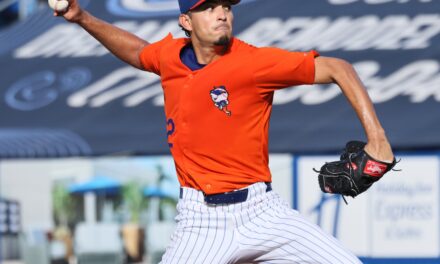
Daviel Hurtado had one of the best seasons among all Mets minor league pitchers. In 86 innings mostly at High-A, he had a 2.93 ERA and 1.03 WHIP while striking out more than a batter per inning and running one of the best walk rates in the organization. He has a hard fastball, hard slider, good curveball and a developing changeup. He throws strikes, misses bats and keeps the ball on the ground at a well above average clip, all while possessing maybe baseball’s most valuable trait: throwing left-handed.
He throws in the mid-90s, which already puts him above average for fastball velocity among MLB lefties. He has the potential to add more velo too as he gets older. Hurtado is still just 21 years old. He won’t turn 22 until late January. He was one of 17 minor league pitchers who were 21 years old or younger and reached at least High-A to throw at least 80 innings with a strikeout rate above 25% and a walk rate below 10%. That might sound like a lot of qualifiers, but it really isn’t. It’s just age, level, sample size, strikeouts and walks, which are among the most basic things to look at when viewing a minor league pitcher’s stats. Just four of the 17 were left-handed: Kade Anderson, David Shields, Jacob Bresnahan and Hurtado. That’s good company. Also of note, Mets right-handed prospect Jose Chirinos also made the list as one of the 17, and while he won’t be fully covered in this story, he had a really nice season as well.
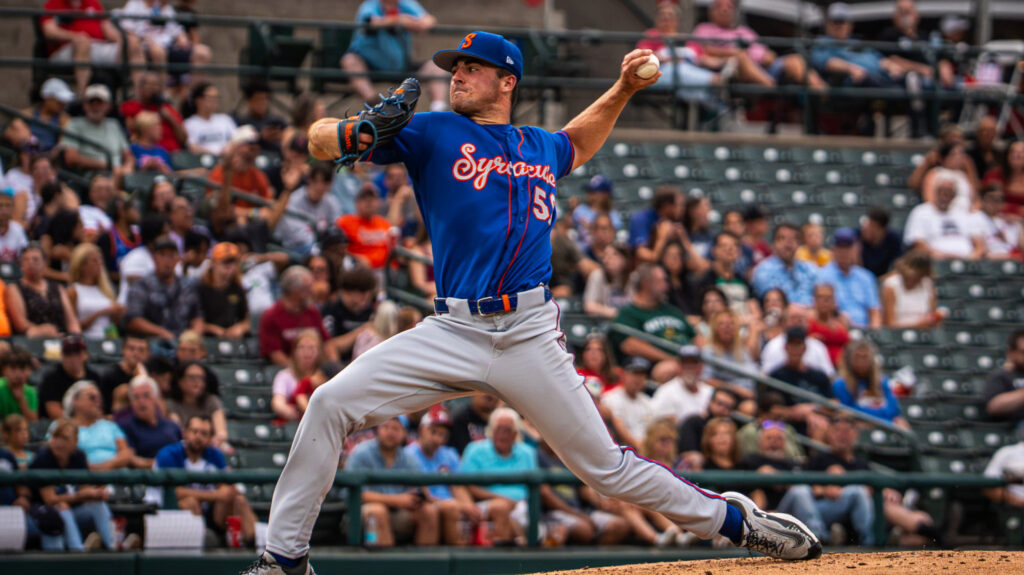
Jonathan Santucci. Photo Credit: Syracuse Mets
Jonathan Santucci
While Jonathan Santucci was already well known heading into the season, he did a good job of firmly establishing himself as the organization’s top pitching prospect. With Jonah Tong graduating, Santucci now has a firm hold on that spot. No one struck out more batters in minor league baseball last year than Santucci, who punched out 163 in just 125 innings. While his ERA finished just a hair above four on the year, that was largely due to getting hit hard in his first handful of starts in Triple-A, a common thing to happen for pitchers as they adjust to throwing the MLB ball. He had a 3.54 ERA in his final four starts at the level, which was almost exactly what he posted in over 90 innings at Double-A as well.
Santucci hadn’t thrown many innings in high school or college before joining the Mets, but he and the organization have done a really good job of building him up over the last two seasons. He threw 117 and 2/3 innings in 2025 and followed that up with his 125 in 2026. He’ll be valuable major league depth next season, and should be among the top candidates to receive a promotion when the Mets inevitably need to call on a Triple-A starter (assuming there’s a season). His walk rate is a little high, and his secondary pitches still need some refinement, but he has an incredibly high ceiling. Like with Hurtado, a lefty who can throw as hard as he can has serious value.
Channing Austin
One of the more unheralded Mets pitching prospects entering 2026, Channing Austin burst onto the scene in the first half of the year. A former college reliever, the Mets signed him as an undrafted free agent in 2024 and turned him into a starter. He broke out in High-A to start this season, putting up a 1.17 ERA in eight starts at the level before he was promoted to Double-A. His time in Binghamton wasn’t quite as successful, and he made two separate trips to the injured list, but he was good enough to still keep his ERA at 2.26 for the season. He throws a really strong fastball that has good velocity and movement, along with a slider, curveball and changeup. His arsenal is still very much in development, though, as he just does not have many innings under his belt.
While he turns 25 years old in December, Austin is actually still incredibly inexperienced as a pitcher. He threw less than 60 innings in his entire college career and has thrown 131 innings in pro ball. All in all, that’s under 200 innings since he was a freshman in college. In my opinion, Austin positioned himself as a no-doubt top 30 Mets prospect. He has big stuff, and he flashed a ceiling that’s among the highest in the organization. If he can stay healthy, I think we’ll see the Prospect Lefferts Garden Native in Queens at some point in the next few years.
Garrett Stratton
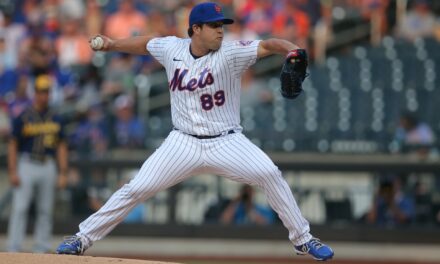
There needs to be some reliever representation on this list, and Garrett Stratton is that man. The third-to-last pick in the 2025 MLB Draft out of Rice University, Stratton rocketed through the minors in his first full season of professional baseball. After starting the year with High-A Brooklyn and dominating, he received a mid-June promotion to Double-A. He dominated that level as well, and earned a Triple-A cameo to finish the year. When all said and one, Stratton finished the season with a 2.51 ERA and 1.08 WHIP in 64 and 2/3 innings with a 32.8% strikeout rate and 7.5% walk rate.
Stratton throws three pitches. His cutter is his best pitch, and he complements it with a four-seam and a curveball. The curveball is of the “death ball” variety, and it became a real weapon for him in 2026. He spins the ball really well, with his spin rates already sitting at marks that would be well above average for MLB pitchers. Seeing as he’s already at Triple-A, Stratton is a prime candidate to make his MLB debut in 2027, and he has the talent of someone who might force his way into sticking on the roster once up there.