Mandatory Credit: Troy Taormina-USA TODAY Sports
Now that the baseball season is over, teams and fans have set their sights on next season (set to begin March 31, 2022 for the Mets). However, next season, and certainly an on-time start to it, are not guaranteed because the collective bargaining agreement (CBA) between MLB and its players expires on December 1, 2021.
If the clock should strike midnight on December 1 without a new agreement in place, there is strong speculation that the owners will impose a lockout of the players, placing a stop to offseason moves, and possibly a delay to the start of spring training.
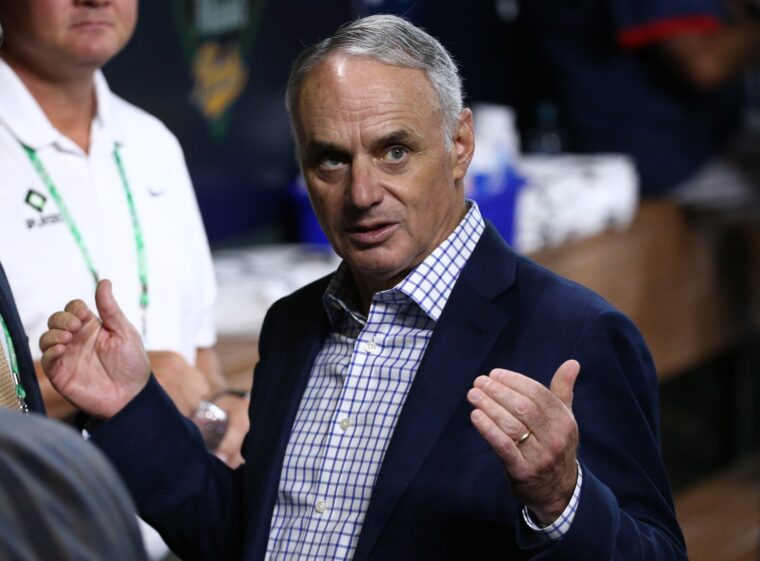
In an article by Jared Diamond of The Wall Street Journal, both sides (Commissioner Rob Manfred for the owners and Union Executive Tony Clark for the players) expressed a desire to get a new done on time. Whether or not that happens remains to be seen. What are the issues that the two sides need to resolve?
The Game’s Competitiveness
The players feel that the current economic system does not discourage teams from deciding to “tank”, or trade off high-value players, and spend little on payroll while accumulating draft picks. This, of course, drags down the average salary of players. According to Diamond, the average salary of MLB players has decreased in recent years, though some superstars (e.g., Francisco Lindor) have earned deals worth over $300 million.
The owners have proposed a “payroll floor”, as a way to remedy having teams decide to spend little in a given season. However, this proposal, made very recently, came with a lower threshold for the competitive balance tax, meaning that teams that want to spend would encounter taxes more quickly than they do now. This may discourage spending on the top end, and counteract the benefit of a payroll floor.
Playoffs
The owners want to expand the number of teams that qualify for the playoffs, and reap the benefits of additional television revenue. While that may sound enticing for both players and fans, the players object to the idea. This is because if more teams make the playoffs, there may be less incentive to spend more on player contracts, and lower-cost “mediocrity” may be rewarded.
Declining Player Salaries
As noted above, much to the chagrin of the players’ association, the average player salary has declined since 2017. Why is that? Diamond suggests that a factor could be the reliance on analytics. With front offices becoming “smarter”, they’re able to compete with young, lower-salaried players, and have a revolving door-like approach of moving young, low-cost talent in and shedding young veterans rather than retaining them or acquiring other expensive players via free agency. Look no further than the Tampa Bay Rays to see this strategy in action.
Free Agency
Neither side likes the current system. Naturally, they have very different views on how to change it. The owners have proposed free agency for players at 29 1/2 years of age, as opposed to the current after six years of service time. That may open the door to free agency earlier for some players (a player who debuts at 25 years of age), but it also may severely negatively impact the earning potential of other players (such as Juan Soto, who joined the Nations at 19 years old).
Mistrust and Acrimony
Labor disputes between the MLB owners and their players have been common over the years, through there has not been a work stoppage since 1994. For a summary of the history of labor strife in baseball, here is an MMO article on the topic.
Most recently, the sides disputed the composition of the pandemic-shortened 2020 season, which resulted in a 60-game campaign imposed by Manfred. Both sides filed grievances over the 2020 season, and then could not agree on when spring training and the 2021 season should start. The bad blood between the two sides clearly has an impact on their ability to roll up their sleeves and get to work on a new deal.
MLB is an $11 billion industry. It has a history of publicly airing its dirty laundry, and shutting itself down, though doing so causes self-inflicted, and at times deep wounds. A work stoppage now, while the nation is still in the grips of pandemic, would be incredibly tone deaf and likely very damaging.
From Diamond’s article, Manfred said during the World Series:
“Have you ever heard me say that I’m anything but optimistic about getting an agreement?” I am a believer in the process. We’re meeting on a regular basis, and I’m hopeful we find a way to get an agreement by Dec. 1.”
“Hopeful” may not be good enough, Mr. Manfred. The game is not in a position to alienate fans and expect all to return. It took a while in 1995, and it may take longer this time. Get to work with Tony Clark now, and remain at work until a deal gets done before December 1. This great game needs your commitment and diligence.
The clock is ticking.