
Credit: Wendell Cruz-USA TODAY Sports
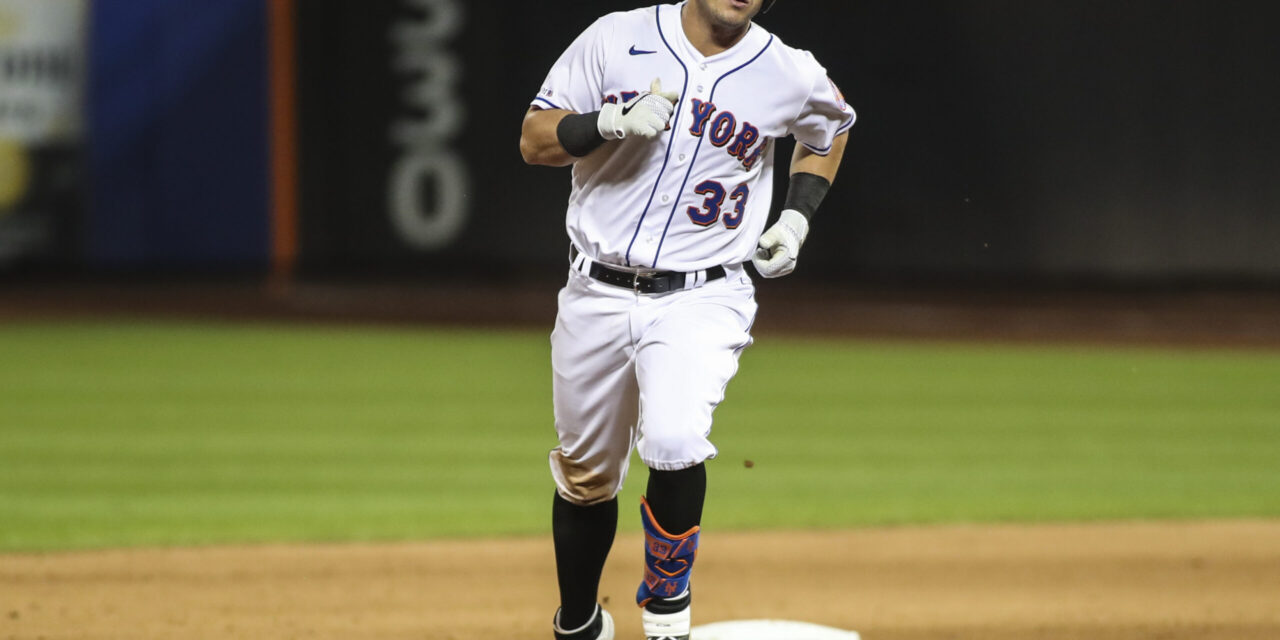
Despite a flurry of impactful moves last offseason, it’s no secret the 2021 season hasn’t gone according to plan for the New York Mets as they’re set to miss the playoffs for a fifth straight year, unfortunately, catcher James McCann is one of the main culprits behind this frustrating outcome.
Needing to add some much-needed stability behind the plate, the Mets made a pretty large splash in free agency back in December, signing McCann to a four-year, $40.6 million contract. In turn, the front office was hopeful this move would allow them to turn the corner on what’s been a very frustrating last couple of seasons at the catcher position.
But sadly, that hasn’t been the case for this team in 2021 as McCann has failed to live up to his extremely high expectations during his inaugural campaign in blue pinstripes.
Continuing a trend that’s occurred since 2019, New York has received inconsistent production, both offensively and defensively, from its starting catcher position for a third consecutive season – proving free agency isn’t always the best solution to solving a dire situation.
Even though McCann had previously served as a backup throughout the majority of his career, management believed he was ready to assume a much larger role during his seventh season in the majors. While the 31-year-old posted 29 doubles, 25 home runs, 75 RBIs, a .198 ISO, a .355 BABIP, a 114 wRC+ score, a 3.7 fWAR and a slash line of .276/.334/.474 through 587 plate appearances from 2019-2020, his offensive production has been far less impressive in 2021.
Credit: Dale Zanine-USA TODAY Sports
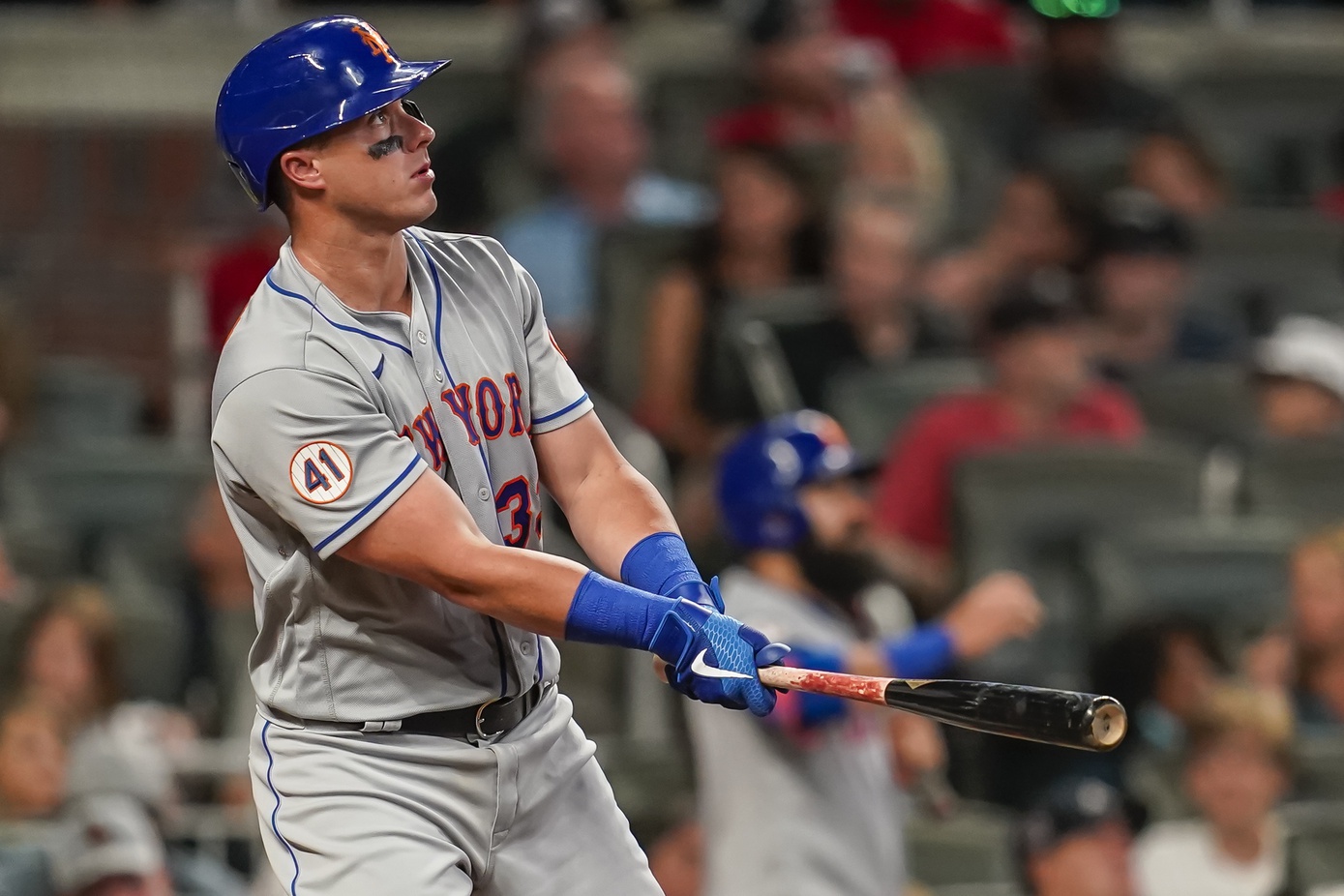
Struggling to hit for power or contact, the right-hander has proven to be a major disappointment in the batter’s box, resulting in just 10 doubles, 10 home runs, 42 RBIs, a .120 ISO, a .309 BABIP, an 85 wRC+ score, a 0.8 fWAR rating and a measly slashing line of 238/.301/.358 over his 385 plate appearances.
Taking his offensive woes even further, McCann has served as one of the least productive catchers in the majors this season, as he’s recorded the sixth-lowest ISO, the 11th-lowest offensive WAR rating (-10.6), the 13th-lowest SLG, the 15th-lowest OBP and is tied for the 15th-lowest wRC+ score among all backstops who’ve compiled at least 200 plate appearances, according to FanGraphs.com.
Additionally, he’s also tied for the 12th-lowest fWAR rating among those same qualifications.
Safe to say, this isn’t the offensive version of McCann the Mets envisioned receiving when they signed him to that lucrative deal over the winter, particularly his lack of power. Right now, the only positive trait regarding his skillset is his encouraging walk rate, which currently sits at a career-best 8.1%.
Unlike the last few seasons, the former Chicago White Sox has struggled to hit line drives and fly balls in 2021, resulting in a dramatic increase of ground balls. As a result, he’s registered a career-worst 52.7% GB rate, which is also tied for second-highest among all catchers in the majors.

Paired with his increased amount of ground balls, McCann also hasn’t been inducing nearly as much hard contact compared to previous seasons, proving to be a recipe for disaster. By hitting over half of his balls in play on the ground, opposing defenses haven’t needed to stress over their defensive alignment, add in his increased amount of soft contact, and defending against him can be fairly easy.
After registering career-highs in average exit velocity, barrel rate and hard-hit rate last season, the 6’3″ catcher has witnessed significant declines in all three of those departments this time around. Barring some dramatic turnaround during the final week of the schedule, which seems extremely unlikely, he’ll finish with some of the worst hard-contact metrics of his career.

While there’s no question the Mets acquired McCann for his offensive capabilities, at the very least, they were hoping he’d be able to serve as an average defender behind home plate. Since that was easily attainable for him in 2020, resulting in the top defensive statistical showing of his career, it seemed like his chances of playing up to that expectation were fairly high.
Similar to his offensive performance, the former second-round selection has disappointed on all fronts involving his defense, transforming him into a defensive liability. In turn, he’s become one of the worst defending backstops across the majors, causing him to rank near the bottom in multiple different categories.
Beginning with his overall advanced metrics, McCann has created the 10th-worst CDA (0.5) – catcher defensive adjustment – and the 12th-fewest FRAA (zero) – fielding runs above average – among all catchers who’ve received at least 8,000 pitches, according to BaseballProspectus.com.
As for his pitch-framing ability, the 2019 American League All-Star is tied for the seventh-worst CSAA (zero) – called strikes above average – and has generated the 10th-fewest FrmR (0.1) – framing runs – among those same qualifications.
Failing to block errant pitches effectively, the California native has produced the ninth-fewest BlkR (0.1) – blocking runs – in comparison to the rest of the competition.
Combining all of these defensive factors, it’s clear McCann hasn’t provided much, or any at all, upside for the Mets behind the plate this season – something this team can’t afford to continue moving forward. But if these woes carry over into 2022, then perhaps the coaching staff will be forced to increase backup Tomas Nido‘s workload.
Even though Nido has only participated in 56 games in 2021, mostly due to injuries, his defense has proven to be far superior to his counterpart’s, which has seen him record a team-high 6.9 FRAA, 7.1 CDA, 0.021 CSAA, 6.8 FrmR and a 0.1 BlkR through just 350 2/3 innings.
With three years and $32.45 million remaining on McCann’s contract following this season, the early results on this free-agent signing certainly don’t favor the Mets in any way, which is obviously not ideal. That being said, a bounce-back performance next season, while it may seem unlikely, could help everyone forget this miserable 2021 performance.
So while Year One of McCann’s tenure in New York has been a season-long nightmare, here’s to hoping a strong offseason will allow him to enjoy a much-improved showing in 2022.