When Michael Wacha made his New York Mets debut against the Boston Red Sox, there was a little bit of uncertainty with regard to manager Luis Rojas‘ rotation.
Sure, the front end looked secure thanks to solid outings from Jacob deGrom and Steven Matz, but Rick Porcello‘s unimpressive debut on Sunday Night Baseball is what spearheaded the uncertainty. Along with that outing not being what New York was looking for, Corey Oswalt came in as a reliever to eat up some innings and performed so badly that he got optioned to Brooklyn.
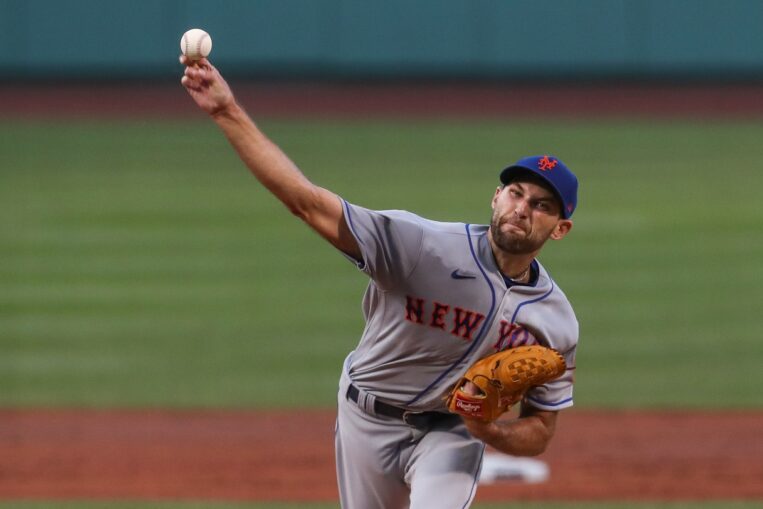
So, the Mets’ third starter got roughed up, their fifth starter didn’t even get a chance to start before getting demoted, and their fourth starter was looking to begin a rebound season against a good Red Sox offense. As we all know, Wacha was up to the task in an impressive performance — he needed just 77 pitches to toss five innings of one-run ball, allowing five hits, one walk, and four strikeouts.
With the backend of the rotation potentially in limbo at that point — they appear to be in a better place thanks to Wacha and David Peterson — this outing from the former St. Louis Cardinal was welcomed with open arms. In looking at some of the numbers he produced from his start at Fenway Park, I couldn’t help but notice a few things that literally jumped off his FanGraphs page.
His strikeout rate (20.0%) was in line with what he did over the past couple seasons, but it was nice to see his control get off on the right foot (5.0% on Monday, 10.1% and 9.8% the last two seasons, respectively). He induced ground balls at a 57.1% clip while holding opposing hitters to a 26.7% hard-hit rate, as well.
What jumped out the most, though, was how his pitch mix ended up once the night was over. Here’s a look at the last few seasons compared to what he put together on Monday:
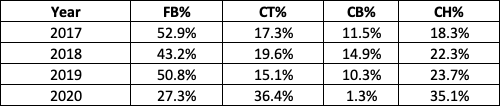
And before anyone says it — yes, I know how ridiculous it is to compare one start to an entire season’s worth of work. With that in mind — and remembering that his final month of the 2019 campaign was pretty good — I looked back at his pitch usage on a start-by-start basis, specifically focusing on the second half of play.
The Offspeed Stuff
What falls in line with Wacha’s 2020 debut when revisiting last year’s pitch usage numbers was how often he was throwing his curveball and changeup.
The right-hander’s changeup usage varied from start-to-start early on, but over his final nine starts (August 15th through the end of the season), that usage rate never dipped below 27.4% and surpassed 30.0% five different times. Wacha leaned on his curveball more heavily at the start of 2019, and it progressively decreased as the season wore on. During this same period of time (August 15th onward), his start-by-start curveball usage read like this: 15.0%, 4.1%, 4.4%, 4.2%, 5.3%, 7.3%, 9.5%, 9.3%, 2.3%.
So, he was seemingly already trending in this direction for these two offerings. It makes a lot of sense, too — his changeup produced a 34.4% strikeout rate with an opponent wRC+ of 60 last season, while his curveball produced a 10.0% strikeout rate and 215 opponent wRC+.
The Faster Stuff
It was encouraging to see Wacha’s average fastball velocity get a small lift when compared to last year (93.1 mph to 94.4 mph). As we can see from the above table, though, his usage of the ol’ four-seamer plummeted. He didn’t come close to that kind of low usage (or high cutter usage) on a start-by-start basis at any point last year.
As with most things, it was likely by design — opposing hitters put together a 152 wRC+ against his four-seamer last year. And while his cutter actually performed worse (166 opponent wRC+), the pure execution of the offering improved.
Here’s a quick look at the pitch value of Wacha’s offerings from 2019 compared to what he did in his 2020 debut (on a per-100-pitch basis):

Here I go again with the whole comparing uneven sample sizes thing, but if we ignore the extremeness of the 2020 numbers because it’s only one start, this mostly checks out. His four-seamer and curveball were on the wrong side of zero, while his changeup was an asset. The one outlier was his cutter, which he used well and used often.
All in all, Wacha’s Mets debut was exactly the kind of performance they needed, especially after lackluster Opening Weekend results against the Atlanta Braves. The 29-year-old is a former All-Star that has experienced big-league success in the past. He was already motivated to rebuild his value by taking a one-year deal with New York in the first place, and that motivation likely increased when he was on the verge of being forced to the bullpen during Spring Training.
That, plus working with a different perspective thanks to new pitching coach Jeremy Hefner, just may be all the ingredients needed to have the rebound campaign he’s aiming to experience.