
On Sunday, the Mets opted to use Tobias Myers to open in front of David Peterson. While this was likely intended as a way to circumvent the issues Peterson has had early in games — which worked — it did also signal a potential loss of faith in Peterson by the Mets. That, coupled with the Mets not naming a starter for Thursday’s game, on Kodai Senga‘s day to pitch, raises the question: Could one of the Mets’ young starters at Triple-A be in line for a call-up?
So, let’s check in on Christian Scott, Jonah Tong and Jack Wenninger, and see how they’ve been doing.
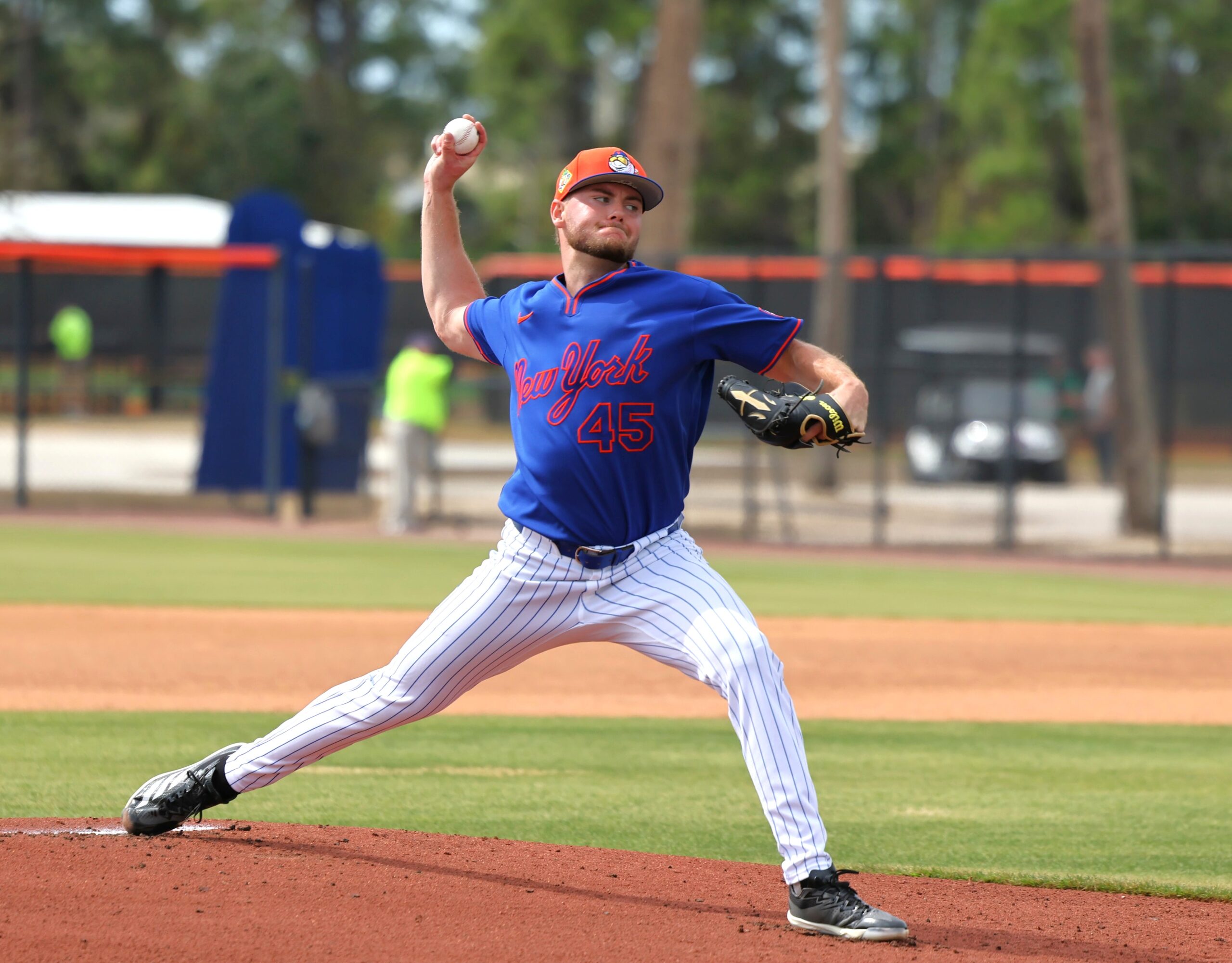
Christian Scott Photo by Ed Delany of Metsmerized
Christian Scott
Scott’s surface numbers aren’t good, but there’s significant context needed here. In three starts and 13.2 innings, Scott has a 5.27 ERA and 1.10 WHIP with 17 strikeouts and two walks. In his first start of the season, and his first non-spring training start since July 2024, Scott gave up nine hits and six earned runs in 3 and 1/3 innings. In his next two starts, he gave up four hits and two earned runs in 10 and 1/3 innings.
He got roughed up in his first start back from an elbow injury that cost him about a year and a half. You can pretty much toss that one in the trash. In his next two, he looked much better. Take a look at how his first start compared to the next two:
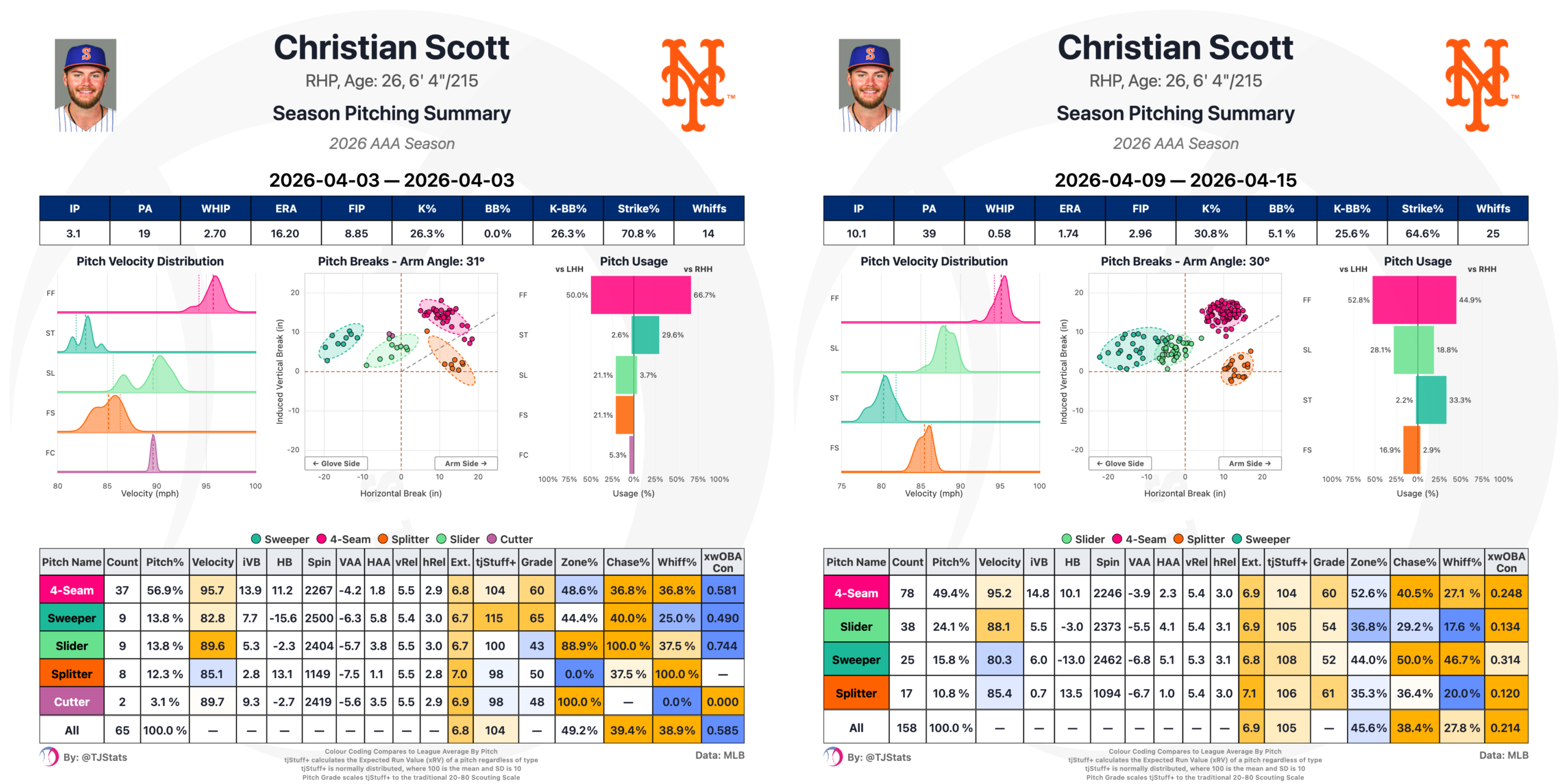
Images courtesy Thomas Nestico @TJStats on X.
Honestly, there’s no crazy difference in the quality of his stuff. His four-seam and sweeper both look good, with the only noticeable difference being in his hard slider and splitter. Even the chase and whiff rates looked great. The only true difference is that he simply got hit harder. This could have happened because he didn’t have his slider and splitter working as he would have liked in his first start, impacting the rest of his outing, or it could just be small sample size randomness. In his next two starts, he looked fantastic.
The splitter is the most interesting part of this picture. He threw it the last time we saw him in the big leagues, but it got hit HARD. He throws it almost exclusively to left-handed hitters, and he’ll need it to have success at the next level. In his nine MLB starts in 2024, Scott allowed a .942 OPS to lefties and a .532 OPS to righties. The splitter is important. If he can rely on it to get lefties out, he has a good chance at being a good MLB starter. If he can’t … he might struggle.
Scott is the closest to being MLB-ready. There’s a non-zero chance he starts for the New York Mets on Thursday in Senga’s spot. What that would mean for Senga, who knows. But that’s not Scott’s problem. And while that’s ultimately unlikely, he’s still the clear frontrunner to be the first one of the trio to get a call-up.
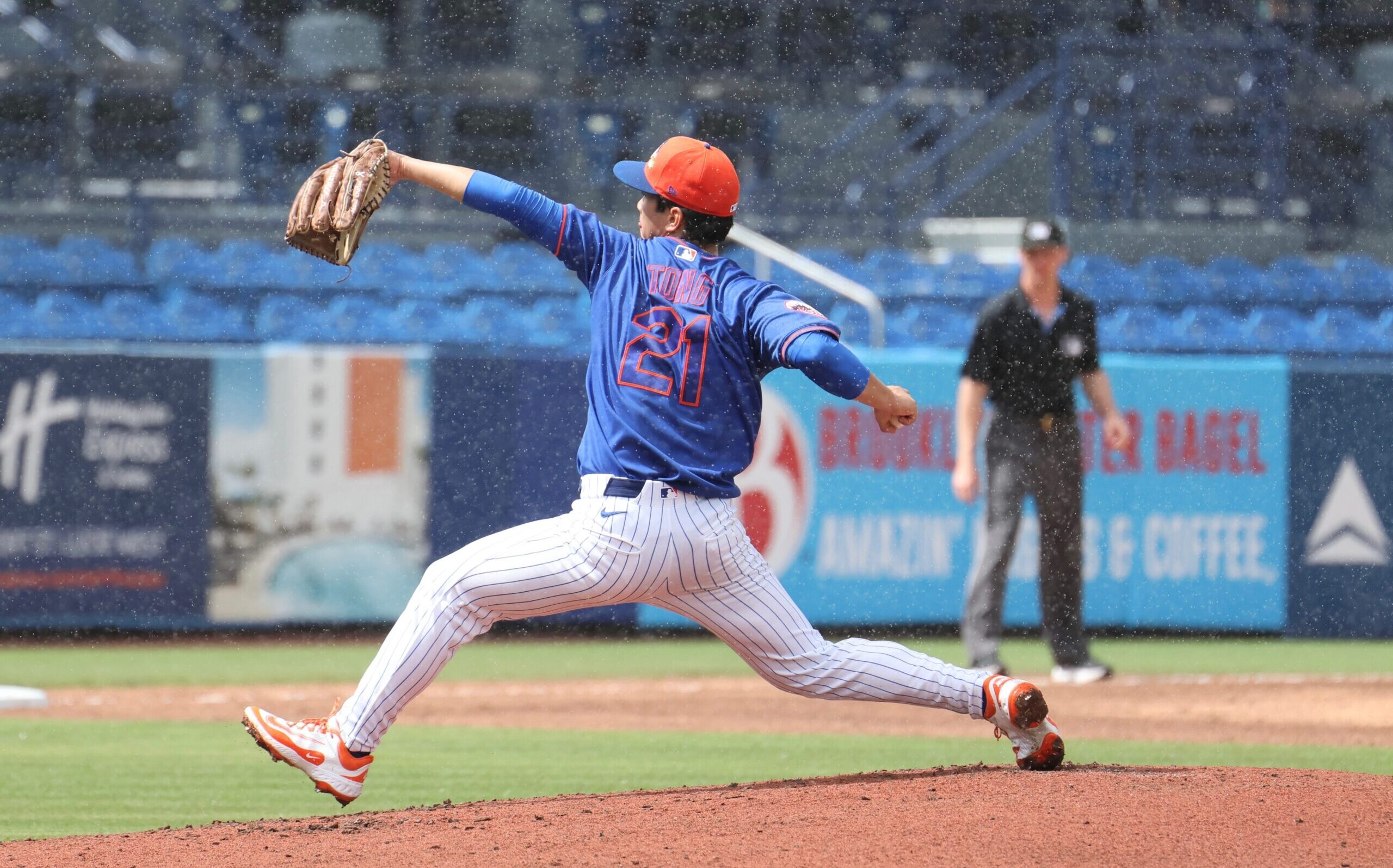
Jonah Tong
Photo by Ed Delany of Metsmerized
Jonah Tong
Tong’s stats have been bad; there’s no sugar-coating it. Through four games and 15 and 1/3 innings, he has a 7.04 ERA and 1.37 WHIP with 23 strikeouts and 10 walks. His FIP is 5.88, and his xFIP is 3.66, so maybe he’s gotten a bit unlucky, but he’s also given up hard contact, making it hard to chalk much up to luck.
With Tong, it’s important to remember he’s at Triple-A to work on pitches that aren’t his four-seam fastball and changeup. It might seem silly to say this, but the results aren’t the most important thing. They’d be nice! But really, what matters for Tong is just getting reps in throwing his cutter and curveball.
Take a look at how his arsenal has looked this year:
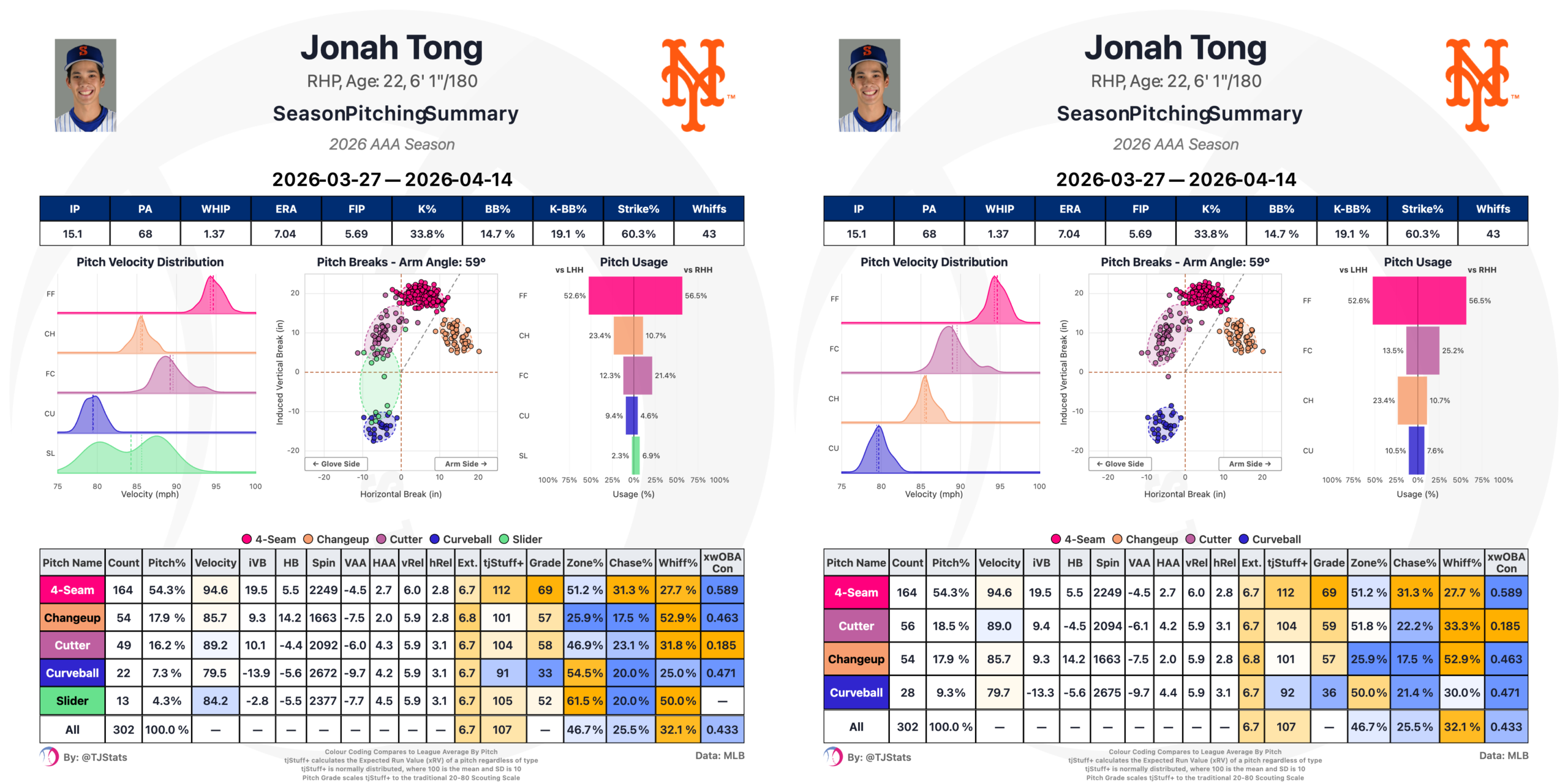
Images courtesy Thomas Nestico @TJStats on X.
I’m not going to pretend to be an expert on pitch shapes, but something here felt off. The initial card (left) had Tong throwing a slider, but it really looked like some cutters and some curveballs were being classified incorrectly. The seven “sliders” that I reclassified as cutters averaged 87.6 mph, well within the range of his other cutters. The seven “sliders” that I reclassified as curveballs averaged 80.4 mph, well within the range of his other curveballs.
After that, the new card (right) looks a little cleaner and gives Tong a definitive four-pitch mix. Who knows? Maybe he is actually throwing two different variations of a slider. I’m more confident in the ones reclassified to curveballs, but some of the reclassified cutters do have unique shapes. Maybe those actually are attempts to throw a slider. Some cutters look to blend in with his four-seam, but those were left unchanged.
It seems to me, though, that it’s more likely his cutter and curveball are inconsistent. He’s working on them, and in the process, some are being tagged incorrectly.
Now, onto the results of the new pitches. The good news is the cutter looks like it’s working. It’s creating a lot of swings and misses, and when hitters make contact, they’re not doing much damage off of it. The bad news is that the other three pitches have gotten crushed, including the four-seam and changeup. Those two are his two plus pitches, and they’re at least producing good whiff rates, so maybe it can be chalked up to small sample sizes. It could also simply be growing pains as he’s not only refining two pitches, but learning how to sequence with this new-look arsenal.
When it comes together, and it will, it will be time for him to return to the big leagues. Until then, though, he should keep working on it in Triple-A.
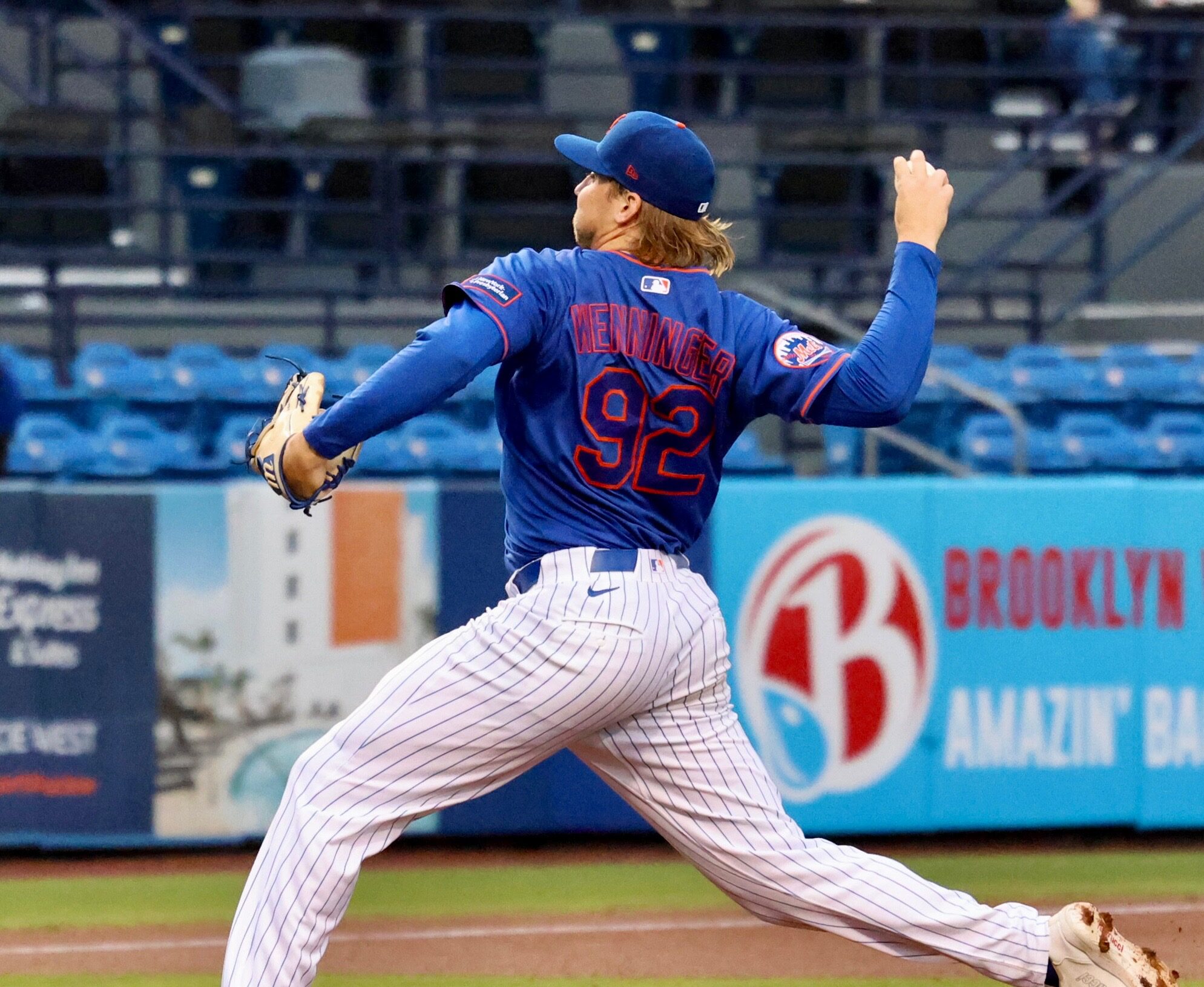
Jack Wenninger. Photo by Ed Delany of Metsmerized
Jack Wenninger
Wenninger is emerging as a top-end MLB prospect. He’s already a top 100 prospect on some lists, and by the mid-season update, he should be on all.
Through three starts and 13.2 innings this year, he has a 1.26 ERA and 1.19 WHIP with 15 strikeouts and 6 walks. Here’s what the mix has looked like this season:
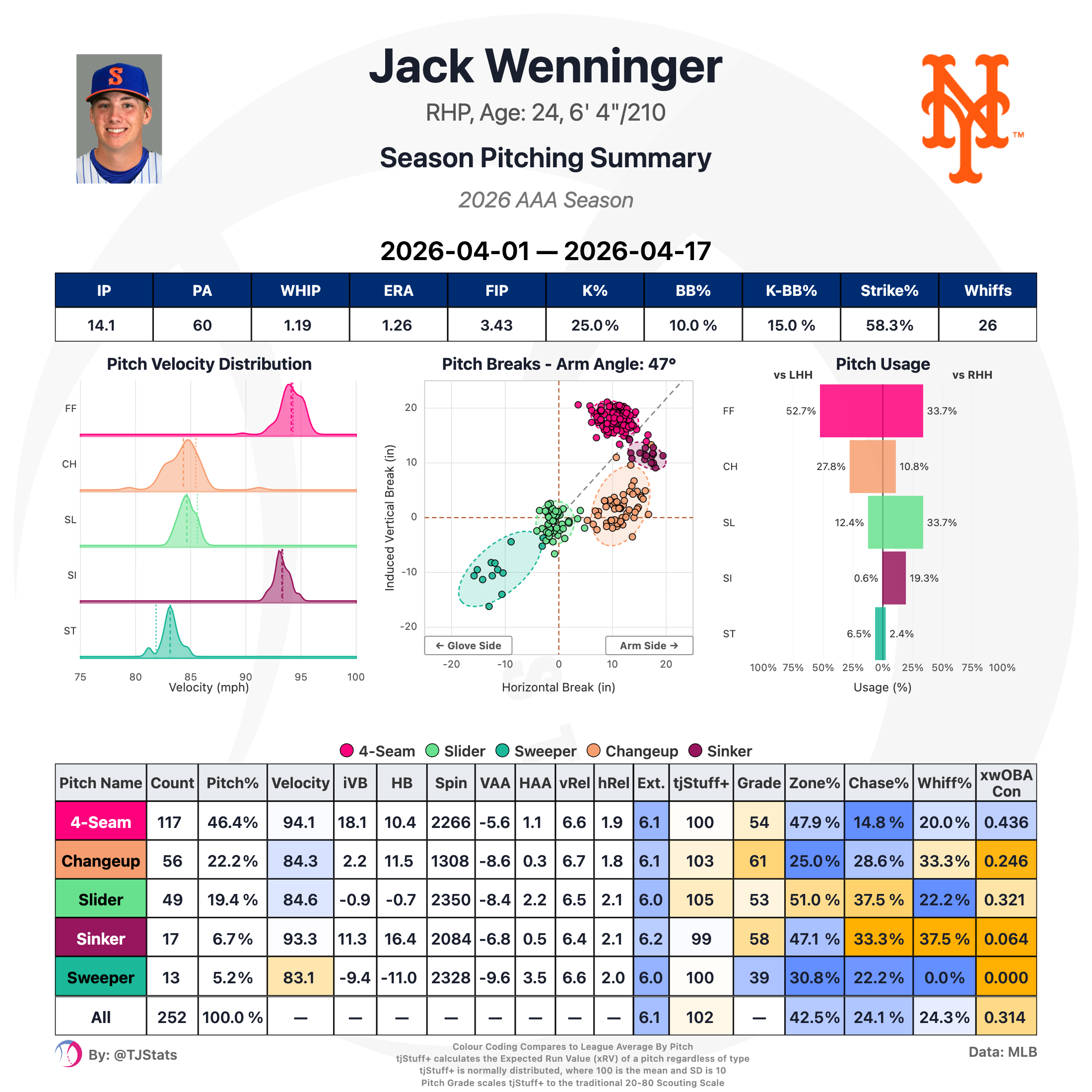
Image courtesy Thomas Nestico @TJStats on X.
The fastball is fine, and the rest of the breakers are good. His calling card is his splitter (labeled a changeup here), a pitch Baseball America slaps a 70-grade on. It’s a filthy pitch. The other breakers also play, and he uses them throughout his starts. It would be nice if he were in the zone a bit more, but it’s not overly concerning as of now.
He’s reliable, gives a good innings floor, and turns in a good start seemingly every time out. In his three starts so far this year, he’s gone between 4 and 1/3 innings and 5 1/3 innings while allowing one earned run or fewer. Don’t worry about the slight lack of length either; it’s early in the season, and pitchers are still building up. Especially in the minor leagues.
Wenninger simultaneously has the highest floor and the lowest ceiling of this trio. That’s not a knock on him either. Wenninger is probably the highest-probability MLB starting pitcher still in the minor leagues for the Mets. He is really, really solid, and even if he doesn’t have an elite overall ceiling, he should have a good chance to stick in a big league rotation. Don’t be surprised to see him up before Tong, either. He’s much “safer,” and if Tong is still trying to nail down his cutter and curveball and the Mets have a need, it could be Wenninger.