
Let’s all be entirely honest with ourselves here. It’s very unlikely that the Mets sign Bryce Harper, and it seems more and more unlikely that they will acquire A.J. Pollock, despite a market yet to truly develop for him as we approach the new year.
We can, and should, be upset about the franchise not allocating resources as back into this team, but as reality has it, the Mets still have to plan for what is to come. Are there options out there that could supplement the offense necessary for the Mets in 2019?
Admittedly, exactly zero names I am going to propose are going to jump off the sheet to anyone, but perhaps some of the numbers will. The name of the game here is playing to players strength: team optimization.
Avisail Garcia
Age: 27
2018 Salary: 6.7M (non-tendered by White Sox)
2018 Stats: .236/.281/.438, .308 wOBA, 92 wRC+
Our first option here was written about just written about recently in our Free Agent Profile series by our own Sam Lebowitz. While this season seemed somewhat paltry, Garcia is a year separated from a season in which he hit .330/.380/.508. Like Sam pointed out in his write-up, Garcia did have an unsustainable .392 BABIP, which means that he fell into more than just his fair bit of luck.
It bears the question then as to why I would recommend Garcia then. Well, what stands out to me was his performance vs left-handed pitching. The 2018 Mets were 29th in all of baseball against left-handed pitching in OPS (.649), just behind the San Francisco Giants, just edging out the Miami Marlins. Garcia hit .279/.333/.477, .344 wOBA, 119 wRC+, against left-handed pitchers in 2018. For his career, his line against left-handed pitching is .304/.358/.457, /348 wOBA, 121 wRC+. Garcia would definitely provide some needed offense against lefties off the bench.
His defense in right field has been a place of concern, as he posted -24 DRS in right field over his first 4 seasons. Over his last 3 seasons, he’s been worth -2 DRS, including -4 in 2018. Statcast had him at 5 outs above average in 2018, as well. Garcia isn’t a world-beater out there, but he certainly isn’t a butcher either. At least not anymore.
Realistically, I could see Garcia going for less than his projected 8 million dollar arbitration salary. Perhaps an average annual value of $6 million.
Robbie Grossman
Age: 29
2018 Salary: 2M (non-tendered by Minnesota Twins)
2018 Stats: .273/.367/.383, .333 wOBA, 108 wRC+
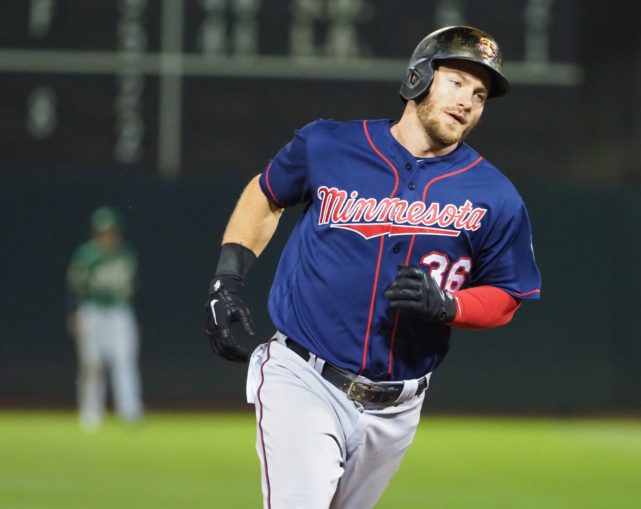
Grossman had an overall better season offensively than Garcia last season, but perhaps his ceiling is not nearly as high as Garcia’s. What Grossman does do well is getting on base, as seen in his .367 OBP in 2018, which was aided by a very respectable 12.9% walk rate. Grossman also keeps the bat on the ball. Grossman had a low 5.7% swinging strike percentage in 2018 (tied-17th in MLB with Jean Segura – min. 400 PA) accompanied by a 85.7% contact rate, including contact on 93.8% off all pitches he swung at inside of the strike zone. Grossman has the ability to be a top of the order bat to be on base for stronger hitters to drive in.
Like Garcia, what drives me towards Grossman is his ability to hit against left-handed pitching. Grossman had a great year against opposite-handed pitchers. He hit .325/.438/.444, .398 wOBA, 147 wRC+, against southpaws, which ties him for 34th overall against southpaws in wRC+ with new Met Wilson Ramos, as well as Yuli Gurriel, and Mitch Haniger. While there isn’t much power to his bat, the on-base percentage is extremely impressive, and exactly what the Mets order could use against lefties.
Once again, like Garcia, Grossman’s defense in the outfield is a bit of a concern. Grossman posted -3 DRS in 2017 in 357.0 innings in 2017 and -4 DRS in 623 innings in 2018 respectively, and is close to being on the wrong side of 30 to hope for much improvement, but just 1 less defensive run saved in almost 300 innings more is slightly encouraging perhaps on a defensive position side of things. Statcast has had Grossman at zero Outs Above Average over the last two seasons after a disastrous 2016 where he posted -15 OAA and -21 DRS in 637.1 innings. Not throwing a party over those numbers, but it’s always good to see an improvement.
It isn’t beyond reason to think that Grossman could be had for just above the $2 million he made in 2018.

Mark Canha
Age: 29
2018 Salary: 0.5M
2018 Stats: .249/.328/.449, .334 wOBA, 113 wRC+
Our first and only trade candidate on this list is Mark Canha. Our very own Josh Finkelstein speculated a couple of days ago that the Mets and Athletics could see eye-to-eye in a deal that would include Kevin Plawecki for Mark Canha, and he certainly has a point. As Finkelstein pointed out, the A’s are set to run Josh Phegley and Chris Hermann at backstop, both of which performed well below average offensively last year. It would three of control of Canha for four years of control of Plawecki, and presumably, the Mets would have to add another piece to this trade. Plawecki could start at catcher for the A’s and eventually compete with A’s prospect Sean Murphy for the position.
The A’s are starting to find a logjam in their outfield and are slated to run Nick Martini, Ramon Laureano, and Stephen Piscotty in all three outfield positions, with the defensibly flexible Chad Pinder as an immediate backup, according to their MLB.com Depth Chart. Of those four outfielders, three are right-handed hitters, just like Canha, but the A’s also have Dustin Fowler, who came alongside Jorge Mateo and James Kaprielian in the trade that sent Sonny Gray to the New York Yankees. Many believe Fowler should be in Oakland now, since it doesn’t seem that he has much to prove in the minor leagues anymore. Fowler is also a left-handed hitter who can help offset their heavily right-handed hitting outfield.
As for Canha, he would also provide solid offense against left-handed pitchers, who, as I mentioned twice prior, the Mets were woeful against in 2018. Canha hit .282/.337/.604, .390 wOBA, 152 wRC+, which would have him tied for 28th in all of baseball in wRC+ versus left-handed pitchers with newly acquired Met Robinson Cano, and Tampa Bay Rays first baseman C.J. Cron.
Canha plays a reasonable corner outfield, posting 1 DRS in left field in 283 innings and 0 DRS in right field in 71.1 innings, he just shouldn’t go near first base. Canha also plays a fair first base, which could be an excellent backup plan in case Peter Alonso and Dominic Smith struggle early in the season. Statcast had Canha at just -1 Outs Above Average around the field.
Canha would be under team control until 2022, which fits under payroll restrictions set with the Mets.

Mel Rojas Jr
Age: 28
2018 Salary: 0.8M
2018 Stats: .305/.389/.590
Lastly, and perhaps the most “out there” idea is Mel Rojas Jr. Yes, the son of former Mets pitcher Mel Rojas. Rojas has never had a trial at the major league level, despite perhaps earning one in 2016 when he was a member of the Atlanta Braves organization. Rojas always held decent contact rates, and a fairly good eye at the plate, with walk rates often over 10%, but it wasn’t till that 2016 season that he found his power stroke.
Over the last season and a half, Rojas Jr has been playing for the Korean Baseball Organization for the KT Wiz. Rojas Jr has continued to discover his power in Korea, hitting a home run every 18.7 at-bats in 2017 (18 HR) and every 13.1 at-bats in 2018 (43 HR). For comparison means, power-hitting first baseman Eric Thames hit a home run every 10 at-bats in 2015 and every 10.9 at-bats in 2016 in his last 2 seasons in Korea before getting a contract from the Milwaukee Brewers. Thames shook the Korean baseball world with his powerful bat, but also does play a position almost exclusively dedicated to power. Rojas Jr is an outfielder who has spent time in all three outfield positions.
Rojas Jr is also a switch hitter, too, who traditionally hit better from the right side of the plate. In Korea, Rojas Jr has more contact from the left side, hitting .317 versus right-handers, and .275 against left-handers. His power has been almost identical from both sides, hitting a home run every 13.8 at-bats against lefties, and every 13.1 at-bats against right-handers.
All reviews of Rojas Jr seem to agree that his approach at the plate, his swing, his physique, and his defense have all improved abroad. Defensive stats are not as accessible for the KBO, despite them implement Trackman in all their stadiums (though anyone with a source would be greatly appreciated). On the point of Rojas Jr’s approach, he did walk 11% of the time just last season, and struck out 22% of the time; almost on par with his minor league numbers, but encouraging to see with more power.
The hope would be for Rojas Jr to take advantage of the adjustment period that they would need to take for his new approach, as they had to do with Thames. Then, as stated as the unifying theme of this all, play him to his strengths.
As far as what a potential contract would look like, Thames got a 3-year, 16 million dollar deal from the Brewers with more of a track record than Rojas Jr. Realistically, Rojas could be had for about 2 years, and anywhere 2 and 4 million a year.
There are certainly some good options out there in what is considered an extremely thin 2019 outfield market. All will just depend on where the focus of the 2019 Mets will be under the command of new general manager Brodie Van Wagenen.