

Mandatory Credit: Brad Penner-USA TODAY Sports
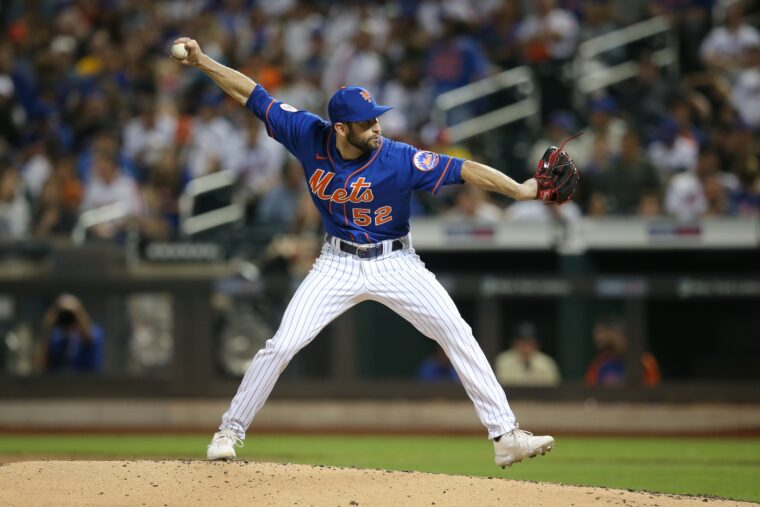
The New York Mets claimed right-hander Jake Reed off of waivers from the pitching-powerhouse Tampa Bay Rays at the beginning of the month. It was not until two nights ago he made his Metropolitan debut.
Reed did so in a mop-up role behind quickly pulled Carlos Carrasco in the third inning of Sunday night’s blowout loss. In this appearance, he excelled, as he pitched three innings and allowed only two hits, walked none, and struck out three Los Angeles Dodgers’ hitters.
He did so by only throwing 46 pitches against the best lineup in the MLB. Why shouldn’t this stellar outing come as a surprise? Let’s look into it.
Reed is already 28-years old and was drafted in the 40th round back in 2011. He has spent countless years in the minor leagues where he has always put up solid numbers. In 345 total innings pitched across all the minor league levels, Reed has a 3.70 ERA with 362 strikeouts and a home run rate per nine innings (HR/9) of only 0.4.
He has also only allowed only 296 hits. Looking at his Triple-A level statistics only, the numbers are still impressive. He has a 3.84 ERA with 205 strikeouts over 187.1 innings pitched. His HR/9 again is stellar, at only 0.5.
This season in Triple-A, besides his difficult stretch with the Los Angeles Angels’ affiliate, he has pitched 12.2 innings and has struck out 21 while only walking three. Meanwhile, in his 8.1 innings pitched at the MLB level this season, he has only allowed seven hits and two earned runs. He also has eight strikeouts and only two walks.
So, how has he built this success? He has two very solid pitches he relies on. His slider, which he has thrown 67% of the time in his small sample in the big leagues, has a whiff rate of 40%.
Meanwhile, his changeup, which is his second pitch (thrown 22% of the time), has an xwOBA of .225, which is the lowest of the three pitches he has featured this season. Add in an unorthodox, side-armed type of delivery, and hitters have had a hard time timing and measuring up his effective pitches.
Also, throughout his career, he has had an elite home run rate, as was mentioned above. In an era where the home run ball has become so important to several offenses around the league, limiting the long ball is vital. This is something Reed has done at every level he has played.
Of course, his MLB tenure is a very small sample size, but it has been a very good one. He is utilizing an unorthodox type of delivery while leaning on two different pitches to generate a ton of swings and misses. He has also limited the home run ball, as evident by his overall career HR/9 of 0.3, which is so important in today’s MLB.
For reference, Corbin Burnes leads the MLB this year with a HR/9 rate of 0.4. Overall, his very solid minor league numbers show why the major league success should not be held with a grain of salt.
After the Mets’ most recent flurry of roster moves, it was good to see Reed remain with the big club. Hopefully, his stellar performance against the Dodgers will allow him to continue to show he may just belong at the major league level.
Worth noting, it should not be expected Reed develops into some kind of high-leverage reliever for the Mets. But, he does have the tools to be a nice back-end, bullpen piece which is not so shabby for a waiver pickup.