In 1999, Chili Davis finished a 19-year major league career featuring three All-Star appearances and three World Series wins. The outfielder that played for five different teams and finished his career with 38.3 WAR spent the next decade out of baseball until he joined the Pawtucket Red Sox as a coach in 2011.
Davis has been the hitting coach of four teams (Oakland, Boston, Chicago, New York). He’s looking for his fifth team after the Mets relieved him and assistant hitting coach Tom Slater 23 games into the 2021 season.
The man the Mets chose to replace Davis, is Hugh Quattlebaum.
In 2000, Quattlebaum began his professional baseball career at 22. A corner infielder, he appeared in 49 games for Oneonta in the New York Penn League. By 2003 he reached Triple A. He played in three games, recording nine plate appearances for the Ottawa Lynx. He had a single, double, and was hit by a pitch.
Quattlebaum left professional baseball that year.
Instead, he went to Finland to try professional basketball. He won a dunk contest against five Fins and left the country. Quattlebaum moved to Los Angeles working as a screenwriter and bartender to make a living.
Five years passed and baseball came back to him. He started as a private coach in 2006, volunteered briefly at West Los Angeles College in 2015, and was hired by the Seattle Mariners as their minor league hitting coordinator in 2018.
Why did the Mariners take a chance on the failed player? And why have the Mets decided to hand the keys to the 42-year-old?
“We felt like the players needed a different level of support, and maybe some different skills brought into the mix,” Mets general manager Zack Scott said.
Davis is an old-school baseball coach. His philosophies toward hitting have been proven wrong by modern standards. After a one-year run with the Cubs in 2017, his hiring to Mickey Callaway‘s staff in 2018 was already suspect.
Before Davis the Mets had players use one swing no matter the situation. Davis emphasized using different swings for different situations and putting the ball in play. That might be fine in 1921 but not 2021.
Davis subscribes to the Charley Lau school of hitting. Lau developed a list called the “absolutes of hitting.” This includes things like striding with the front toe closed and shifting weight from back to front. Notably, he had the barrel of the bat going in a straight line down to the ball.
Lau’s method worked there’s no denying it. He’s been heralded by Tony La Russa as “the greatest hitting coach of all time” and George Brett, who had a measly 3,154 hits, said, “Charley made me a hitter.”
It just doesn’t work anymore.
Through thorough film study, independent coaches across America have realized that the best hitters in baseball don’t follow those teachings. They don’t swing down or “chop wood” as they’ve been taught. Henry Aaron, Stan Musial, Mickey Mantle, Ted Williams were doing something different. Batters didn’t propel their bats forward with their top hands, they kept the barrel behind the ball for as long as possible.
That discovery was made by Craig Wallenbrock, an independent hitting coach once called “The Oracle of Santa Clarita” by Sports Illustrated. Wallenbrock learned from the greatest hitter of all time, Ted Williams. His coaching influences continue to grow, including Quattlebaum.
Wallenbrock is just one of the many hitting coaches Quattlebaum follows on Twitter. He also follows Doug Latta, Bobby Tewksbary, and Richard Schenck. What do they all have in common? They turned hitters into stars.
Ted Williams wrote his hitting manifesto The Science of Hitting in 1968. Decades ahead of its time, Williams hypothesized about a slight upswing around 10 degrees. He disagreed with the swing level or down approach. He’s right, the only way to hit a home run or drive the ball is in the air. The emphasis is on the upswing. If a ball is coming down from the mound the best way to beat it is to swing up and through it.

The swing-down approach that Davis used stemmed from the dead-ball era. Prior to 1920, baseballs didn’t travel nearly as far. In the early days of baseball, fielders didn’t use gloves, and hitting toward inexperienced fielders was encouraged because they were prone to mistakes. Not to mention the incredibly large park dimensions that made home runs impossible and the rule that if the ball was fielded on one hop it resulted in an out.
Okay, that’s fine but does it work? Just ask former Mets Marlon Byrd and Justin Turner or Josh Donaldson, or Aaron Judge, or J.D. Martinez, or Kris Bryant, and so on and so on. The teachings of Williams passed down and perfected have transformed careers.
At age 35, Byrd hit 21 home runs with the Mets over 117 games in 2013. His previous high was 20 in 146 games in 2009. How did he do it? He brought Latta’s at the time “radical” approach to the team in spring training. It was so radical that the Mets didn’t want him talking to teammates about it. The only one who listened was Turner.
Turner spent the offseason working with Latta at the Ball Yard in Chatsworth, California. He transformed his swing and his career making people ask how the Mets ever let him go.
Robert Van Scoyoc was an assistant under Wallenbrock. They were tasked with transforming Los Angeles Dodger Chris Taylor. They turned him from a career .231 hitter with one home run to a 21 home run hitter with a .496 slugging percentage in the offseason of the 2016-17 season. Today, Van Scoyoc is the hitting coach of the Dodgers and has a World Series ring to show for it.
These developments in baseball started appearing a decade ago. It’s taken until now for the Mets to notice them. New York has made a real investment into analytics with Steve Cohen as owner. Scott and his staff knew they couldn’t continue with Davis’ teachings.
The baseballs debuted this year have increased drag. They make home runs harder, increased pitch movement, and tanked the league-wide offensive numbers. The Mets needed a new approach. Quattlebaum will give them what they were missing.
The changes won’t come overnight. The players that worked to develop entirely new swings spent months working privately in batting cages with these coaches. Some even paid to fly them out for a quick tune-up during a slump. The hope for Quattlebaum will be an increased development in using film to correct swing paths and creating more consistent results at the plate.
Some players might not need as much help. Jeff McNeil displayed this during his solo shot last week.
Jeff McNeil is first pitch-swinging and goes yard for the first run of the ballgame! pic.twitter.com/DadIQFGA15
— SNY (@SNYtv) April 27, 2021
Basic things to watch for is the way he sets up and initially moves his hands back to create a faster swing, then drives up and through the ball to launch it into the second deck. You can watch it happen again during his ninth-inning home run against Miami on April 9.
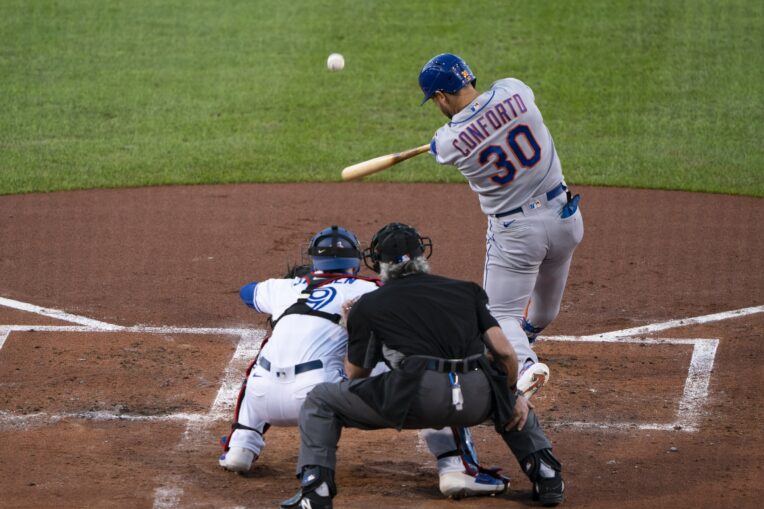
The Mets offense should revert to the mean as the season plays out. Michael Conforto, Pete Alonso, and McNeil have recently kicked the early season struggles but Francisco Lindor and Dominic Smith struggle more than ever.
Removing Davis, Cohen showed he doesn’t have a penchant for poor results. Quattlebaum will need to act fast in his new role, and if players listen the Mets’ offense will certainly live up to the hype.