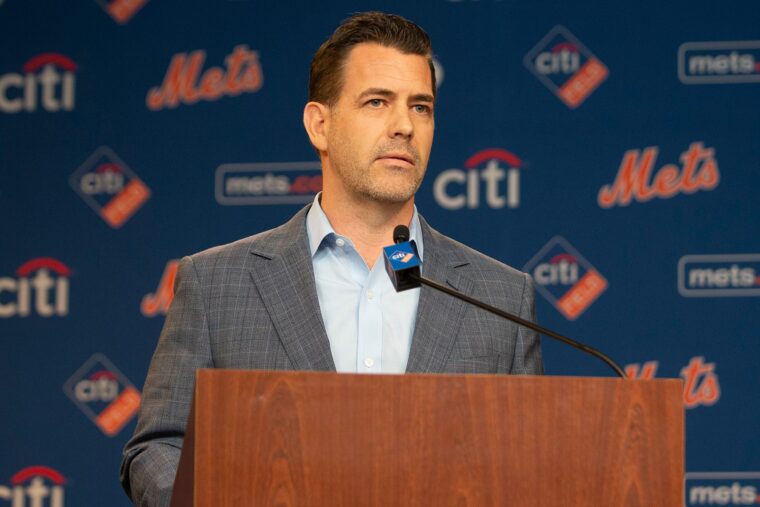
In a matter of just four days, the New York Mets have gotten right back on the saddle. As a baseball team training to prepare for the upcoming 2020 season, things seem to be moving swimmingly. New manager Luis Rojas has laid on the charm in his early work with the players and the media, Marcus Stroman looks to be in even better athletic shape than he was in 2019 (seriously), Dellin Betances is eyeing an Opening Day activation, and of course, general manager Brodie Van Wagenen is talking.
What it is he is talking about, however, is especially par for the course.
This would be the convenient place to jokingly reminisce a time in the younger days of his tenure, when his rally cry of “come get us” after signing Jed Lowrie (who has yet to be definitively spotted or mentioned at Port St. Lucie after a year in which he never played in the field) couldn’t be as easily mocked. However, it may, in fact, be more appropriate to address his most recent comments in response to some shots fired by former Met starter Zack Wheeler on Thursday.
Now a centerpiece in the Philadelphia rotation with a $23.5 million annual price tag to his name, Wheeler was arguably the most desirable free agent pitcher not named Gerrit Cole, and for good reason. Combining for a 7.4 bWAR/8.9 fWAR since he returned to health in 2018, his 3.37 FIP across 377.2 innings made for the ninth and twelfth-best figures among major-league starters.
The Mets are certainly worse off having let him go, even more so to a division rival, and Wheeler, who had never been shy about his initial desire to remain in Queens, is making sure people also understand the motivations for his decision not to return. In an interview Thursday, Wheeler told Greg Joyce of the New York Post, “It was basically just crickets when I did [hold out for an offer]… Because it’s them. It’s how they roll.”
On his last point, Wheeler made sure to elaborate: “everything was kind of jumpy because certain people would want something, others wouldn’t. I don’t think everyone was on the same page.”
Both the longtime Met’s statement that the team never reached out to him and his allusion to dysfunction in the front office may have been driven, at least in part, by Brodie Van Wagenen’s initial defense of the team’s inactivity in November – one that, even at the time, seemed less than constructive.
Van Wagenen had told reporters, “the projections we have for Wheeler, both short and long-term, didn’t match up with the market…”
Put another way, the Mets didn’t think Wheeler was worth the money. Why swallowing your pride and owning the fact that you weren’t able to maintain him or even congratulate a former player of yours for seven years on cashing in after he spent three years struggling in his recovery from Tommy John surgery? (one the Mets themselves may have driven him to by overusing him during the 2014 season)
Like the textbook entitled jock who gets rejected in front of the entire school after elaborately soliciting a cheerleader’s hand to prom, all of this can simply be erased with the excuse that the endeavor “wasn’t worth it anyway.”
In this light, one can easily comprehend why Wheeler issued the response he did: the organization thought so little of his desired salary – one that the market had clearly dictated to that point – that they didn’t even reach out to try negotiating further. And to make matters worse, the team’s lead executive and spokesman attempted to pull wool over the fanbase’s eyes by painting him as unreasonable. Of course, Wheeler would take exception.

But the mudslinging came to a head yesterday when Brodie doubled down:
“[The Mets] helped him parlay two good half-seasons over the last five years into $118 million,” he told Newsday‘s Tim Healey. “I’m proud of what our group was able to help him accomplish. I’m happy he was rewarded for it.”
Never mind that the personnel measures they took translated to replacing Wheeler with Rick Porcello and Michael Wacha – statistically, two of the league’s worst starting pitchers in 2019. Judging by his comments to the media, both past and present, it’s evident that Brodie Van Wagenen (and evidently the organization as a whole) does not give a damn about Zack Wheeler.
It would be too easy to dismember the notion that Wheeler is getting paid for “two half-seasons” given a body of work that spans 60 starts and has an edge over 80% of the qualified arms in baseball. Any under-30 pitcher with an upward trajectory and a 97 mph fastball has more to show than whatever selection of starts Van Wagenen was or was not watching.
Rather, it’s time we address just how poorly this longtime sports agent has handled player relations, more notably as it relates to those on the way out, but also to a lesser extent with current and prospective talent. Having experienced one full season and two offseasons, there are plenty of moments that render his spat with Wheeler just one example in a remorseless pattern of burning bridges.
Of the smaller-market offenses, Van Wagenen has withheld jobs from two players for equally suspicious reasons in Devin Mesoraco (prior to the 2019 season) and Adeiny Hechavarria (in the home stretch of the 2019 season).
Upon signing with the team, Mesoraco (a preferred batterymate of deGrom’s, mind you) was promised a backup role to Wilson Ramos in the event that Travis d’Arnaud began the year on the injured list. Once it became clear d’Arnaud would not be healthy, the team went back on its word, choosing Tomas Nido and suspending Mesoraco when the latter refused his outright assignment.
In this case, most teams release players so they can pursue a better opportunity. The Mets refused to do so, keeping Mesoraco suspended until he had to announce his retirement (for those interested, FanGraphs provides a decent rundown of the situation and the upward mobility clause the front office refused to honor).
Hechavarria, meanwhile, ultimately had his contract purchased in early May, though the team designated him for assignment a day shy of a $1 million playing time incentive he would have accrued. In a postgame interview (through an interpreter), Hechavarria told reporters,
“It can’t be a coincidence the day before I was due a bonus it obviously went down. I think the same thing happened with Carlos Gomez as well. It’s hard to believe and hard-pressed to say it’s a coincidence.”
Baseball is obviously a business propelled by business decisions, and it’s not uncommon for teams to cut players in order to avoid further payment. Nonetheless, to pull the rug out from two (potentially three) players – particularly those providing cheap depth and desperately trying to find stable roles – all in one season, no less, is a questionable (at best) way to make an impression with other players.
Even free agents who have other options at their disposal report having issues communicating with the current Met front office. Asdrubal Cabrera‘s mid-summer decision to sign with the Washington Nationals and explicitly not the Mets serves as the best example.
Cabrera, who would help the Nationals secure a wild card spot and blister through the playoffs en route to a World Series title, told the New York Post that the organization had reached out to express interest, but never called back to touch base before they signed Jed Lowrie a week later.
The front office made no effort to follow through on basic courtesy, disrespecting a former Met and fan favorite in the process and discouraging him from ever considering a reunion.
There have been a handful of additional stories that further highlight Brodie’s myopia as a trustworthy intermediary between ownership and the dugout, most humorously the mid-July tantrum (and chair) he threw while castigating the big-league coaching staff, merely two weeks after he’d fired two such coaches in Dave Eiland and Chuck Hernandez.
Most damning, however, may have been his puzzling decision to fire Edgardo Alfonzo from his post as manager with the short season-A Brooklyn Cyclones – mere months after he’d led the team to a New York Penn League championship title.
Alfonzo told Mike Puma of the New York Post that he was never given a reason as to why he was fired, though industry assumption has been that Van Wagenen wanted an opportunity to implement his own regime of minor league coaches. Considered by many fans to be one of the best middle infielders in franchise history, he had been expecting a promotion.
This sort of incompetence falls on ownership, but also to an extent on the general manager, at least when you consider the measures Sandy Alderson and past executives have taken to mitigate the frigidity of this same business. At the very least, it would be beneficial if the front office could keep a lid on the fallouts in the interest of optics.
Brodie Van Wagenen trashing the second-best starting pitcher the Mets have had the past two seasons not once, but once more after being called out for not doing due diligence, is a reckless and self-indulgent attempt at saving face.
It serves little to no benefit for the organization in the public eye, but more importantly, it is yet another deterrent for players that may be considering coming to an otherwise exciting, young team. The numerous Mets to have played with Wheeler will inevitably have to do some processing of their own.
So long as this cycle in deceiving, dismissing, and disrespecting other personnel continues, a PR shadow will only continue to follow this club as it tries to win with the resources it does have. No executive should struggle this badly to appeal to the rest of Major League Baseball, much less a former player agent.