It might seem like a hallucination at this point, but Justin Verlander was a New York Met for a brief moment in time. The future first-ballot Hall of Famer inked a two-year mega deal with the Mets ahead of the 2023 season, and while he pitched relatively well (3.15 ERA over 94 and 1/3 innings), the season went south for the Mets. At the trade deadline, the Mets sent Verlander back to Houston. In order to receive better prospects back, the Mets agreed to pay $35M of the $58M remaining on his deal.
The Mets received two prospects. The higher-ranked one at the time was outfielder Drew Gilbert, who, after a couple mixed seasons in the Mets minor league system, was flipped with Blade Tidwell and José Buttó for reliever Tyler Rogers at the 2025 trade deadline. Rogers was really good for the Mets over the two months and change he was in Queens, but the Mets failed to make the postseason. He left in free agency, ending that branch of the Verlander trade tree. Gilbert was a big leaguer before the end of 2025, but doesn’t look like much more than a back-end bench outfielder at this point, even with his moderate improvements in 2026.
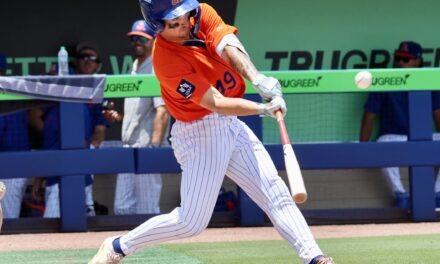
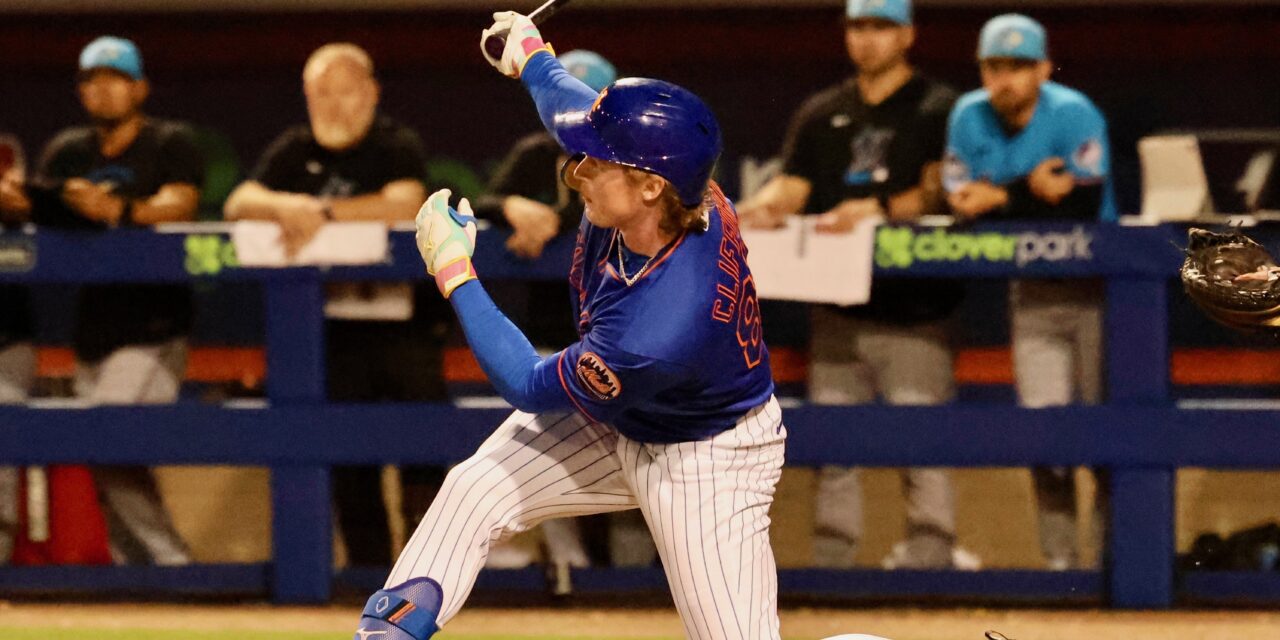
The other was Ryan Clifford. While he was generally considered the second of the two prospects in the trade, Clifford was still a big get for the Mets. He had his believers too, with some thinking he was a bigger get than Gilbert. While that was the minority opinion at the time, it was out there.
In a way, Clifford received one of the largest signing bonuses handed out to any prospect in history. The money just didn’t go to him. It’s not quite that simple — the Mets were already on the hook for Verlander’s full contract whether they liked it or not before they traded him — but the implication was that the Mets could have taken lesser prospects to shed more money. Instead, they chose to eat well over 50% of the remaining money owed to Verlander to get Gilbert and Clifford.
With Gilbert gone and nothing to show for him besides 27 and 1/3 innings of a reliever in a playoff-less season, the entire $35M investment essentially rides on Clifford.
Since joining the Mets, Clifford has been the prototypical three true outcomes player. He has prodigious power and has been one of the best home run hitters in the minor leagues whenever he wasn’t playing for the High-A Brooklyn Cyclones in the power-drain of an environment that is Maimonides Park. In 2025, Clifford’s 29 home runs ranked sixth across the entire minor leagues. In 2026, his 14 home runs through June 6 are tied for 13th.
He also has prodigious swing-and-miss issues. However, while the strikeout rate was still high in previous years, he had actually been making steady improvements. That is, until this season. After getting his strikeout rate all the way down to 25.6% in 2025, it’s ballooned to 35% in 2026. Therein lies the problem. A 35% strikeout rate in Triple-A is unsustainable for any level of consistent success at the big leagues.
Players can produce with a high strikeout rate. The top four qualified hitters in the big leagues this season — Oneil Cruz, Kyle Schwarber, Hunter Goodman and Munetaka Murakami — have all been productive despite the lofty strikeout rates.
That list is just the qualified hitters, though. When the minimum plate appearance mark is set to 50, the list grows substantially. Cruz drops all the way from first to 12th, and Murakami from fourth to 28th. Of the 24 new players between No. 1 and No. 28, just three have an OPS over .760: Joey Wiemer, Kerry Carpenter and Luke Raley. Even of those three, one of them is misleading. Wiemer’s numbers are inflated by a red-hot first nine games when he OPS’d 1.243 and only struck out 26.5% of the time. In his next 23 games, Wiemer is OPS’d just .687 and struck out 40.8% of the time.
Players can be productive with strikeout rates as high as Clifford’s, but it’s rare. And remember, this is his Triple-A strikeout rate. Pitchers are better in the big leagues.
Let’s dig deeper. Here are his contact rates, the backbone of strikeout rate.
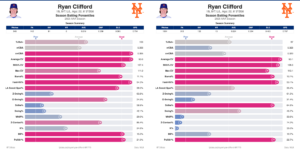
Ryan Clifford‘s Triple-A percentiles in 2025 (left) and 2026 (right). Image courtesy of Thomas Nestico @TJStats on X.
Overall, Clifford’s 2026 numbers look similar to his 2025 Triple-A numbers, but there are a few glaring issues. His chase rate is way up, and his in-zone contact rate is way down. Clifford is still patient — just in the wrong places. He’s swinging at pitches in the zone at a rate under the Triple-A average, but chasing at a rate above the Triple-A average. Previously, he was patient both ways. Now, he’s patient in the zone and aggressive out of the zone, not a good combination.
Then, when he does swing the bat at pitches in the zone, he’s not making contact. His in-zone contact rate is 74.2%, down over 10% from 2025. It cannot be understated how massive of a concern that is. Yes, similar to strikeout rate, there are a rare few who can survive with in-zone contact rates this low, but it’s generally not a recipe for success.
It has also impacted his ability to draw walks, going from one of the best hitters in Triple-A at doing so in 2025 to well below average in 2026. If Clifford is going to stick as a big leaguer, walks have to be a part of his game. Even if he gets the strikeout rate relatively under control, he’s always going to have his fair share of punchies. That has to be countered by a high walk rate.
There have been some improvements throughout the season. In his first 31 games, Clifford posted a .704 OPS with a 39.8% strikeout rate. In his next 28, he had a .832 OPs figure with a 30% strikeout rate. But it’s not enough.
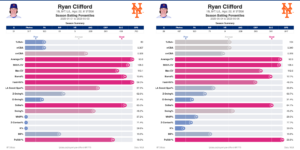
Ryan Clifford’s Triple-A percentiles in his first 31 games of 2026 (left) and next 28 games of 2026 (right). Image courtesy of Thomas Nestico @TJStats on X.
The chase rate is identical, the walk rate is virtually identical, and the in-zone contact is still a big step down from 2025. His surface numbers have improved, but the underlying data tells the story of a hitter who actually hasn’t changed much.
Even if we use his 77.7% in-zone contact rate in his last 28 to measure, it does not suggest he’ll be able to have success at the MLB level. There are 83 hitters in Triple-A with an in-zone contact rate of 77.7% or worse; a handful have spent time in the big leagues, and none of them came close to any form of sustained success this season. Matt Wallner, Nick Yorke, Esmerlyn Valdéz, Patrick Wisdom and Spencer Jones are a few of the big leaguers to run Triple-A contact rates in line with Clifford. None are productive, or frankly, close to it.
This is not a final indictment on Clifford. It’s early June; there is time for Clifford to turn it around. But it is important to note that — even with the surface numbers improving and the recent home runs lighting up your social media feeds — he is a different hitter than he was last year, and not in a good way. If he is going to have an impact at the MLB level in 2026, real change needs to occur. Improving the strikeout rate without truly improving the chase or contact rates isn’t enough.
The 2025 version of Clifford can be a productive big leaguer. He’ll have his flaws, but he can be a true power threat. The 2026 version of Clifford, to this point, cannot.