
FIP is not everything, but when a player has the tenth-highest gap between their ERA (3.21) and FIP (4.13), it is hard not to take notice. For Michael King, this is not a one-year issue. Year-over-year, he has out-performed his FIP, xFIP, xERA and SIERA, and by healthy margins. Entering his age-32 season, it is worth diving into what he does well and why he has out-performed to date, and how much we can trust him to continue to do so as he ages.
Why Has This Worked So Far?
Looking at King’s three years in San Diego, the one consistent factor is that he has excelled at limiting hard contact overall. One area of concern is that he is no longer elite at limiting barrels, so when hitters do make hard contact, it is more often at an optimal launch angle.
| Metric | 2024 | 2025 | 2026 |
|---|---|---|---|
| Avg EV Against | 85.7 mph (99th) | 87.8 mph (84th) | 87.0 mph (86th) |
| Hard-Hit Rate Against | 30.3% (97th) | 38.1% (68th) | 32.7% (89th) |
| Barrel Rate Against | 6.2% (79th) | 11.4% (7th) | 8.2% (37th) |
| GB Rate | 41.5% (46th) | 39.1% (34th) | 45.1% (66th) |
| Percentiles in parentheses; higher is better for the pitcher. Source: Baseball Savant. | |||
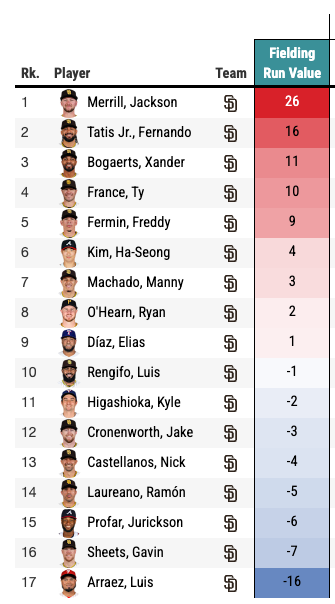
His ability to suppress hard contact has helped him continue to be productive even while he has seen his swing and miss and strikeout numbers decline while his walk rate has increased from 8.7% in 2024 to 9.2% in 2026. Additionally, he has been aided by playing in front of multiple plus-defenders over the years on both the infield and outfield, including Jackson Merrill, Fernando Tatis Jr., Ty France, Manny Machado and Ha-Seong Kim.
Baseball Savant
How is King Trending?
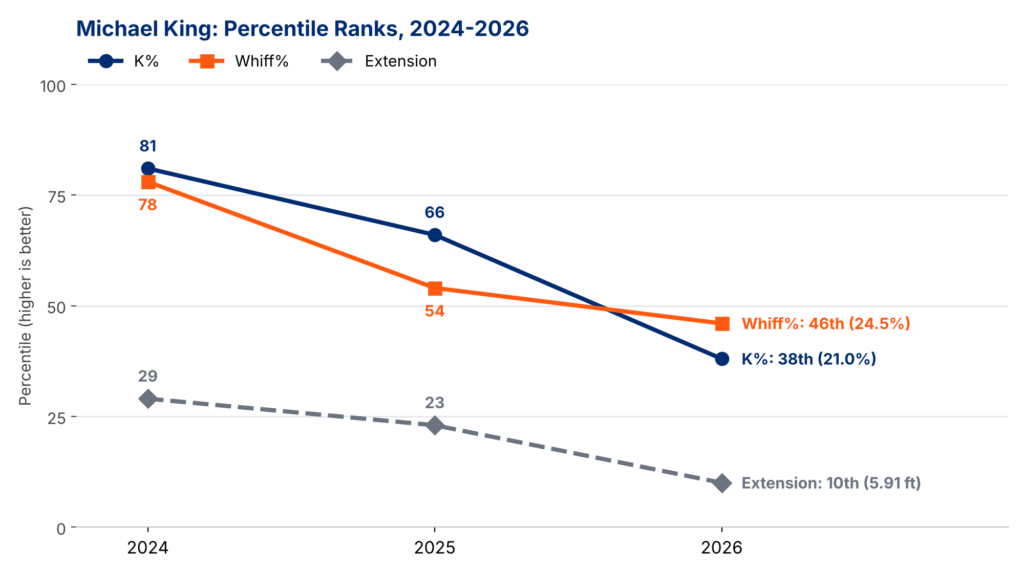
The answer, unfortunately, is that he is not trending in the right direction. While he has not lost velocity, his pitches across the board do not have the strong movement profile they had in his twenties. His changeup and sinker do not have the same horizontal break they used to, leading to less separation from his four-seam fastball. That could be part of why his fastball value has fallen, per Statcast, from +6 run value in 2024 to exactly 0 in 2026. He has also lost extension year-over-year, so while he has not technically lost velocity, his perceived velocity is lower.
All of this has helped contribute to a decline in swing and miss over the last two seasons with his strikeout rate falling to the 38th percentile. The less swing and miss King has, the more important his contact suppression is as he no longer can rely on strikeouts as a safeguard. It also means that the defense behind him becomes more important because he relies on them more.
What Can We Take Away From This?
As long as King’s stuff and command holds where it is at and he pitches on a team with both good infield and outfield defense, he should be able to continue to overperform his FIP. We could see some batted ball luck regression, but it would not be surprising to see him post better than the 4.07 ERA STEAMER projects or the 4.19 ERA OOPSY projects. It is also possible the regression does begin at his age-32 season and those projections end up being accurate.
Jeff Zimmerman of FanGraphs found that BABIP and BB% tend to begin to skyrocket around a pitcher’s age-32 season. For everything discussed above, that would be disastrous for King.
There is an argument to be made that because King was a reliever for much of his early career and has less mileage on his arm that his decline could come later. If true, maybe he has another two seasons or so left at this level before a sharp fall-off. It is also possible injuries have played a part in this data falling where it is and a potential bounce-back before final decline is possible.
Whatever the case, teams probably should not be lining up to give five- to six-year offers to King, instead trying to get him on a two-or three-year contract.