
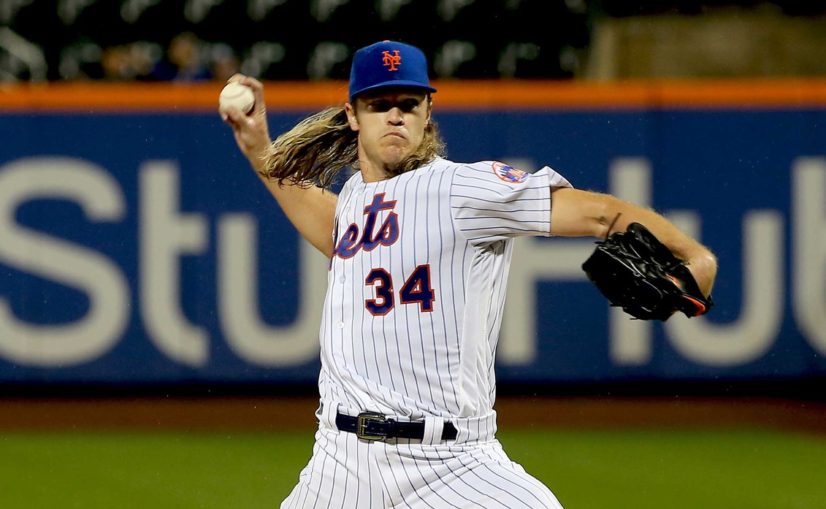
Heading into last night’s contest against the Atlanta Braves, Noah Syndergaard had a chance to become the first Met pitcher to win seven consecutive starts at home since Frank Viola pulled off such a stretch between the 1989-1990 seasons. As his start pressed forward and the rain continued to fall, Syndergaard seemed to be inching closer to the feat. By the time he had been lifted in the bottom of the sixth inning, he had been enjoying a cozy 3-0 lead. Naturally, the bullpen yielded seven runs over the next three innings as the Mets went on to drop the opener.
From the bullpen self-destructing to the revelation after the game that Syndergaard had been pitching through illness, pretty much everything that transpired after his six scoreless frames served to demonstrate just how impressive the righty truly was. He struck out five Braves hitters – all swinging, while allowing just three hits and two walks over 89 pitches (61 strikes). At 69% strikes, the righty posted his fourth-highest rate of the season, and a personal best dating back to his complete-game masterpiece in San Francisco.
The most inspiring aspect of Syndergaard’s evening was definitely his resilience. Between the slippery conditions that plagued him in the early going and the clear fatigue and stress his body was playing under on top of it, the righty made a case for himself as a strong-willed, resourceful pitcher that – despite the generally satisfying results – had been missing through most of the season.
After opening his night with a swift strikeout of Ronald Acuña and a weak popout off the bat of Ender Inciarte, Syndergaard allowed a double down the line from Freddie Freeman and lost Nick Markakis to an eight-pitch walk. And while he was able to extort another popup to short (this one from the red-hot Johan Camargo), Syndergaard ended his inning with a familiarly unsettling 24 pitches.
The combination of scoreless and seamless pitching didn’t seem meant to be, and whatever frustration followed the righty out of the first inning had a positive impact on his next inning of work. Syndergaard missed on the first pitch to three of the four batters he faced, with two even easing their way into 2-0 counts. Again, however, the Braves couldn’t capitalize. Kurt Suzuki had walked to lead off the inning, but Syndergaard managed to strand him to cap off a 16-pitch frame.
While Syndergaard only managed one strikeout over his next three innings of work, he also needed just 31 pitches, 17 between the fifth and sixth, and he didn’t walk a single batter. Granted, he allowed two hits, but quickly worked around them, inducing a double play on a crafty sinker to end the fourth and mixing things up to get flyouts from Freeman and Markakis in the sixth – both of which left Inciarte and his 28 stolen bases dead at first.
Whereas he had usually exploited a particular pitch to excise himself, Syndergaard instead dug deeper in last night’s start, dealing every hitter a different cocktail of changeups, sliders, and curveballs to contrast a more mortal 96 mph fastball and a mean sinker. And considering the circumstances, Syndergaard brought out a side to his game that deserved a 13th victory. Ironically enough, pitching with the moxie and fightback we’ve often seen from deGrom instead yielded an outcome that has typically targeted the ace himself.
“After the first, we didn’t know if we were going to be able to leave him out there,” Mickey Callaway said following the game. “He grinded through six innings and was done. He just didn’t have anything left. We sent him home, he was that sick… He was white as a ghost right there at the end… We have to give him credit for grinding through six innings and keeping us in the ballgame.”
Had it not been for the unspecified illness, there’s no doubt that the seventh inning would have gone to Syndergaard. He would have had the bottom third of the order to himself, and given the trajectory of his start prior to the team’s decision to pull him (and furthermore send him home to recuperate), it’s tough to imagine a situation where Atlanta would have knocked the righty clean out of the game. That sort of aura that has long followed Syndergaard’s reputation as a dominant starter-turned lethal once in a groove came back in full swing last night. It’s a shame we didn’t get to see how he would have fared at full health.