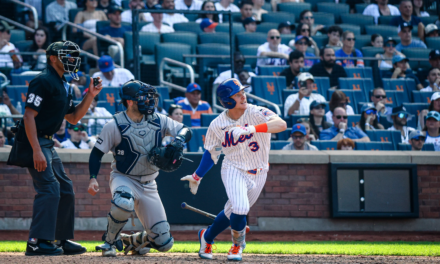

So who had Robinson Canó being the proud owner of a 1.074 OPS and 186 wRC+ halfway through the New York Mets’ shortened season on their 2020 bingo card? I sure didn’t, but I’m welcoming this development with open arms anyways.
It was encouraging to watch Canó get his 2020 campaign off to a hot start (.412/.462/.559 through 39 plate appearances). Once he hit the injured list, though, I was already mentally preparing myself for his production to come back down to a normal level upon his return.
Again, I was wrong and I’m happy about it. Through 103 plate appearances, Robbie is slashing .375/.408/.667 with seven home runs and 18 RBI. He’s leading the squad in a number of offensive categories, and his 1.3 fWAR is tied with Michael Conforto at the top for Mets position players.
This stretch of top-shelf production is the continuation of what he did during an abbreviated second half in 2019, too. However, it doesn’t make what he’s been able to maintain any less surprising. In a regular 162-game season, we’d certainly be questioning whether he could both sustain a version of his current performance and stay healthy for the long run.
But not this year — Canó has just four more weeks to build upon what he’s already done.
He’s Earning It
Whenever I see a player with a batting average this high past the first couple weeks of a season, the next thing I look at is what their BABIP is doing.
Not shockingly, Canó’s BABIP is rather high compared to his career norms. Prior to 2020, he owned a lifetime BABIP of .318 and his current season-long mark is much higher at .367. One would imagine the universe will correct itself at some point and that number will drop down to something we’re more used to seeing from the 37-year-old.
Even if that does happen at some point, he hasn’t lucked into this in the slightest. Entering Wednesday’s action, he owned a 47.6% hard-hit rate and a 29.3% line-drive rate, both of which are on track to be career highs for a single season. This rise in liners has come at the expense of his ground-ball rate, which has dropped from 48.9% in 2019 to 42.7% so far this year, which is on track to be his lowest ever.
Line drives obviously yield the highest offensive numbers in a typical circumstance, and that’s certainly the case here. After posting a 345 wRC+ on liners in 2019, that number was up at 448 before Wednesday’s game against the Baltimore Orioles. It’s also supported by a 62.5% hard-hit rate. Although that number is actually lower than what he did last season (64.6%) it’s not by much and it’s helpful to be creating that batted-ball event on a more frequent basis.

Swinging At Everything
Jeff McNeil has built a reputation on being aggressive in the batter’s box. Maybe Canó has taken a note or two from his teammate?
The second baseman has only seen his overall swing rate dip below 49.2% in a single season once since debuting in 2005 (it was 47.7% in 2018). That number crept back up to 53.4% in 2019 for New York, and it’s all the way up to 57.1% at the moment.
That’s among the top-10 highest in all of baseball, but don’t worry, McNeil is still outpacing him slightly with a 57.4% swing rate.
Even with this noticeable rise in swing rate, Canó isn’t striking out more. In fact, his current 10.7% strikeout rate is on track to be his lowest since 2014. His 40.6% chase rate has the potential to challenge his current high-water mark, as is his swing rate on strikes, which was sitting at 78.6% heading into Wednesday.
The obvious key here is that if you’re going to swing more often, you better make more contact. Canó’s contact rate outside the strike zone has stayed similar to last year, which is probably a good thing, and his contact rate within the zone has increased nearly five percentage points to 95.3%.
Swinging more often doesn’t always cure everything, but it’s helpful in certain situations — like this one.
A Shift in Pitch Mix
For the most part, Canó has seen certain pitches (sliders, cutters, curveballs) at virtually the same frequency as last year, but he’s seen fewer changeups and more fastballs. He’s taken advantage of that by posting a 256 wRC+ against four-seamers heading into Wednesday’s game, but I couldn’t take my eyes off the early results he’s had against breaking pitches.
The sample sizes are small, but check out how his OPS and wRC+ against sliders and curveballs have changed between 2019 and 2020.

Like, holy smokes, dude. Pretty much the opposite of what McNeil has been doing against those pitches thus far.
Given the above stats, it also shouldn’t be surprising that Canó owns a 58.3% line-drive rate against sliders. His fly-ball rate against curveballs is up at 60.0%, and nearly half (three, to be exact) of his homers have come off that offering.
Will the questions about his age stop heading into next year? No, definitely not, and even if Canó does keep some semblance of this pace up through the next four weeks, the next question will be what could he actually sustain for the long haul in a typical year.
Those will be questions for another day, though. Let’s just hope he stays hot down the stretch and others in the offense follow suit.