It was the ninth game of the 1970 season. The Mets and their fans, still on a high from the Miracle that took place in the fall of 1969 and were looking for more of the same in 1970. The season started with the club splitting their first eight games as they prepared for game number nine against the Philadelphia Phillies in front of 23,500 fans at Shea Stadium.
The day before, Tom Seaver blanked the Phils, scattering eight hits in a 6-0 Mets win. It was the sixth straight loss for the Phillies and first-year manager Frank Lucchesi had seen enough, calling a team meeting after the loss…it didn’t help.
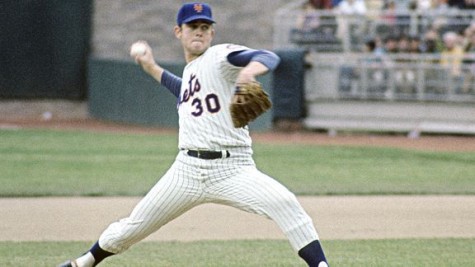
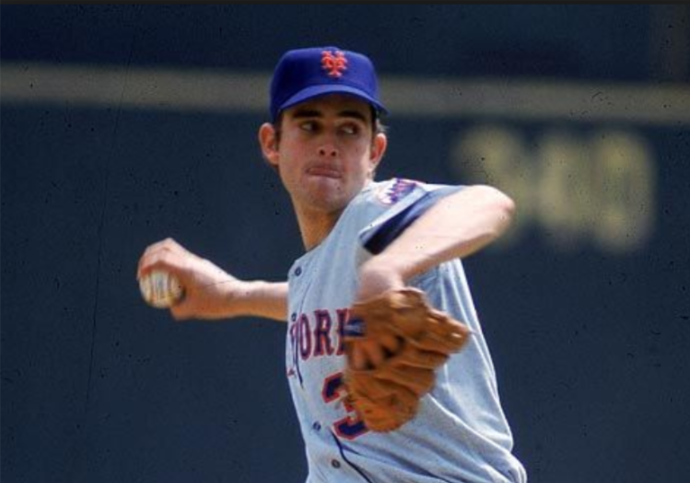
On the mound for the Mets was 23-year old flamethrower Nolan Ryan making his first start of the season. Ryan hadn’t pitched since April 2 in an exhibition game, and told reporters after that he felt “rusty” as he was warming up.
His rustiness showed some in the first as he loaded the bases allowing two walks and a single. The hit was by Phillies’ lead-off man Denny Doyle. Ryan would say later that, “I was trying to keep it outside, but it had part of the plate and he just reached out and stroked it.”
No one knew that Doyle’s hit would be the only one for the Phils in an otherwise stellar performance by the Mets righthander. In the complete game victory, Ryan struck out 15 to tie a then club record for K’s shared by Jerry Koosman.
That record would only last our days, however, though, as Tom Seaver mowed down 19 San Diego Padres in a brilliant two-hit performance on April 22.
Ryan’s wildness nearly cost him a chance for the complete game as he walked six through five innings to go along with (to that point) 11 K’s. Ryan had already tossed 107 pitches and the game was barely half over. After issuing two walks to begin the fifth, however, Ryan noticed that things begin to change. “I got my rhythm about the fifth inning,” he said, “and everything fit into place after that.”
He struck out the side in the sixth and faced the minimum nine batters in the final three frames to earn the victory. The one-hitter was the first of Ryan’s illustrious career, he would go on to record 11 more tying the great Bob Feller for most all-time.
The shutout was the first of 61 he would throw in a career that spanned four decades, making Nolan one of only 29 players in MLB history to accomplish that feat. His 5714 career strikeouts is an MLB record by a wide margin, as are his 2795 walks. His BA against of .204 is also a major league record.
Ryan was elected to the Hall of Fame in 1999. He became one of five pitchers in the Hall with more strike outs than innings pitched. Sandy Koufax, Trevor Hoffman, Pedro Martinez and Randy Johnson are the other four. Ryan had his number retired for three different teams, the Los Angeles Angels, Houston Astros and Texas Rangers.
Interestingly, with all his potential, Ryan had trouble breaking into the Mets rotation in 1969 along with parts of ’70 and ’71. He was mainly used as a spot starter and in relief.
He showed promise in the playoffs in 1969, pitching seven innings of relief in game three of the NLCS against the Atlanta Braves to get the win. It would take another 12 years for Ryan to earn his next playoff win.
Then, in the World Series, Ryan got the save in game three, pitching 2 1/3 effective innings in game 3 against the Baltimore Orioles. It was to be Ryan’a only appearance in a World Series in his entire career.

Ryan, who routinely tossed 100 MPH pitches, credits Tom Seaver with turning him from just a flamethrower to a pitcher. Unfortunately, Mets fans got to see very little of the new “pitcher” as on December 10, 1971, the 25-year-old Ryan was traded to the California Angels along with pitcher Don Rose, catcher Francisco Estrada, and outfielder Leroy Stanton for shortstop Jim Fregosi.
In five seasons with the Mets, Ryan appeared in 105 games with 74 starts. He had a 29–38 record, with a 3.58 ERA, 1.39 WHIP, with 344 walks and 493 strikeouts in 511 innings.A mediocre start for a player who turned out to be a legend.
But there was nothing mediocre on April 18, 1970 as Ryan and the Mets torched the Phils on a sunny afternoon. It may have been only one game, but it foreshadowed the brilliance of the man nicknamed The Ryan Express. It is certainly worth remembering this performance some 50 years ago if for nothing more than to witness the seeds that would turn into greatness.