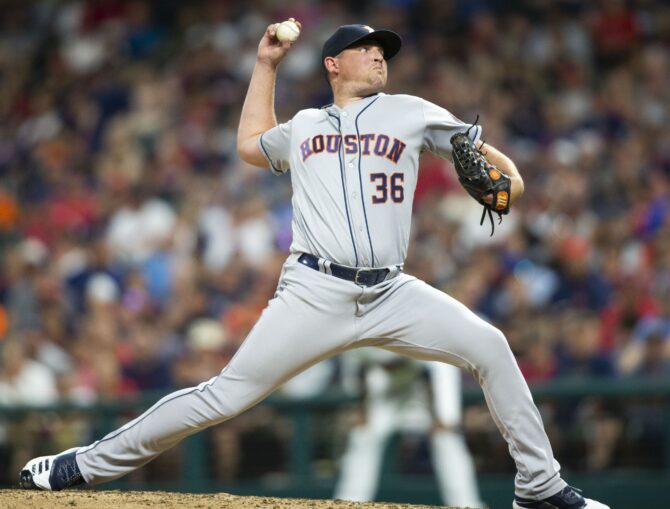
Will Harris
Position: RP
Bats/Throws: R/R
Age: August 28, 1984 (35)
Traditional Stats: 4-1, 1.50 ERA, 0.933 WHIP, 2.1 BB/9, 9.3 K/9
Advanced Stats: 2.1 bWAR, 1.1 fWAR, 309 ERA+, 3.15 FIP
Drafted in the ninth round by the Colorado Rockies in 2006, Will Harris did not make his big league debut until the age of 27. In 2012, Harris made 20 appearances as a rookie with the Rockies, but did not fare well pitching at Coors Field. He pitched to a 8.15 ERA in 17 2/3 innings, landing himself on waivers after the season.
Harris was ultimately claimed by the Arizona Diamondbacks, where he finally began to find some success at the big league level. In his first season with Arizona, Harris produced a 2.91 ERA with 53 strikeouts in 52 2/3 innings pitched. He then appeared to regress in his following year with the Diamondbacks, pitching to 4.34 ERA and was placed back on waivers after the season. That is when he was claimed by the Houston Astros, which changed the direction of his career.
Since becoming part of the Astros bullpen in 2015, Harris has been one of the most reliable relievers in the baseball. In five seasons with the Astros, Harris has pitched to a stellar 2.36 ERA, with 315 strikeouts in 297 innings pitched. What has made Harris so successful in Houston is his ability to keep the ball in the yard. Since becoming an Astro, the right-hander is yielding less than a home run per nine innings (0.8 HR/9).
In 2019, Harris posted some of the best numbers of his career.The 35-year-old dominated with a career best 1.50 ERA, while also producing a 0.93 WHIP – the second-best mark of his career. Harris was also part of a combined no-hitter, pitching the seventh inning after Aaron Sanchez threw six innings to start the game. Then at the end of the season, Harris threw an immaculate inning against the Los Angeles Angels, striking out the side in just nine pitches.
While Harris doesn’t rely on velocity for outs, he succeeds because of the great movement on his pitches. Almost exclusively using a two-pitch arsenal, with his cutter and curveball, Smith only threw his fastball 1.1% of the time this year. Smith’s 91 mph cutter is his primary pitch, which he contrasts with a curveball that hovers at 81 mph with extreme movement. The spin rate on his curve was in the 87th percentile this year, with statcast measuring both the average horizontal and vertical movement at over four inches per pitch. As long as that curveball remains a plus-pitch, Harris may continue to get hitters out in this league for a long time.
Contract
Harris is entering free agency at 35-years-old and has only made just north of $11.6 million in his career. Harris is likely looking to match that mark over the next couple of years, as he tries to secure one significant contract before retirement.
The biggest question is going to be how much money are teams willing to pay a reliever that is on the wrong side of 30? Last year the Mets signed Justin Wilson to a two-year, $10 million contract, which might be the neighborhood of Harris’ deal. There is a chance that a team overpays Harris based on his great ERA, but it is more likely that he lands a deal in the $5 to $7 million range on a two or three year commitment.
Recommendation
The real question when it comes to the Mets signing Harris is what does the free agent budget look like for Brodie Van Wagenen? With a payroll that could be pushing $165 million after arbitration, New York is going to have to be careful about how they spend their money this offseason.
A pitcher of Harris’ caliber is really intriguing, but there is something about a 35-year-old getting his first payday with the Mets that is concerning. Harris has also spent the last five years of his career pitching for one of the top analytically-driven organizations in the sport, as the Astros have routinely gotten more out of their pitchers than we have seen elsewhere. With that being said, the chances of regression are significant.
If the price is right, Harris could prove to be a great asset in the Mets bullpen. On the other hand, the risk of regression may be too steep, especially when the Mets can’t afford to miss on any of their relief acquisitions this offseason. New York would probably be better served exploring other options before trying to attain Harris’ services.
By Ryan Finkelstein