By Matt Musico
While Mickey Callaway will no longer be managing the New York Mets, he left his post after watching his starting rotation compile the third-highest fWAR in baseball for the second straight year (18.0 in 2018, 19.7 in 2019).
When going through this same exercise last year, the noticeable trend among all the Mets’ starters was that each of them produced their best start of 2018 in September. This year, though, it’s a little more varied.
Prior to Zack Wheeler hitting free agency following the conclusion of the World Series, New York’s rotation includes the following hurlers:
- Jacob deGrom
- Noah Syndergaard
- Zack Wheeler
- Marcus Stroman
- Steven Matz
Obviously, Brodie Van Wagenen and his front office will need to find a solution for Wheeler’s spot if the right-hander doesn’t re-sign. The solution could potentially be filled internally with Seth Lugo (although that’d create another issue in the bullpen). It could also be filled externally by signing another free agent, or by swinging a trade (Gerrit Cole would be nice, right? Shh, just let me dream).
Below are the best single-game performances for New York’s rotation in 2019, with FanGraphs’ Game Score v2.0 being the determining factor.
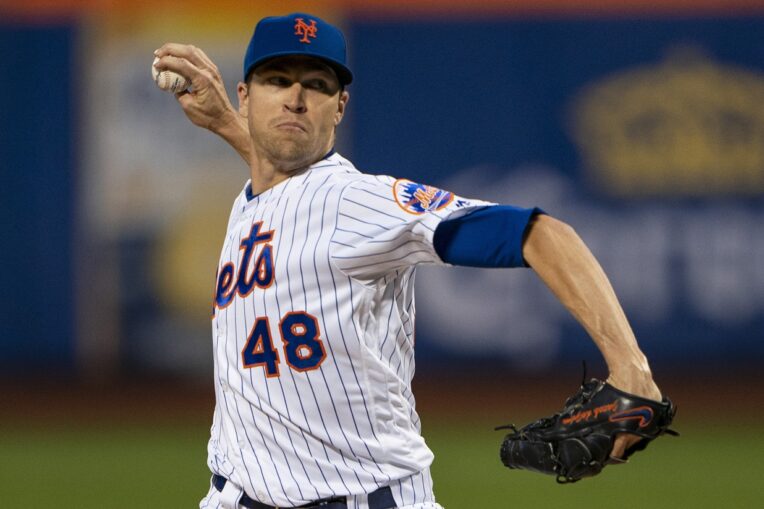
Jacob deGrom, April 3rd vs. Miami Marlins
The Game Score: 88
The Line: 7 innings, 0 runs allowed, 3 hits, 1 walk, 14 strikeouts
More Stats: This was deGrom’s second start of the season, and while his first one was spectacular (six shutout innings while allowing five hits, one walk, and 10 strikeouts), this one was obviously a cut above that. This effort allowed the right-hander to tie Bob Gibson’s record for consecutive quality starts, and he also added to it by slugging a home run at the plate.
He went from one extreme to the other in his next start because after dominating the Marlins, deGrom produced a Game Score of 13 just six days later against the Minnesota Twins, which also ended his streak of 26 consecutive quality starts. He struggled in his final two April starts before turning things around and performing like the Cy Young award winner that he is for the remainder of 2019. DeGrom produced seven Game Scores of at least 80 this year, with six of them coming in the second half and three occurring in September.
The Highlights:
Noah Syndergaard, May 2nd vs. Cincinnati Reds
The Game Score: 94
The Line: 9 innings, 0 runs allowed, 4 hits, 1 walk, 10 strikeouts
More Stats: Similar to his rotation mate, Syndergaard also added a dinger in his best start of 2019. This particular performance was a welcome sight for obvious reasons, but also because the starts that came before this one weren’t great. The right-hander toed the slab six times before registering this complete-game effort. In those starts, he pitched past the sixth inning once and allowed fewer than four runs once. Cumulatively speaking, he owned an uncharacteristic 6.35 ERA throughout his first 34 innings before seemingly turning things around against the Reds.
This marked the start of a very good three-month stretch for Syndergaard, as he put together a 3.33 ERA over 100 innings between May and July before watching that number jump up to 4.66 during his final 63.2 frames in August and September.
The Highlights:
Zack Wheeler, April 23rd vs. Philadelphia Phillies
The Game Score: 83
The Line: 7 innings, 0 runs allowed, 5 hits, 0 walks, 11 strikeouts
More Stats: In what appears to be a requirement for this exercise, Wheeler joins deGrom and Syndergaard by both hitting a homer and striking out 10-plus hitters in his best start of 2019. He controlled the quality of contact and type of contact made throughout this start. While Phillies hitters produced just a 14.3% soft-hit rate, they couldn’t make real solid contact (21.4% hard-hit rate). When combining that with a 57.1% ground-ball rate and a 33.3% infield-fly rate, it’s not hard to see how Wheeler dominated.
From the standpoint of ERA, Wheeler wasn’t really able to kick it into high gear until August. Through the end of July, he owned a 4.71 ERA through 124.1 innings. His final 71 frames where much more fruitful by the look of his 2.66 ERA, which was just in time for his impending trip to the open market.
The Highlights:
Marcus Stroman, September 17th vs. Colorado Rockies
The Game Score: 79
The Line: 7 innings, 0 runs allowed, 4 hits, 1 walk, 7 strikeouts
More Stats: Since Stroman didn’t arrive in New York until the trade deadline, we only looked at his starts with the Mets for the purpose of this exercise. This particular start still ended up being tied for his second-best outing of the year when looking at his total body of work. Coors Field typically isn’t the go-to place for a pitcher to experience a huge performance, but that’s exactly what happened for Stroman. He took advantage of a Rockies team that mustered just a 97 wRC+ at home in 2019.
What’s interesting here is that the right-hander only induced ground balls at a 37.5% rate during this outing, and mostly skirted any damage despite also watching Colorado hitters produce a 43.8% fly-ball rate, 0.0% infield-fly rate, 6.3% soft-hit rate, and 43.8% hard-hit rate.
The Highlights:
Steven Matz, July 27th vs. Pittsburgh Pirates
The Game Score: 91
The Line: 9 innings, 0 runs allowed, 5 hits, 0 walks, 7 strikeouts
More Stats: Matz went hitless during this start but at least made up for it by registering his first career complete game, right? There was really no contest as to what the southpaw’s most impressive performance was from 2019. This was his only complete-game effort, and the next-closest start of his from a Game Score perspective was 72, which happened on August 14th.
This outing served as the exclamation point for Matz’s best month of the year. Through 20 innings in July, the lefty twirled a 1.80 ERA and .256 wOBA allowed with a 19.0% strikeout rate, 2.5% walk rate, and 0.45 homers allowed per nine innings. Coincidentally enough, that all happened following his worst month of the year. In June, he struggled to a 7.36 ERA and .386 wOBA allowed in 29.1 innings, which also included 19.4% strikeout rate, 9.4% walk rate, and 2.45 homers allowed per nine innings.
Baseball, man.
The Highlights: