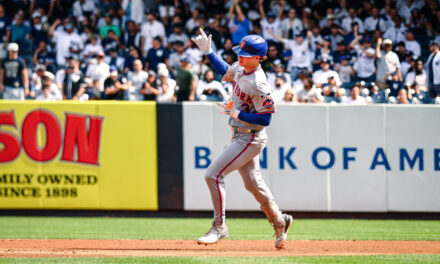
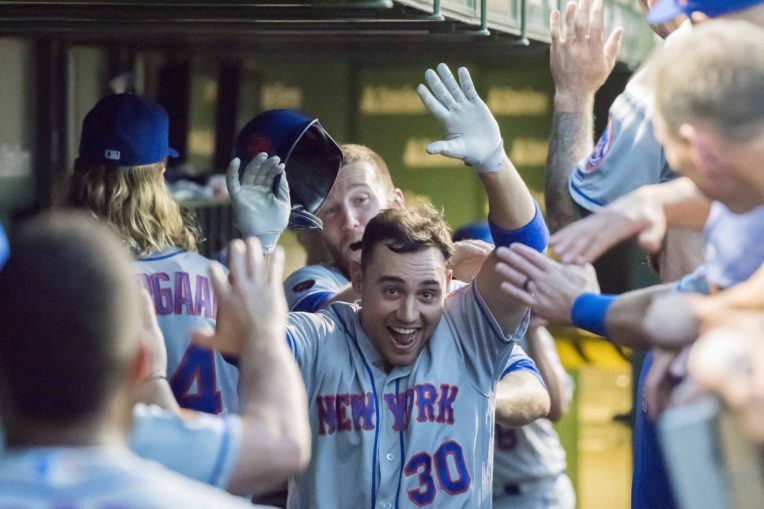

It’s safe to say that New York Mets outfielder Michael Conforto has saved his 2018 season thanks to what he’s done since the All-Star break.
Heading into the midsummer classic, the 25-year-old was simply an average big-league hitter according to wRC+ (100), which was mostly engineered by a 15.3% walk rate. His .216/.344/.366 triple slash was disappointing for someone who was expected to be a key offensive cog, as was his 11 homers, 30 RBI, and .150 ISO in 346 plate appearances (he had 14 homers and 41 RBI in the first half of 2017, but paired that with a .258 ISO and 149 wRC+).
The tide has obviously turned during the second half, which is pretty easy to see in the numbers — through just 237 plate appearances, Conforto owns a .278/.346/.547 triple slash with 15 homers and 45 RBI, which is good for a 141 wRC+. More than doubling one’s homer and RBI production in about 100 fewer plate appearances is a noteworthy accomplishment. It’d also be natural to assume that he’s likely hitting more fly balls in the second half than he did in the first half.
He’s not, though. After posting a 37.9% fly-ball rate prior to the All-Star break, it’s dropped to 33.3% so far in the second half. Despite that, his homer-to-fly-ball rate has more than doubled (14.3% to 29.4%). So what gives? The proof lies in his batted-ball profile, which shows noticeable improvements in a number of categories, like line-drive rate (LD%), infield-fly rate (IFFB%), soft-hit rate (Soft%), and hard-hit rate (Hard%).
| 2018 | PA | LD% | GB% | FB% | IFFB% | Soft% | Hard% |
|---|---|---|---|---|---|---|---|
| First Half | 346 | 18.7% | 43.3% | 37.9% | 11.7% | 18.2% | 33.5% |
| Second Half | 237 | 23.5% | 43.1% | 33.3% | 3.9% | 14.4% | 40.5% |
This is good to see in its own right, but it’s even better when realizing those second-half numbers get much closer to resembling his All-Star production from 2017, when his homer-to-fly-ball rate was a career-high 27.3%. When a hitter like Conforto puts balls in the air at this low of a rate, it’s important to maximize the ones that do get up there (like how J.D. Martinez has slugged 40-plus dingers with a fly-ball rate below 35.0%).
And although Conforto’s plate-discipline numbers haven’t changed much from one half to the next, the situation in which he’s making contact definitely is.
The young outfielder’s overall contact rate has barely shifted (73.6% in the first half, 74.3% in the second), but check out his contact rate on balls outside the strike zone (O-Contact%) and inside the strike zone (Z-Contact%)
| 2018 | PA | O-Contact% | Z-Contact% |
|---|---|---|---|
| First Half | 346 | 60.3% | 81.5% |
| Second Half | 237 | 52.9% | 87.1% |
Those improvements in hard-hit and soft-hit rate suddenly don’t look nearly as surprising. After all, it’s typically easier to make hard contact on balls that are in the strike zone. This improved production is a welcome sight for a number of reasons — outside of the obvious ones, of course.
Following that terrible injury he suffered last August, it finally looks like he’s past it and is back to his normal self. Without Yoenis Cespedes at least out for a significant chunk of 2019, Conforto and Brandon Nimmo have emerged enough to at least be two solid offensive weapons in the Mets’ outfield.
The second half has been filled with some impressive performances at the plate for New York, with Nimmo, Conforto, Jeff McNeil, and Amed Rosario leading the way. Assuming these four stick as potential answers for a 2019 club that’d like to contend for a playoff spot, Conforto is the clear power bat in this group.
Nimmo does have a chance at slugging 20-plus homers this year (while more than doubling his career total entering the year), but with an on-base percentage that ranks among the best in baseball, one of his greatest skills is consistently clogging the base paths. Conforto, on the other hand, is that middle-of-the-order thump the Mets really need — since the start of 2017, nobody has hit more homers for the Mets than Conforto’s 53, and it’s not particularly close.
There have been — and should be — plenty of caveats when talking about New York’s potential of competing next year. The roster needs plenty of help this winter, but they’ll also need their young players to perform up to expectation. Now that Conforto has worked out his kinks and looks fully healthy again, let’s hope he can carry this second-half momentum into a full season’s worth of plate appearances next year.