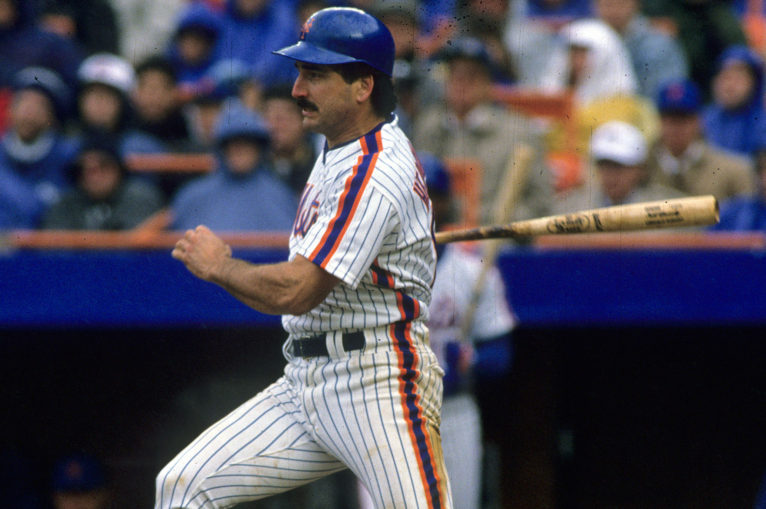
With a steady stream of talent bubbling through the New York Mets’ farm system in the early 1980s, general manager Frank Cashen had plenty of options on how to proceed.
Young stars Darryl Strawberry (drafted first overall in 1980) and Dwight Gooden (fifth overall, 1982) were making their way through the pipeline, and cornerstone hopefuls Mookie Wilson and Hubie Brooks were entrenching themselves in Flushing after making their respective debuts in 1981.
Former Mets slugger Dave Kingman returned for his second tour of duty in Queens in 1981 and Cashen acquired 1977 NL MVP George Foster the following season, but the results weren’t quite what Mets brass was hoping for.
With a potential championship core nearly ready to be fully unveiled at the major league level, New York needed something more than a solid bat or a former All-Star to fill out their roster. They needed veteran leadership, as well.
Keith Hernandez was an undisputed talent for St. Louis, sharing the 1979 NL MVP with Pittsburgh’s Willie Stargell and winning a World Series with the Cardinals in 1982.
Despite elite production during his time in the Gateway, Cards manager Whitey Herzog had grown weary of the situation, referring to Hernandez as a “cancer on his team” (You’re Missing A Great Game, Jonathan Pitts, 1999) and holding strong suspicions regarding his star player’s recreational drug use — later confirmed by Hernandez’s inclusion in the Pittsburgh drug trials of 1985.
When Cashen and the Mets came calling for Hernandez’s services in June 1983, needless to say, it didn’t take much for St. Louis to part with their star first baseman. Hindsight would prove the Cardinals’ decision as hasty and overwhelmingly incorrect.
In one of the more one-sided deals in league history, on June 15, the Mets sent pitchers Neil Allen and Rick Ownbey to the Cardinals for the player who would become the catalyst of New York’s jarring turnaround.
Hernandez performed well over the final months of the 1983 season (.303/.424/.434, 16.5% walk rate, 143 wRC+) and the Mets showed an incremental improvement, playing to a 38-44 record over the second half of the season (30-50 in the first half).
Initially, adding Hernandez seemed to be a solid, exciting move for the young Metsies despite the risks. After a couple of seasons and some additional, extremely efficient roster tinkering via Cashen & Co., it had become crystal clear that New York had fleeced St. Louis and they began reaping the benefits.
In 1984, the Mets won 90 games, finishing six games behind the eventual NL champion Chicago Cubs in the NL East. That didn’t take long, huh?
By 1985, powered by the acquisition of Gary Carter from the Expos and rapid development from youngsters Wally Backman, Lenny Dykstra, Ron Darling, and Sid Fernandez, New York emerged as a powerhouse, winning 98 games and falling just short of Hernandez’s former mates in St. Louis in the East (three games shy).
Over the course of the 1984 and 1985 seasons, Hernandez absolutely raked, hitting .310/.397/.439 with an 11.1% strikeout rate (8.7 percent in 1985), a 13.0% walk rate, 170 runs scored, 185 RBIs, and a 138 wRC+.
In addition to his exploits at the plate, Hernandez continued to expand his impressive collection of Gold Glove Awards for his pristine play at first base, earning his seventh and eighth consecutive honors at the position in 1984 and 1985 (the streak would continue through 1988).
As manager Davey Johnson proclaimed in Spring Training of that season, the Mets would dominate in 1986, winning 108 regular season games en route to the franchise’s first NL East title since 1973 and their first World Series championship since 1969.
Naturally, Hernandez’s contributions were invaluable. A .310/.413/.446 line at the plate with 34 doubles, 94 walks, 69 strikeouts, a 146 wRC+, and 5.8 wins above replacement (FanGraphs) – his most since his co-MVP season of 1979 (7.4 fWAR) – would set the pace for the Metsies’ offense.
And with boatloads of talent in Strawberry, Carter, Dykstra, Wilson, Backman, and Kevin Mitchell, among others (such incredible depth; we see you, Danny Heep) around him in the lineup, no one was saddled with any extra pressure. Everyone did their jobs and good things happened.
The young guys needed to see how an elite, championship-level player went about his business and the investment paid off handsomely. The repercussions of that exposure were instrumental in the Mets’ return to prominence in the 1980s and Cashen’s construction of that team has become the benchmark of building a winner in Flushing.
Although New York only secured one championship during that run – their 100-win season in 1988 was stopped short by Los Angeles in the NLCS – the legend of that team’s greatness still reverberates today, unfulfilled potential be damned.
And, in this writer’s opinion – and many others’ – it all began with the addition of Keith Hernandez.