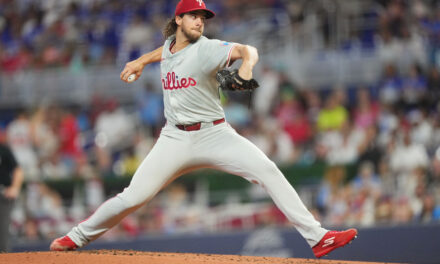
With the 27th overall pick in the draft the New York Mets have selected Carson Wiggins out of University of Arkansas. He is the younger brother of Cubs prospect Jaxon Wiggins. Wiggins has a low effort delivery from his 6′ 5″ frame and when healthy has plus velocity and plus spin.
Wiggins was ranked 88 on Pipeline, 104 on Baseball America, and was unranked on Baseball Prospectus.
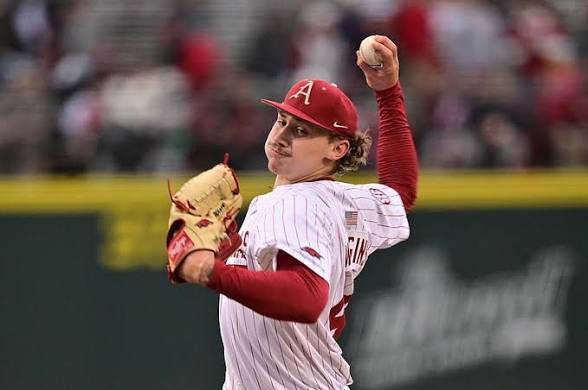
He is expected to sign under slot meaning the remainder of the draft they should have plenty of money to go over slot throughout the draft. Some expectations like Best of Arkansas Sports have him signing around at the bottom of the slot allowance (75%) which would be roughly $2.6 million which would allow the Mets to spend that $900,000 on the remainder of the draft.
Wiggins is a difficult pitcher to truly evaluate because he is still returning from tommy john surgery in May of 2025 and was not throwing at full strength at the combine. He did hit 97 miles per hour at the combine. In May of 2026 his college coach Dave Van Horn said to HogSports, “Carson has been to the doctor and he’s 100% healthy, but as of right now, they’re not going to let him pitch. That’s all I’m going to say. I’m not real happy about it.”
If Wiggins is completely healthy he should be able to pitch as normal with the Mets and should not be delayed. MMO previously posted about how the Mets would need to be creative and follow different strategies and this is what getting creative looks like.
Arsenal
Fastball – 70 on Baseball America, 80 on MLB Pipeline
Before his injury Wiggins was touching 102 miles per hour on his fastball. Since the injury he has yet to throw at full strength and has topped out at 97 miles per hour. In his short college stint before his injury he averaged 98.7 miles per hour. His success will largely depend on that fastball returning to its full velocity.
Slider – 60 on Baseball America, 70 on MLB Pipeline
He throws a high spin, upper 80s slider, something the Mets have targeted in the past, and it has the potential to be a true wipeout pitch. It pairs well with his fastball and is a strong swing and miss pitch for batters who sit on his fastball. He exceeded 2,500 rpm in high school on this pitch.
Curveball – 55 on Baseball America, NR on Pipeline
Wiggins has a top down curveball that Baseball America described as a “power curve” and he throws it in the mid 80s. He hit 2,719 rpm of spin in the combine.
Changeup – 40 on Baseball America, NR on Pipeline
He has played around with a changeup which came in the mid 80s with interesting tumble but it is not something he focused heavily on. He has paired it with a splitter which he also threw infrequently.
Control – 40 on Baseball America, 45 on MLB Pipeline
Wiggins ran a high walk rate in his short college stint and will need to throw more strikes if he wants to be a major league starter. He can command his fastball and slider to land in the zone but will need to better command his other secondaries. His command has also been described at times as “erratic”.
Conclusion
The Mets got creative and went for upside while also going with a player fully expected to sign under slot. It is interesting that they went with a player who went to the combine because that means they are locked into signing him at nothing less than 75% of value. Coming off Tommy John surgery there are also big concerns the velocity could not fully return, and the injury also raises his reliever risk. That said, you would expect the Mets have access to his medicals and have weighed all of these concerns with this selection. But you also can look at other names who went after Wiggins that are expected to sign under slot and have big upside and wonder what they are seeing with Wiggins that public outlets like Baseball Prospectus, Baseball America, and MLB Pipeline aren’t seeing.
On the more positive side, if he returns from injury the same as before, the upside is very much there. He is a hard throwing draft eligible sophomore that could move very quickly through the Mets system and his feel for spin is something the organization has had success with (looking at you Nolan McLean). Few pitchers have thrown 100 miles per hour on a consistent basis have not had success in the majors to some degree. While he does have reliever risk you would expect his arsenal, if it looks the same after surgery would be among the better relief arms.
In general, this pick brings up more questions about the Mets strategies than answers. They are not getting a massive savings from this pick – even the maximum amount is under $1 million. They do not have a second round pick and their picks in each round are in the middle, not the beginning so they are not in the best position to maximize these savings. It is impossible to know who will be available in the third round unless they have promised someone to go very over slot to try to float them down.
All of this points to the idea that the Mets must have really liked what they saw from Wiggins to take him over names like Tegan Kuhns or Taylor Rabe who were selected after Wiggins. Whether this year or next, when we see Wiggins pitch and see his velocity and spin rate, we will have a much clearer idea of what the Mets saw. And a few hours after this pick was made we will see what the Mets do with their third round pick (if they have not already done so by the time you read this).