Mandatory Credit: Brad Penner-USA TODAY Sports
The New York Mets’ first year under owner Steve Cohen didn’t go how anyone would’ve liked, and that’s just considering what happened on the field.
Let’s not forget that things did look promising at the All-Star break. Manager Luis Rojas watched his squad endure injury after injury, and while they could’ve pulled away, New York still owned a 48-40 record and was a first-place club. We all know what happened from there as they took a second-half nosedive en route to a 77-85 final record.
We continue to wonder who the Mets will bring in to lead the front office — most likely as the next general manager — but it certainly seems as if the organization’s goal for this winter is clear:
Great exchange noted by @TimBritton from the recent Sandy Alderson presser:
For you and your eventual GM, what sort of flexibility is there for you payroll-wise this offseason?
Alderson: There’s flexibility.
What kind?
Alderson: Lots.
— Mike Mayer (@mikemayer22) November 11, 2021
That answer from Sandy Alderson is obviously vague, but with baseball’s richest owner residing in Queens, we can feel reassured that this comment isn’t just smoke and mirrors. No action has been taken yet, but we’ve already seen reports of the Mets scouting Justin Verlander at his recent workout. We also know they recently met with Javier Báez‘s camp and talked to Scott Boras about free-agent Kris Bryant.
Actions speak louder than words, but this feels like a good barometer with regard to how serious the Mets are about this. That’d make sense, especially since Cohen wants to win reasonably quickly, as well as sustain that success on a yearly basis. Outside of seemingly having to spend a bunch of money to improve this roster for 2022, New York will also have to make a significant jump in the win-loss column.
With that in mind, I was curious about a couple of things. First, I wanted to know what the biggest one-year turnaround was. Second, I wanted to know how many times the Mets improved by more than 10 wins from the year prior.
Making Arbitrary Eliminations
Of course, while making significant strides in overall record is never a bad thing, they’re not necessarily all created equal. The first thing I did was eliminate the significant improvements that were either a result of a strike-shortened season or if that improvement still ended with a losing record.
So, yes — while it was great that the 1963 Mets improved by 11 games, it wasn’t necessarily impressive or awe-inspiring when one saw they finished with a 51-111 record. The same can be said about the 1966 club, which improved by 15 wins from ’65, but still finished 66-95, as well as the ’68 squad (73-89, 12-win improvement, which ultimately proved to be a springboard to the Miracle Mets).
The 1982 and 1995 seasons (improvements of 24 and 14 wins, respectively) were also tossed out because they were each impacted by work stoppages. Last, but most certainly not least, anything involving 2020’s 60-game schedule didn’t qualify.
Now that we’ve trimmed the fat, let’s look at the improvements that have mattered the most in franchise history.
Miracle Mets Reign Supreme
The Mets accomplished quite a bit in 1969, and winning the first World Series in franchise history was just one of them.
Not only did New York finish with a winning record for the first time, but they also eclipsed the century mark for good measure by going 100-62. The 27-win improvement from that 1968 team mentioned above is still the greatest one-year turnaround the organization has ever seen. Putting it further in perspective, New York enjoyed the greatest three-year progression in its history between 1967 and 1969.
In 1967, they were still perennial losers with a 61-101 record. Just two years later, they essentially turned that record around, enjoying a 39-win improvement on their way to October glory. This may have been the biggest and most impactful turnaround the Mets have seen to date, but there are a number of others that have happened at crucial points in time.
Finding a Pattern in Other Occurences
There have been seven other instances in which the Mets enjoyed a double-digit win increase from the season before that ended with a record above .500. Here they are:
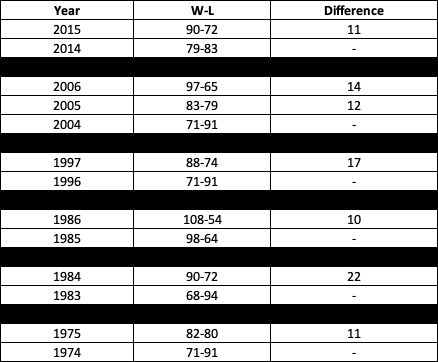
Outside of the improvement between 1974 and 1975, every other one listed above either immediately resulted in a postseason trip, or it eventually happened because of it. That 1983 season was tough on the results, but it started laying the groundwork for New York’s eventual success. Darryl Strawberry debuted, the Mets traded for Keith Hernandez, and Dwight Gooden joined them the following year as the dark days of the late ’70s and early ’80s began to feel like a distant memory. That improvement from ’83 to ’84 is the only other time in Mets history where they’ve improved by 20-plus wins from one year to the next.
We can see the patterns in the rest of these occasions, too. The ’85 to ’86 progression got them over the hump and into the playoffs. They didn’t qualify for October in 1997, but it was the beginning of another successful time in franchise history. The same could be said for the 2005 club, as first-year manager Willie Randolph attempted to change the culture in the clubhouse after a number of tough years. And of course, we can’t forget the progression from 2014 to 2015 as the Mets captured their fifth National League pennant.
Outside of New York’s appearance in the 1973 playoffs, every other trip to October has been accompanied by a drastic increase in overall performance by New York. If Cohen greenlights the Mets to spend as much as it seems this winter, maybe another one of these significant improvements is on the immediate horizon for the organization.
Time is of the essence, and as Alderson said at the GM meetings recently, there is no rebuilding in New York. So, the Mets will look to load up and hope for the type of improvement that has typically come right before more significant success in past years. From there, it’ll be up to the new regime to sustain those winning ways instead of watching a once-in-a-decade cycle continue.