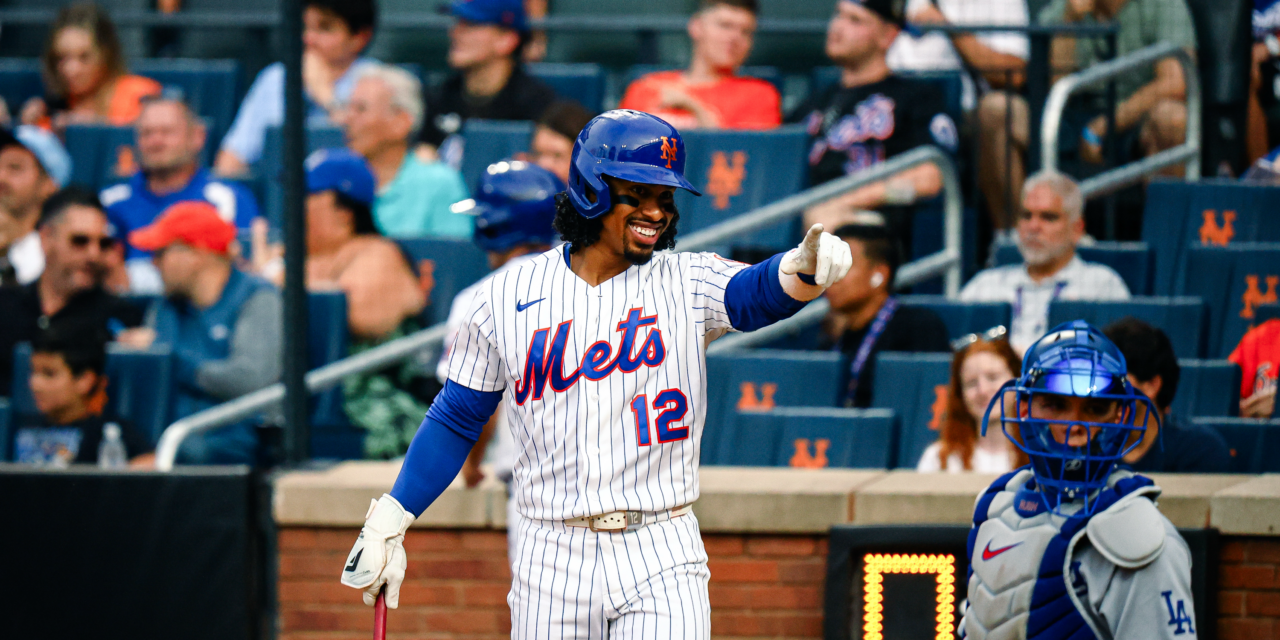
Francisco Lindor has not had his finest season defensively.
He entered Friday with a -3 DRS, -1 OAA and a career-worst .963 fielding percentage. He made another error — his ninth — in Friday’s game against the Nationals, leading to an unearned run that put the Mets in a 1-0 hole.
It was his own homer that tied it. The Mets eventually won, 4-1.
Despite Lindor fading defensively, his offense has continued to trend upward after a slow start. That’s often the way Lindor’s seasons at the plate have gone: a rough start followed by a meteoric ascension. This season, Lindor has lessened some of the blow from his defensive performance by getting it going with the bat as of late.
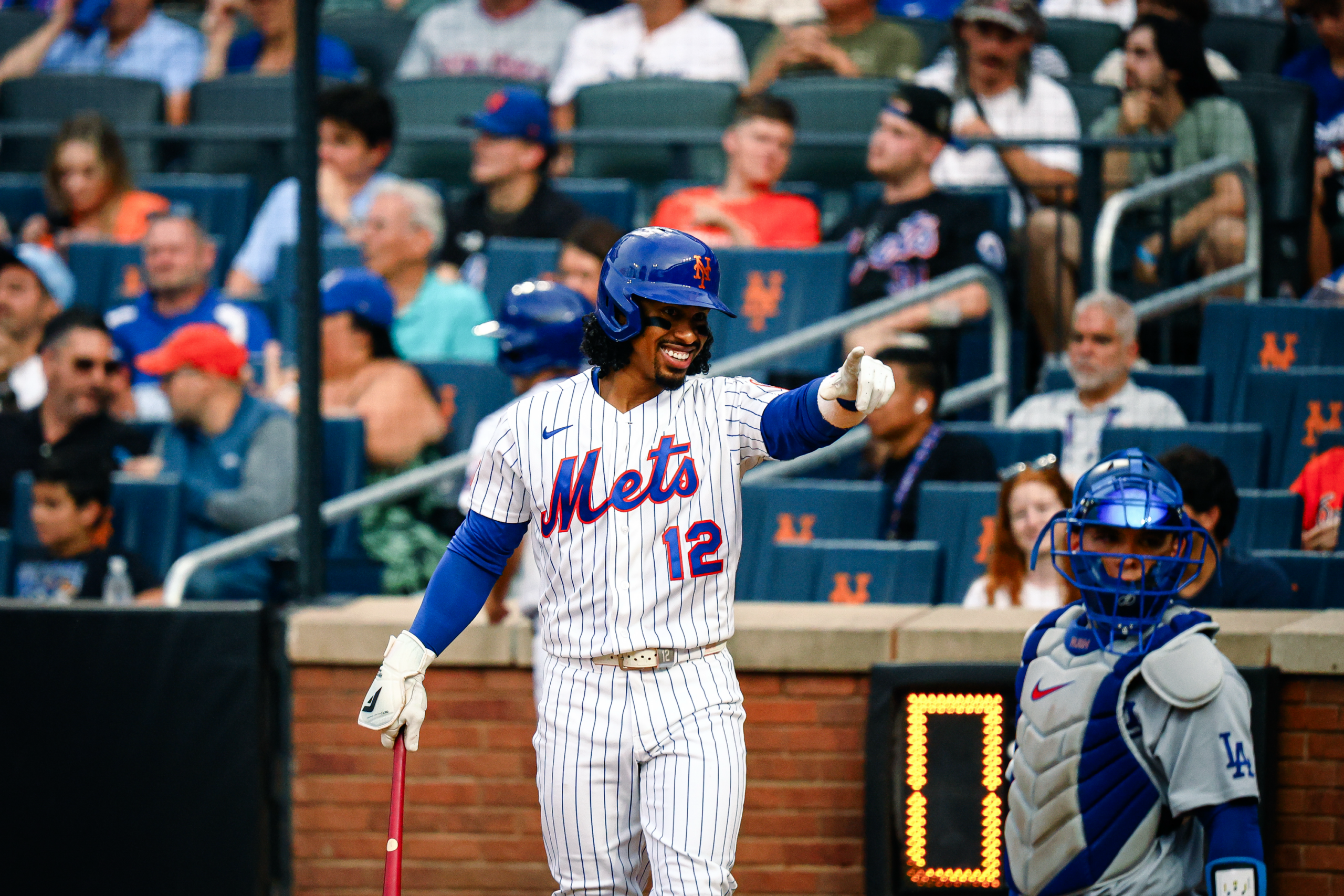
Francisco Lindor by Berto Carlo
Lindor’s latest error looked potentially costly in the early going on Friday, with the way the Mets’ bats were looking. He booted a potential double play ball in the third inning, leading to an unearned run against Robert Stock, who overall bounced back nicely from his previous outing. Stock was good, but he was expectedly limited in length, being capped at 4 1/3 innings and 84 pitches.
Lindor made another misplay in the top of the sixth. He did a good job to get to a ground ball up the middle, but it clanked off the heel of his glove for an infield hit. It wasn’t an error, but it was the type of play one might have expected the Lindor of old to make.
Two pitches later, Lindor got the Mets back in the dugout anyway by completing a 4-6-3 double play.
Still down 1-0, the Mets needed a spark.
They got it from none other than Lindor himself. Evening the score against his error, he homered in the bottom of the sixth off of Nationals starter Aaron Alvarez, who’d been cruising. It was Lindor’s fourth of the season as a right-handed batter and 12th overall. Lindor has pretty even splits for his career but had been better as a left-handed hitter this season (116 wRC+ vs. 103).
The ball was rocketed at 110.3 mph off the bat, traveling 409 feet.
Lindor’s OPS is now up to .769 for the season, not bad when considering how slow he started, a stretch that was only further prolonged by the left calf strain that forced him to miss about two months. Over his last 30 games, he’s hitting .277/.367/.554 — numbers that are in line with the best version of Lindor from seasons like 2018, 2024 and 2025. He’s hit 10 of his 12 home runs since returning from the injured list on June 24.
In 25 games in July, Lindor posted an .860 OPS. Through 12 games in August, he’s had an .852 OPS.
The defensive numbers still look much more pedestrian than past seasons for Lindor. For reference, his -1 OAA (Outs Above Average) compares to a career cumulative mark of 138 in that category. His -3 DRS has lowered his career number to 48. His “Range” — Statcast Runs Above Average — is -1, the first time it’s been negative in a career where he’s accumulated a positive 103. His Fielding Runs Above Average (based on OAA) is 0, compared to 105.9 cumulatively for his career.
None of these defensive statistics is necessarily perfect, but they are all generally trending in the same direction, which confirms mathematically what is fairly apparent to any onlooker. Lindor isn’t a bad fielder, but he hasn’t been nearly as pristine this season as he’s been for most of his career. His current defensive level combined with the way he’s hitting is still a very, very valuable player overall. Coming into Friday, he’d been worth 1.6 fWAR in 65 games, which translates to a hair under 4.0 when extrapolated to 162 games.
So Lindor might be losing a step defensively. Perhaps some of it is due to lingering effects from the calf strain. Maybe some of it is due to age. Some of it could just be from not being out there every day.
Thankfully for the Mets, Lindor is back healthy and playing, and he’s still showing that he can hit like he has throughout his career.