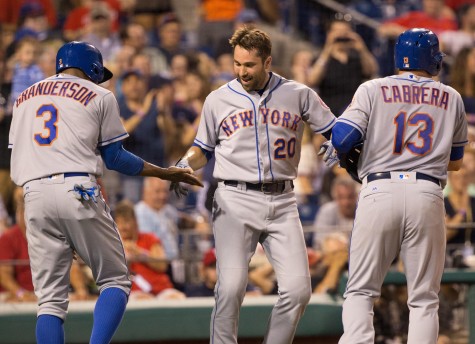
The 2016 Mets offense hit 218 home runs, setting a new franchise record and was the 5th highest mark in the Major Leagues. They had four players hit more than 20 home runs, two of which hit more than 30. However, despite the many long balls, the 2016 Mets offense has been described by plenty of people as one-dimensional. Would that be a correct assessment?
Despite hitting the 5th most home runs in the Major Leagues, they were 16th in slugging percentage with a .417 mark. Slugging percentage is calculated by dividing total bases by at bats, and therefore a pretty good measure of the power of a certain player or team. It stands to reason that a team or player that hits a lot of home runs, which account for four bases in one at bat, would have a high slugging percentage. For example, the Baltimore Orioles led the league with 253 home runs and had a team .443 SLG% good for third in the league.
How is it possible that they hit so many home runs but still could only manage a .417 SLG%? It might have something to due with the fact that the Mets’ 240 doubles ranked 29th in the Majors only ahead of the Phillies’ 231, and their 19 triples rank 27th. If they had never brought in Jose Reyes, who hit four of those triples, they would have ranked 29th ahead of only the Baltimore Orioles, who tallied only six.
Out of all the Mets players who hit at least 15 home runs in 2016, only one of them hit more doubles than dingers. Yoenis Cespedes hit 31 home runs and 25 doubles, Curtis Granderson hit 30 home runs and 24 doubles, Wilmer Flores hit 16 home runs and 14 doubles, and Neil Walker hit 23 home runs and only 9 doubles. Asdrubal Cabrera stood apart with his 30 doubles compared to 23 home runs. Curtis Granderson hit five triples, Jose Reyes hit four, Juan Lagares hit two, and nobody else hit more than one.
The Baltimore Orioles have an excuse for their low double and triple rates compared to home runs in that their stadium is a bandbox. Their offense was built to hit home runs to take advantage of their stadium, just as the Yankees stack their offense with left-handed hitters to take advantage of their right field dimensions. The Mets do not have that excuse in that Citi Field has a roomy outfield and can definitely be describes as a pitcher-friendly park.
Apart from slugging percentage, the Mets were lacking in other offensive categories as well. They stole 42 bases, and with the exception of Jose Reyes who swiped nine, nobody else stole more than five. They ranked 28th in stolen bases ahead of only the Cardinals (35) and the Orioles (19). They were, however, successful in 70% of their stealing attempts, good for 14th in the Majors. If they were adequate in that category, why didn’t they steal more bases?
The most glaring response to that would be that they hit so many home runs so they didn’t have the chance to steal. Another less obvious response would be that they didn’t find many ways to first base in general. The Mets were 23rd in the Majors with a .316 OBP, which when combined with their .417 SLG%, adds up to a .733 OPS, good for 17th in the Majors.
The Mets aren’t a slow team. While they don’t steal many bases as a whole, they are not too slow to get to second or third base on a ball in the gap. The problem seems to be that they’re not hitting line drives to the gap. They’re hitting the ball high in the air, either sending it over the fence or in to an outfielder’s glove. Hitting a ton of home runs is absolutely fine and fun to watch, but as the Mets were 26th in runs scored in 2016, they obviously need to do more.