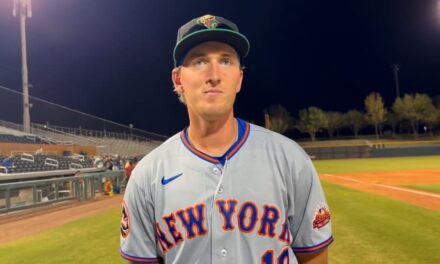
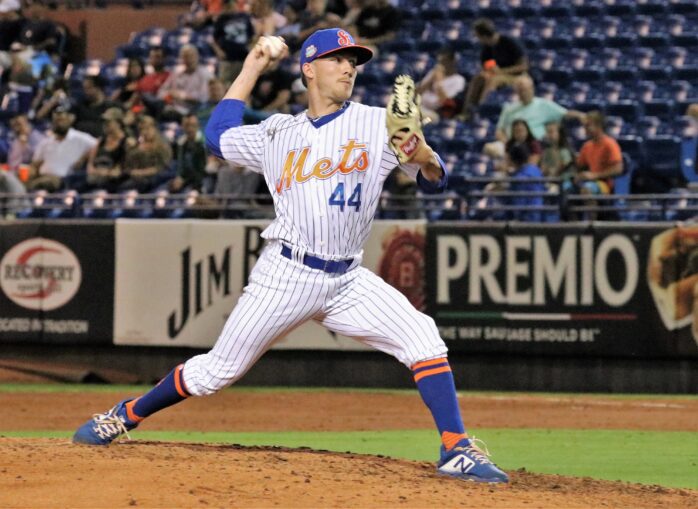
Photo by Ed Delany, MMO
The Mets bullpen struggled to begin the 2019 season with a 5.55 ERA in April despite the offseason additions of Justin Wilson, Jeurys Familia, and Edwin Diaz.
May has been a much better month for the Mets pen with a National League best 1.83, but to keep arms fresh, there’s always going to movement among the last couple of bullpen spots.
Every healthy pitcher on the Mets 40-man roster has been on the big league roster this year already so let’s take a look at new intriguing arms not on the 40; righties Ryley Gilliam and Steve Villines.
I will start with Villines given that he’s only one step away in the big leagues with Triple-A Syracuse right now. The Mets drafted the sidearmer with their 10th round pick in the 2017 from the University of Kansas, and he’s been dominant since.
In 111.2 minor league innings, he has allowed only 80 hits, 21 walks, and struck out a whopping 156 batters. He has given up only four home runs in that span as well. That gives him an impressive 2.26 ERA, 1.81 FIP, and 0.90 WHIP to begin his career.
The 2019 season has been much of the same for Villines with 19 strikeouts and only 11 hits allowed in 17.2 innings. He has yet to allow an earned run this season (three unearned) between Double-A Binghamton and Triple-A Syracuse. He has walked seven hitters (all lefties) which is out of the norm for him, though two of them came at the tail end of a 52 pitch outing.
Villines brings all of his stuff from a funky angle that isn’t seen very often these days and makes it tough for hitters to gauge. He uses a fastball in the 85-89 mph range, slider from 75-80 mph, and occasionally mixes in a changeup.
As we’ve seen with sidearmers/submarine type pitchers they can be susceptible to left-handed hitting, but that has not been the case for Villines thus far. Lefties are hitting .159 against him in 170 at-bats and striking out 40% of the time. He’s been successful against lefties because he’s not afraid to elevate his fastball when ahead in the count as a strikeout pitch.
The question for Villines will be can he continue to have the great command necessary to success at the major league level at his velocity. I believe he will be able to, but the extent of his role will ultimately depend on if he continues to be able to get lefties out at a high rate.
He’s shown capable of working in a variety of different bullpen roles with three saves this season and has gone more than an inning in six of 12 appearances this year.
When the Mets took right-hander Ryley Gilliam with their fifth round pick last season from Clemson they knew they were getting an arm that could move fast. Despite the Mets starting him in short-season Brooklyn (story for another day), he’s already pitching in Double-A less than a year after being drafted. Ryley was also a part of the 2017 USA Baseball Collegiate National Team in which they won all three series they played and he tossed 8.1 scoreless innings.
The 22-year-old had a 2.08 ERA, five saves, and struck out 31 in 17.1 innings for Brooklyn though he struggled with his control, walking 13 batters. His control has been much better this season with only five walks and 31 strikeouts in 18.2 innings between Class-A St. Lucie Mets and Double-A Binghamton Rumble Ponies. The former Clemson closer has a 2.41 ERA, 0.91 WHIP, and a fantastic 6.20 SO/W ratio.
Gilliam is mostly 93-94 with his fastball that tops out at 96 mph, but his quick arm action on the pitch increases the perceived velocity. His best secondary pitch is a curveball in the high 70s that has tight spin and good late break, he generates lots of swings and misses with this offering. Also a guy that tends to work very quickly on the mound which fielders always appreciate.
The impressive potential high-leverage reliever has 15 strikeouts in eight double innings this year and his 36.1 K-BB% ranks him 18th among 1,632 minor league pitchers with at least 10 innings pitched this year.
Gilliam and Villines are both going to pitch at the major league level, and it could be in the near future for the Mets.