
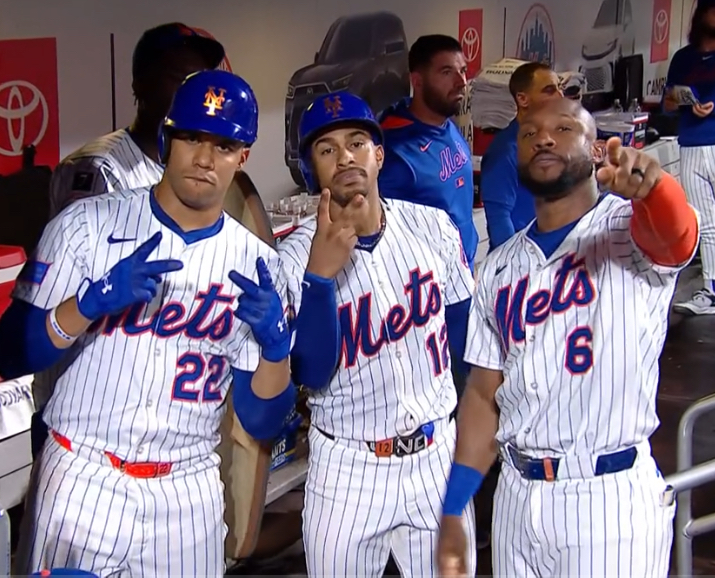
The New York Mets have one of the best offenses in baseball. Despite their loss to the Miami Marlins on Saturday at Citi Field, New York posted eight more runs. They have now scored at least six runs in seven of their last nine games. They also have the second-most runs in August. After months of ranking at the top of the league in several important underlying offensive metrics, the actual output has followed suit.
After Saturday’s game, New York ranks fifth in OPS, home runs, slugging percentage, and on-base percentage. These figures have culminated in them ranking ninth in overall runs scored; the most important part.
For the longest time, New York’s Achilles heel on offense was hitting with runners in scoring position. Well, the tides on that have turned dramatically. The Mets are hitting .328 with a .967 OPS with runners in scoring position in the second half of the season. As a result, prior to Saturday’s game, they owned the 10th-highest batting average with runners in scoring position and the third-highest OPS on the season overall. A far cry from where they were earlier in the season.
Looking up and down the Mets’ lineup, there really is not much of a hole, especially when Francisco Alvarez returns. Seven Mets have an OPS above .750 and five have an OPS above .785. Each of the team’s top-four hitters have 22-plus home runs and 75-plus RBIs. Not to mention, Mark Vientos seems to be nearing his 2024 form at exactly the right time.
Reading all the above may surprise you, given that several were calling for changes to be made on the offensive side of the ball for the Mets earlier in the season. When a team has as good as underlying metrics as the Mets have had all season, the tides are bound to turn. That is exactly what has happened for New York over the last month-plus as they are consistently getting the results the team has deserved all season long.
Entering Saturday, the Mets ranked third in xBA, second in xSLG, 1st in xWOBA, second in hard hit rate, and second in average exit velocity. At the plate, the approach is strong as well. They rank fifth-lowest in chase rate, ninth-lowest in whiff rate, have walked the fourth-most in the league, and are in the bottom-half of the league in strikeout rate.
The two potential areas of issue is the team’s ground ball rate, which has swung toward league average (11th-highest) as well as pull rate (ninth-lowest). However, when the rest of the numbers are so strong, and each the ground ball rate and pull rates are not catastrophic, things should still skew very strong.
Really, for the longest time, the only valid gripe you can make with the Mets’ offense was the hitting with runners in scoring position, which was analyzed above. However, as been shown time and time again, that statistic is largely one of the most volatile in baseball, and, if your offense is strong overall, hitting with runners in scoring position is bound to positively regress. That is exactly what has happened in New York’s case, as the above mentioned statistics indicate.
Add in the season-long run with underlying metrics being off the chart, plus the positive regression in clutch hitting, and you get one of the best offenses in baseball and one that can carry a team in October.