Over the last few years we have seen a high number of relievers convert into starting pitchers with success. Recent examples include Michael King, Seth Lugo, Reynaldo López and the Mets’ very own Clay Holmes. With Christian Scott‘s hip impingement, the Mets currently have two guaranteed starting pitchers in their rotation: Freddy Peralta and Nolan McLean. Sean Manaea has looked better since regaining his velocity and has made his first two starts of the year, David Peterson has struggled and pitched mostly in relief or bulk roles, and Kodai Senga has struggled with injuries while also allowing four runs over four innings in his return to the Mets against the Cincinnati Reds earlier this week.
The Mets need innings now, especially if they sell at the deadline, and the solution may be in their organization already with their relievers.
The Mets themselves in recent years have had success not just at the major league level with that transition but in players they have drafted too. McLean, Scott and Tylor Megill were primarily relievers when they pitched in college, and the organization converted them into starting pitchers.
So what traits do successful reliever to starters have, and who in the Mets’ system could be potential future converts?
Let’s compare them to three Mets relievers:
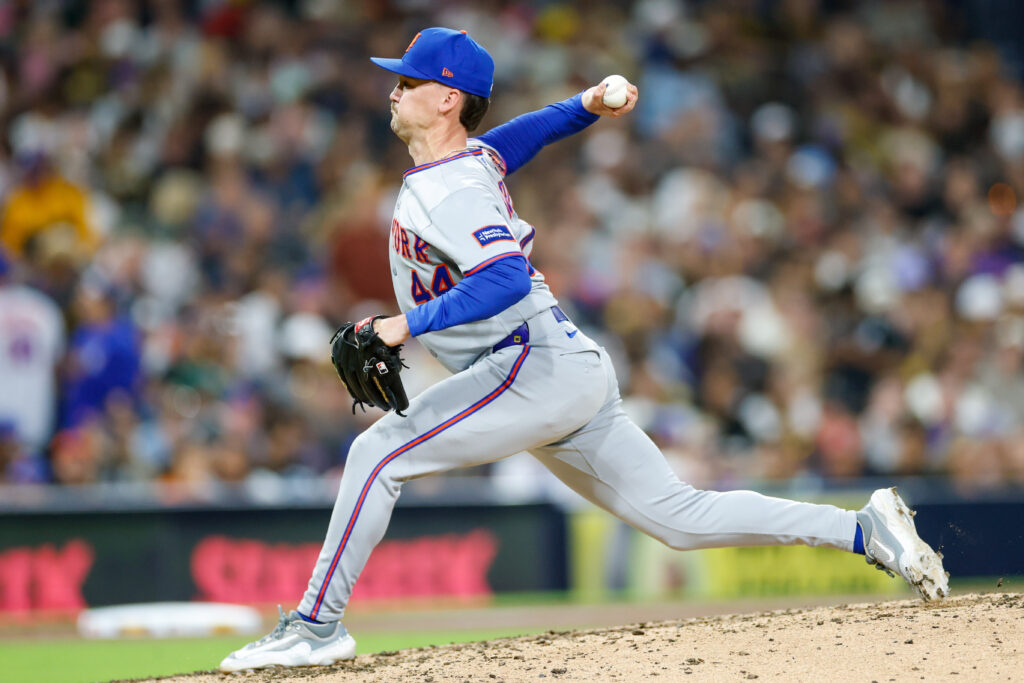
David Frerker-Imagn Images
Velocity
Most pitchers lose around two-to-three miles per hour of velocity going from a reliever role to a starting pitcher role. It makes sense that you can throw harder when you don’t need to worry about saving your energy for a longer outing. Looking at some of the pitchers who converted after pitching in the majors as a reliever, you see their fastball velocity changed to the following degrees:
- Reynaldo López – 98.2 (2023) to 95.5 miles per hour (2024)
- Clay Holmes – 96.6 (2024) to 93.7 miles per hour (2025)
- Michael King – 95.9 (2022) to 93.3 miles per hour (2024)
- Seth Lugo – 94.4 (2022) to 93.3 miles per hour (2023)
While you do not need elite velocity to be a successful convert – there are other traits we will touch on – when you talk about losing velocity, it helps to start from a higher spot.
Where do the Mets relievers mentioned above sit while pitching in the bullpen?
- Jonathan Pintaro – 95.4 miles per hour
- Austin Warren – 94.0 miles per hour
- Tobias Myers – 92.8 miles per hour
Jonathan Pintaro is the only one of those three who has the velocity that jumps out as falling in the same range as the successful converts above. Myers, though, has shown in the majors so far that he has not lost velocity when converting to a starter, even averaging 92.9 miles per hour as a starting pitcher in 2024. Myers also has traits that make his fastball play up more than others, specifically the incredible induced vertical break he creates. Warren does not rely on his fastball as much as the other pitchers, so in theory this could impact him less.
Pitch Diversification
An important part of being a starting pitcher is having enough of a repertoire that you can face a lineup a third time through. Relievers can get through an inning on only two pitches. Outside of 2021 Jacob deGrom, there aren’t many starters who can be successful throwing only two pitches.
Many relievers will add pitches when they convert into starters, but typically they were not only two-pitch pitchers as relievers.
As relievers, the successful converted pitchers mentioned above threw:
- Michael King – slider, sinker, four-seam fastball, changeup
- Clay Holmes – sinker, slider, sweeper, four-seam fastball
- Seth Lugo – curveball, four-seam fastball, sinker, slider, changeup
- Reynaldo López – four-seam fastball, slider, changeup, curveball
All of these converts had deep repertoires as relievers and added to them even more as starters.
For the Mets relievers I mentioned, you have:
- Tobias Myers – four-seam fastball, splitter, slider, cutter
- Austin Warren – sweeper, sinker, four-seam fastball, curveball, cutter, changeup
- Jonathan Pintaro – cutter, sinker, sweeper, four-seam fastball, changeup
All of these Mets relievers have deep repertoires that should allow them the ability to attack a lineup multiple times through.
A High Strikeout or Ground Ball Rate
Quick outs are important as a starting pitcher. You don’t want to get into deep at-bats with a lot of traffic from batters you walk. And when you do let batters get on, you want to be able to get out of trouble with either a well-timed strikeout or a double play ball.
- Michael King – 33.2% strikeout rate and 47% ground ball rate
- Clay Holmes – 25.1% strikeout rate and 65% ground ball rate
- Seth Lugo – 25.4% strikeout rate and 46.2% ground ball rate
- Reynaldo López – 29.9% strikeout rate and 39.2% ground ball rate
Seth Lugo is the only one there that was not elite in one of those two categories, but he was roughly 15% above average in both. Clay Holmes ran elite ground ball rates while King and López ran elite strikeout rates.
As for the Mets’ relievers:
- Tobias Myers – 18.6% strikeout rate and 35.2% ground ball rate
- Austin Warren – 24.1% strikeout rate and 37.3% ground ball rate
- Jonathan Pintaro – 30.9% strikeout rate and 33.3% ground ball rate (In Triple-A)
Pintaro does not have enough of a sample size in the majors so I used his Triple-A numbers, where he is running an elite strikeout rate. Myers sticks out here as he does not fit either category, but he has run a career 6.3% walk rate, which makes up for this. Austin Warren has not been elite at generating strikeouts but is still well above-average.
A True Carrying Tool
Finally, having a true carrying tool can make all the difference in converting to a starting pitcher. For some it is strong movement profiles, for others it is a plus feel for spin and for many it is outlier velocity as mentioned above. Many may have more than one carrying tool. For the successful converted pitchers mentioned, you have:
- Michael King – Plus movement from a deceptive delivery
- Clay Holmes – Plus spin rate on secondaries
- Reynaldo López – outlier velocity
- Seth Lugo – Elite curveball spin rates
It makes sense why these traits would help these pitchers convert to becoming successful starting pitchers. Spin rates typically carry over with the increased work load and helps force weak contact as well as generate swing and misses. Plus-movement profiles also carry over, and a deceptive delivery is repeatable even over longer outings.
As for the Mets relievers:
- Myers – Elite fastball induced vertical break from a unique arm slot
- Pintaro – Plus movement from a deceptive delivery
- Warren – Plus movement and spin from a low arm slot
Pintaro profiles very similar to Michael King, he just does not have the same level of command of his pitches as the San Diego starter. Myers makes up for his velocity with a fastball that is incredibly difficult for batters to pick up. Warren generates both plus-movement and spin and throws from a very low slot compared to Myers’ very high arm slot.
Conclusion
To finalize, let’s recap what each pitcher has going for them to convert to a starter if the Mets were to decide to do so.
Myers
- High iVB fastball from a unique over-the-top arm slot
- Deep pitch mix
- Has had success as a starting pitcher before
- Low walk rate
Pintaro
- Plus movement from a deceptive delivery
- Elite strikeout rate in Triple-A
- Strong fastball velocity
- Deep pitch mix
Warren
- Plus spin rates and movement from a low slot
- Deep pitch mix
- Above average strikeout rate
All of these pitchers could likely have success at least to some extent as starting pitchers, but should they be converted?
Myers struggled in his last appearance, but should be given more of a chance to start than being called up on short rest on the road. He has stretched out to some degree, throwing 43 pitches most recently, and president of baseball operations David Stearns said that they like how Myers can be used as a bulk guy and a starter. He has shown the ability to be a mid-rotation level starter in the majors before, and with his arm slot, pitch mix, and movement, he has the stuff to be a mid-rotation level starter as well if he were to get enough run. With Scott’s injury, Myers should continue to be built up and could slot right into the rotation.
Pintaro should be converted in Triple-A. His ceiling is essentially becoming Michael King if he can learn to improve his command by about a grade. Most likely, a realistic high-end outcome would be a fourth starter. At the very least, it is worth exploring because he very clearly has the stuff to be a pitcher in the majors and it is much easier to convert back into a reliever.
As for Warren, he is having so much success in his current role is it hard to argue moving him out of it. There could even be arguments into developing him further as a reliever into a leverage role, but he has the stuff that if they ever decided to convert him into a starter, he should be able to be at least a backend option.