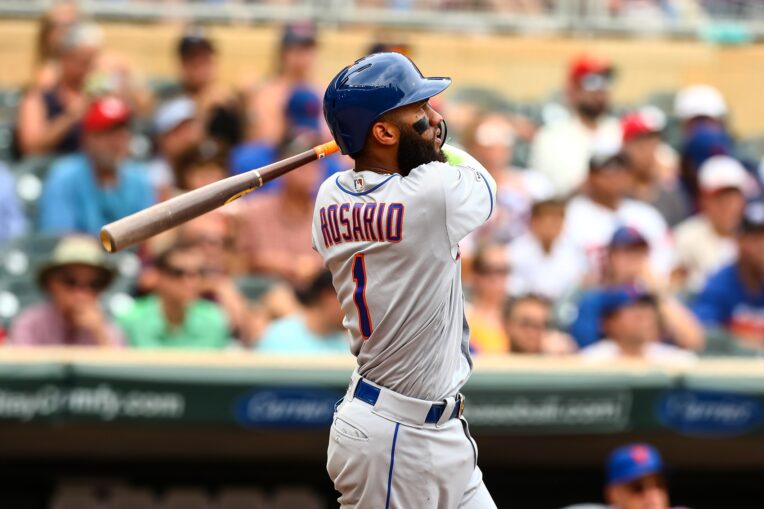
While it hasn’t been at the same level of other young players around baseball these days, New York Mets shortstop Amed Rosario is still showing signs of gradual improvement within the batter’s box.
The 23-year-old’s first sign of significant improvement took place last summer, when his performance in August produced his first above-average month of production as a big leaguer, when looking at wRC+ as the barometer. He also followed that up with another above-average month in September, leading to some optimism that the youngster was figuring things out.
Obviously, spring-training statistics should be taken with a grain of salt, but Rosario’s performance during Grapefruit League action likely built upon that already established sense of optimism — he slashed .356/.442/.556 with just five strikeouts in 45 at-bats. While he was collecting RBI at a pretty high rate, this progress didn’t exactly carry over into the start of the 2019 regular season.
But over the last month, Rosario has caught fire. It’s nice to see that he’s doing this earlier than August this time around, and it’s also continuing to show an encouraging trend with regard to his production on a yearly basis.
The Proof Was in the Peripherals
When looking at the results over the first few months, Rosario’s numbers didn’t look much different than anything else he’s produced during his short big-league career. There were two significant changes that showed up almost immediately despite the lack of results, though, and those occurred in both plate discipline and quality of contact.
There were some ebbs and flows when looking at the young shortstop’s production in these areas on a monthly basis, but for the most part, his approach has been pretty consistent.
One of the most noticeable aspects of Rosario’s late-season surge from last season — and perhaps a concerning part, too — was a huge rise in line-drive rate. Over the final two months (239 plate appearances), he produced a 26.7% line-drive rate, which was accompanied by a .335 BABIP. Through the 523 plate appearances that came before August 1, 2018, Rosario’s career line-drive rate sat at 17.7%, which was accompanied by a .304 BABIP.
But maybe this is the start of him just learning to square the ball up a little better? Rosario’s current 22.7% line-drive rate is on pace to improve for the second consecutive year. It’s nearly improved each month this season, too. The same monthly trend is happening with his hard-hit rate. In 2018, Rosario posted a 27.7% hard-hit rate, but to this point in 2019, his monthly rate has dipped below 30.0% just once (29.1% in May).
So it’s not at all surprising that his current hot streak through 43 July plate appearances has come with a 27.3% line-drive rate and 51.5% hard-hit rate this month.
The Encouraging Yearly Progression
There’s still a couple months left to go before this year’s regular season is in the books. Still, it’s hard to not see the slow and steady climb Rosario’s overall offensive statistics have continued taking. Here’s a look at how things have progressed since he debuted in 2017.
(Some are cumulative statistics, which is a little misleading, but it still shows some growth here.)
| Year | PA | HR | RBI | OPS | ISO | BB% | O-Swing% | Soft% | Hard% | wRC+ |
|---|---|---|---|---|---|---|---|---|---|---|
| 2017 | 170 | 4 | 10 | .665 | .145 | 1.8% | 45.5% | 19.8% | 24.1% | 75 |
| 2018 | 592 | 9 | 51 | .676 | .125 | 4.9% | 41.2% | 20.4% | 27.7% | 85 |
| 2019 | 380 | 10 | 45 | .751 | .167 | 5.5% | 36.9% | 11.6% | 36.7% | 98 |
There’s still a fair amount of progress to be made, but there are some legitimate steps forward going on. It can be hard to patiently watch this happen when there are other former top prospects — say, like Fernando Tatis, Jr. — who are taking the league by storm at either the same age as Rosario or younger. Players adjust to the big leagues at different speeds, though.
Rosario has been in the organization for so long that it’s sometimes difficult to remember he’s still only 23 years old. His physical prime is a ways away, which will give him time to hopefully gain the necessary wisdom to blossom into the type of player talent evaluators had him pegged as.
The only problem? Well, that’d be his defense, which has once again been atrocious when using advanced metrics (-16 Defensive Runs Saved in ’18, -14 so far in ’19). Will he stick at shortstop for the long haul or not?
That’s a topic for another day. His slow and not exactly insignificant improvements in the batter’s box are good to see. It’ll now be up to him to keep the momentum going and finish the season strong on offense. And maybe also improve on the defense a little bit more.