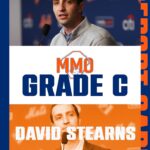
David Stearns, POBO
GRADE: C
A season where you miss the playoffs and lose 88 games has to be an F right? Or at least a D since there were a number of teams who finished with worse records. If that’s your take it is an absolutely fair and reasonable take.
In 2023 in our midseason report MMO gave Billy Eppler a C+. The reminder of the season the Mets front office did very little to set up the 2024 season, largely playing veterans that were never going to play a part in the Mets future and not focusing on development the way you should in a lost season. How should that be factored? Should it be? And did that grade get a bit of a boost from the 2022 101 win season? The Mets went on to finish 75-87 that season.
I am going to try to be a bit more nuanced and really focus on what Stearns could and could not control. That does not take away from the fact this was a bad season. Not one of the worst in the history of the franchise, probably not even top ten worst in most MMO reader’s lifetimes. But a bad season nonetheless.
A lot of his moves did work out but the process made sense.
Stearns biggest issue was not trading away Brandon Nimmo. Marcus Semien did not perform close to what was expected but that was the only way to get out from the Nimmo contract which we saw this year why they needed to happen. Nimmo has not been shy since the trade about his distaste at the idea of being the designated hitter and the emergence of both Carson Benge and A.J. Ewing is a big reason why you could not commit five years to Nimmo who this year was worth only 1.2 bWAR and 1.7 fWAR while dealing with foot, back, neck lower body and shoulder issues. It’s unfortunate the return did not work out but the trade had to happen.
It also was not being one of 29 teams unwilling to give Pete Alonso a five-year contract. He had a monster year results wise but his bat speed fell the third straight year while his 90% exit velocity, max exit velocity and barrel rate all took a sharp turn in the wrong direction. Not what you want to see in year one of a five-year deal.
Bo Bichette was signed to be that .800 OPS bat that replaced Pete Alonso in the heart of the lineup and was not that. He was also a career .294/.337/.469/.806 hitter coming off an .840 OPS season. Should the POBO get blame for this or should Bichette? They should get blame for giving up the qualifying offer benefits on an expensive contract with a first year opt out though. And this was not a clear World Series favorite one Bo Bichette away from being the favorites.
Jorge Polanco is the move most point to as the biggest failure and it absolutely was in year one due to injuries. He was expected to replace Brandon Nimmo’s production and did not. His injury was not a typical major league injury so how do you project that? Polanco did not have a history of this injury. The Mets also had a backup in Jared Young who put up a .759 OPS but he missed a huge chunk of the season with injury.
Similarly, people point to Luis Robert Jr. as the Mets taking on too much injury risk but he was signed to a position they had significant depth with Tyrone Taylor who put up a .794 OPS with the Mets and A.J. Ewing who had a great rookie season. Robert himself put up a fine .702 OPS he just missed huge chunks of the season. He also was basically free, costing a player who was unlikely to make the major league roster. The Mets this year were 13th offensively in center field by WRC+ and by fWAR.
Freddy Peralta had a long history of success before coming here and looked great into June with a 3.63 ERA before he completely collapsed. Could anyone have predicted before the season that would happen?
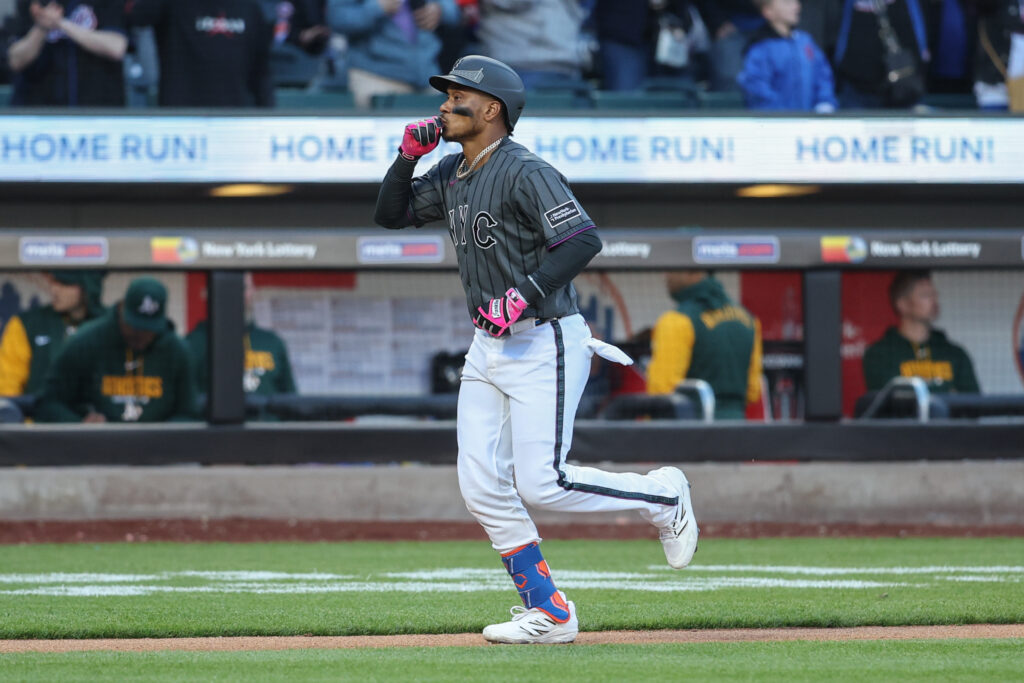
Wendell Cruz-Imagn Images
So What Did Stearns Really Do Wrong?
The first big issue with the Stearns offseason was not pivoting when it was clear all the Mets starters were healthy. Peralta, McLean, Holmes, Manaea, Senga, Peterson and Myers were all on the opening day roster. This meant they had to push Manaea, who had velocity struggles in spring training, into a relief role. This was a shock to Manaea who seemed to not be aware he was competing for a rotation spot. Myers did not have a defined role and was continually shifted between roles. Peterson was out of options while Senga had to approve a demotion to the majors.
The Mets needed to trade one of their starters in spring training and even without hindsight that seemed to be a necessity at the time. The idea of having 7 starters for five roles only works if many of those arms can be optioned to both keep guys fresh and ensure the best arms are in the majors.
Another issue was holding onto Carlos Mendoza too long. Based on comments from owner Steve Cohen, the Mets seemed to believe that they could not fire him before the season due to public perception that the Mets are too quick to scapegoat and give up on staff. This was something written about at length by everyone from the Athletic to the New York Post. It is likely the Mets had a pre determined time frame they felt they could fire him without negatively impacting their ability to hire someone outside the organization this offseason. I would argue that once Alex Cora was fired they had the cover to up that timeline. I would also argue that the firing of Rob Thompson gave them even more cover. The one positive to come out of this manager saga is that the Mets found their manager for the next three seasons in Andy Green but more on that later.
This falls under the Carlos Mendoza manager decision but the Mets played the wrong players far too often. David Stearns has always been very hands off with the major league coaching staff in his career, potentially to his detriment. But there is no reason Marcus Semien should have been playing every single day. There is no reason he should have spent weeks playing through a hip injury. Mark Vientos should not have regularly faced right-handed pitchers that were bad matchups. Players that needed to be platooned were not and players that were did not need to be. Craig Kimbrel should not have been on this roster as long as he was. Do you remember Tommy Pham was a Met?
Starters also did not have a quick enough hook. The Mets did not need to continually try to push Freddy into the sixth inning. Carlos Mendoza stated on multiple occasions that was his call, but David Stearns was the one who continued to let him manage while making those decisions. Similarly, David Peterson and Kodai Senga should not have seen the lineup a third time through near as often as they should have.
What Went Wrong Stearns Couldn’t Control?
I truly do not know how much you should put ownership on players underperforming. I don’t.
What is the split that Bichette and Peralta’s struggles should go on the players vs the coaches vs the POBO? The POBO hired the coaches so should all their ownership also roll up to him? How much of this is truly you can make the right decisions and stuff happens?
I tend to fall more into the camp that the GM/POBO moves should be evaluated largely without hindsight for this type of exercise but that should also not fully absolve him as there were legitimate roster construction issues.
One roster issue that you cannot truly ding Stearns for was designing the lineup around Juan Soto and Francisco Lindor. If you were told before the season that they would miss a combined 108 games you probably would expect their season ended around the record it did. That just is not production you are going to make up on waivers and the Mets heading into the season were probably two years away from the upper minors depth to close that gap. Maybe they should have had another bench bat that could add pop and play the outfield? The issue is that before the season I would have replaced Tyrone Taylor with that bat and I’d expect many reading would have as well.
Similarly, Stearns could not control losing Clay Holmes to a come backer that broke his leg. Losing Holmes was a big blow for a Mets team on life support. You can absolutely argue that Stearns did not get enough pitching depth heading into the season. I would argue this was even more of a reason why we needed to move some of our starters in the offseason. The more you block someone’s path to the majors the harder it is to convince them to sign a minor league depth role with you. But in terms of Holmes specifically, that is a freak injury you cannot prepare for.
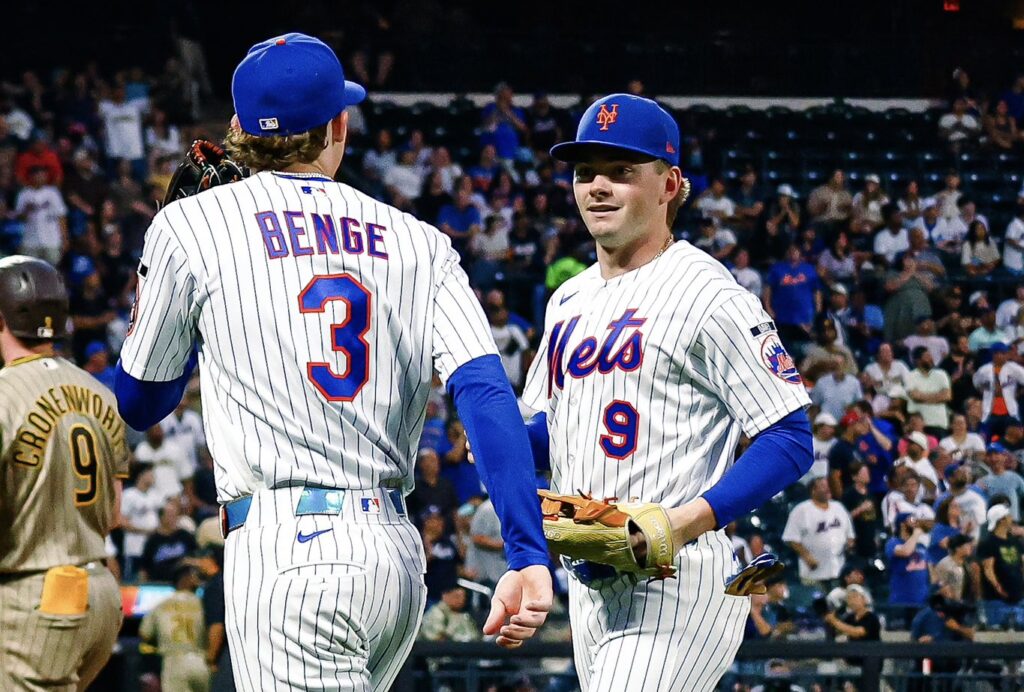
Carson Benge and A.J. Ewing
By Berto Carlo
What Went Well this Season?
I have been very negative throughout this article so I would like to end with some positives.
Leaving room for the young guys was the right decision. The Mets will likely have three rookie of the year finishers this season between Carson Benge, Nolan McLean and A.J. Ewing. Zac Thornton had a great half season where he made some real adjustments that could lead to 2027 playing time. While he was not a rookie, Christian Scott looks like a big piece of the Mets rotation going forward. This is a strong young core forming of homegrown talent. Francisco Alvarez has been up and down and dealt with injuries but he is still only 24 and arguably a part of that core.
The Mets bullpen moves for the most part worked out. Devin Williams and Luke Weaver had terrible first months but from late April onwards looked great. Weaver specifically looked elite. He, Brooks Raley, Huascar Brazobán, and A.J. Minter all performed well and brought back the Mets strong pieces at the deadline. Austin Warren was having a breakout season before his arm injury and when he returned in September looked good. Nate Lavender is another homegrown player who looks like he could be a big factor in 2027. Dedniel Nuñez, Jack Weisenburger, Daniel Duarte, Cionel Pérez, Jefry Yan, and Jonathan Pintaro all had moments this season and could be competing for roster spots in 2027.
The Mets coaching staff was able to help turn around many players who had slow starts. I already mentioned Williams and Weaver, but an under the radar success was Brett Baty’s season. He headed into July with a .589 OPS and then seemed to go back to trading contact for power like he did in 2025. From that point forward he slashed .273/.332/.483/.814. Carson Benge was one of the most notable benefits of working with the coaches, undoing many of the swing changes he made in the offseason to take a big step forward in May. Kodai Senga’s bullpen transition came with some growing pains but he looks like he could be useful to the 2027 ball club potentially as a leverage reliever. Luis Torrens posted his best offensive season as a Met off a hot second half.
It would seem that at least the core of this coaching staff should be around next year since the Mets extended Andy Green as the manager for the next three seasons. Green has been a welcome breath of fresh air in the organization and despite managing a team that sold at the deadline and faces one of their toughest portions of the season, he managed them to a 40-41 record. Interestingly, Green was the runner-up to Carlos Mendoza for the manager job in 2024 which is what led to his hiring as the VP of Player Development. The Mets are still benefiting from ensuring he became part of the organization then, and his relationships with the players in the Mets farm as well as his work with the Mets organizational philosophy makes him uniquely situated to manage the big league club in a way he was not in 2024.
One of the most important things a POBO can do is recognize when the season is likely lost and pivot. You do not want to be the team that holds everyone or even worse buys with virtually no path forward. Time will tell if the prospects the Mets got back will make an impact but so far the early returns have been good.
It is easy to doom and gloom on a season where the team makes the playoffs but there are many reasons to be optimistic about the future. The Mets have a strong young core. They have many exciting players in the upper minors that could make an impact in 2027 and are starting to develop a new track record of prospect success. One thing that seems clear is that Stearns knows which prospects to hold and who to trade away. You do not expect Soto and Lindor to combine for 108 missed games again in 2027.
On top of everything the Mets post deadline record of 27-13, good for a 109 win pace shows what things look like for this team when things are going right. I would guess no one wants to hear this right now but young guys taking a step forward, regular injury health, and positive regression to the mean along could make the Mets a playoff team in 2027. Add some pieces around this new budding core and let’s see what happens.