
When the MLB draft opens today, July 11, the New York Mets will watch 27 picks pass by before they make their first one. For the fourth time in a row, the Mets’ initial selection was moved back 10 slots for exceeding Major League Baseball’s competitive balance tax threshold.
To make matters worse, they forfeited their second-round pick after signing Bo Bichette. This means the Mets’ total spending allocation is $6,730,900 and the slot value of their first pick is $3,466,500.
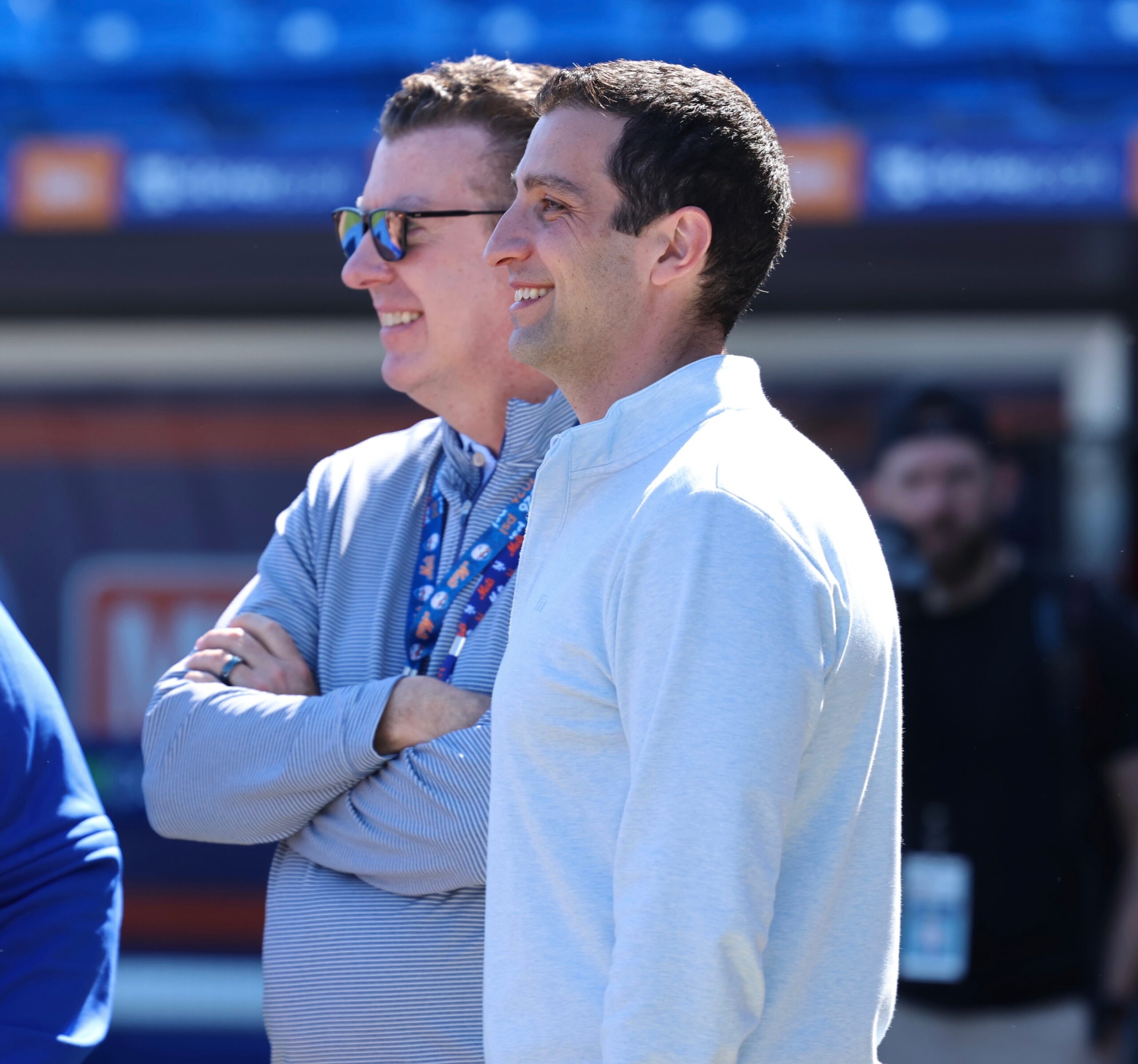
David Stearns
Photo by Ed Delany of Metsmerized
Speaking with Anthony DiComo of MLB.com, Vice president of amateur scouting, Kris Gross discussed how he has been in this situation before with both the Astros and Mets, and how they have multiple plans ahead of them.
“As we pick 27, we’ll just cast a wider net, have multiple plans — Plan A, B, C and D — in case certain players are there, numerous options to pivot to,” Gross said. “Throughout the spring, we just kind of sent out our scouts knowing that the crop is very deep this year and we could have a wide range of outcomes. So I feel like we’re in a good spot as far as coverage, and we know these players that are going to be in our range very well.”
Historically in the first round, Stearns and Gross have typically favored athletic, up-the-middle college hitters with plus plate discipline, pitch recognition, gap-to-gap contact skills, and bat speed, prioritizing hit tools and simple, adjustable swing mechanics over pull-heavy power. Power and physicality tend to be secondary, valued as addable traits once a player’s on base, since contact skills and plate discipline are harder to develop than strength.
Potential Options at No. 38
Over the last month MMO has broken down the mock drafts looking at who is getting mocked to the Mets the most. The players mocked so far have been:
- College Hitter – Aiden Robbins, OF (8)
- College Pitcher – Tegan Kuhns, RHP (4)
- High School Hitter – Bo Lowrance, 3B (3)
- High School Pitcher – Brody Bumila, LHP (3)
- College Hitter – Daniel Jackson, C/OF (2)
- High School Hitter – Will Brick, C (2)
- College Pitcher – Cade Townsend, RHP (2)
- College Pitcher – Mason Edwards, LHP
- High School Pitcher- Carson Boleman, LHP
- College Hitter – Ryder Helfrick, C
- High School Pitcher – Jared Grindlinger, LHP
- College Hitter – Caden Sorrell, OF
- High School Hitter/Pitcher – Archer Horn, SS/RHP
- College Hitter – AJ Gracia, OF
- High School Hitter – Tyler Spangler, SS
- High School Hitter – Aiden Ruiz, SS
- College Hitter – Justin Lebron, SS
- College Hitter – Logan Hughes, OF
- High School Hitter – Cole Prosek, C/3B/SS
On the For All You Kids Out There, a Mets-adjacent podcast by Baseball Prospectus, the hosts discussed the potential players the Mets could choose and named a few not in the mock drafts, including Tyler Head, Liam Peterson, Chris Rembert, Mason Edwards and Martin Shelar.
A little about a few of these potential picks:
Aiden Robbins
Robbins is an athletic outfielder, though scouts have debated whether he can play center field. There are concerns about whether his swing will work against major league pitching, as his whiff rate increased when he moved to the SEC. What he does do well is hit the ball hard when he makes contact, which should translate to above-average power numbers. The upside is that he handles velocity well, has good pitch recognition, is athletic, and a solid runner. The Mets would likely need to adjust his swing, which they had success doing with Carson Benge.
- Robbins ranks 29 on Pipeline, 24 on Baseball America, and 45 on Baseball Prospectus.
Tegan Kuhns
Tegan Kuhns is a draft-eligible sophomore – something the Mets have liked to draft because it means you are getting a player with college experience younger than most college-eligible draftees. He has a good fastball from a low release height, and the fastball has been compared to Bryce Miller‘s. His slider variant has also been compared to Miller’s. He has the arsenal to start but bleeds velocity in outings, which gives him potential reliever risk. He will also need to improve his command to last as a starter.
- Kuhns ranks 25 on Pipeline, 22 on Baseball America and 11 on Baseball Prospectus.
Bo Lowrance
Bo Lowrance projects to be a power over hit prospect whose defense limits him to a corner infield spot. He takes quality at-bats, but you could also argue he is too passive. His above-average arm may keep him at third base but if not he may move to first base or even a corner outfield spot, though his below-average speed may limit him to the infield. He has concerns about hitting spin and his commitment to Virginia may make him a hard sign.
- Lowrance ranks 38 on Pipeline, 45 on Baseball America and 39 on Baseball Prospectus.
Tyler Head
Tyler Head is an athletic, hit over power outfielder who is a no doubt center fielder that covers a lot of ground. He has a very disciplined approach that helps him limit strikeouts and draw walks but he lacks the muscle to turn in hard exit velocities. He has the frame where he should be able to add muscle and tap into more power. Even if that happens, he has so much foot speed he should be able to stay in center field.
- Head ranks 60 on Pipeline, 53 on Baseball America and 36 on Baseball Prospectus.
Liam Peterson
Liam Peterson’s best pitches are his breakers and his biggest asset is his feel for spin – something the Mets have continually targeted. He is not very polished which means he may have some more room to grow and he would very much be an upside gamble as a pick. The Mets have had success developing this type of pitcher in recent years. He will likely need to improve his fastball to be a starter.
- Peterson ranks 20 on Pipeline, 20 on Baseball America and 21 on Baseball Prospectus.
Chris Rembert
Chris Rembert is also a draft-eligible sophomore (noticing a trend here)? He makes a good amount of contact in the zone and has considerable bat speed. He hits the ball in the ground too much which limits his power output and while he plays second base currently, that could be more because of team need than defensive skill. He probably does not move back to shortstop but he could end up at third base or in the outfield. He has looked more comfortable at second base in college so he may just stay there. He is athletic and if he can learn to lift the ball more he has good exit velocities to build upon.
- Rembert ranks 20 on Pipeline, 41 on Baseball America and 47 on Baseball Prospectus.
Final Thoughts
The Mets have many strategies they can use this draft and MMO broke them down here. They could stick to slot value for a balanced budget, go all-in on a talented player who falls in the first round, go under slot early to save money for later picks, target high-upside high schoolers who require over-slot bonuses, or gamble on recently injured players who fall due to medical risk. Each approach carries tradeoffs between risk and floor, and GM Kris Gross’s track record of finding value without early picks in Houston suggests the Mets will likely get creative rather than play it safe.
As Kris Gross said, “There’s been a few years where some guys have fallen into our lap, and we’ve been very excited about it,” Gross said. “So there’s always hope for that. And if it happens this year, we’ll be celebrating in New York.”