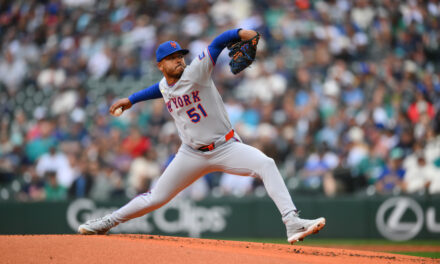
Through April Sean Manaea averaged 89.7 miles per hour on his four seam fastball and was running a 6.55 ERA and 1.64 WHIP. He followed that up with an appearance in Coors Field where he tried to combat the park factors by only throwing his sinker and sweeper and struggled to get even one out. He lost his rotation spot going into the season and it looked like he was trending to becoming truly a one inning reliever.
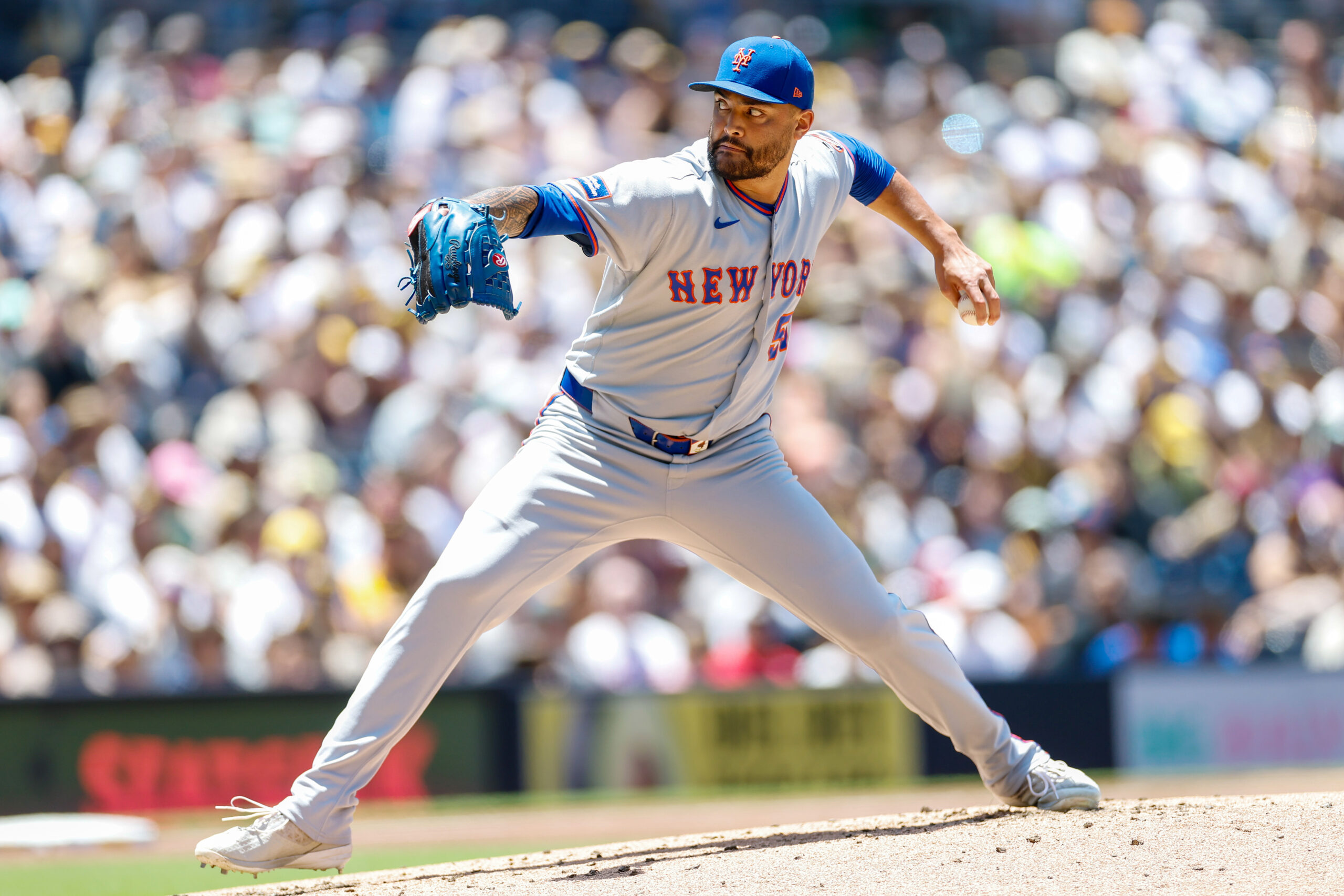
Then his next outing on May 10, he saw a velocity spike. Across 20 pitches he averaged 91.3 miles per hour. A week later on May 17, he threw 57 pitches and averaged 91.6 miles per hour. From May 10, onwards Sean Manaea has averaged 91.1 miles per hour on his fastball and 91 miles per hour on his sinker. He has thrown as hard as 93.9 miles per hour and has thrown 26.2 innings to a 3.04 ERA, 3.49 FIP, and 1.01 WHIP.
To be clear, this is a small sample size but with the Mets injury concerns, it is worth looking into how much Sean Manaea’s velocity changes him as a pitcher and whether or not he should get the opportunity to fully rejoin the rotation.
David Frerker-Imagn Images
What Has Changed?
Obviously the biggest change is that he is throwing harder. Adding two miles per hour may not seem like a huge change, but it has improved his arsenal from the top down. Through the end of April, batters were slashing .279/.354/.512/.866 off his fastball. Since his velocity increase, they are slashing .107/.188/.286/.474. That is roughly the difference between Bryce Harper and James McCann. Against his sinker, batters were slashing .417/.588/.667/1.205 but since the velocity increase they are slashing .258/.281/.290/.571.
His sweeper has also played up, going from a 27.8% whiff rate and 34.1% chase rate to a 35.7% whiff rate and 35% chase rate. He is throwing his sweeper a full mile per hour faster and is generating three inches more of horizontal break.
Across the board everything under the hood looks improved.
Before his velocity jump:
- 39.7% hard-hit rate (66th percentile)
- 22.3% strikeout rate (56th percentile)
- 21.8% whiff rate (29th percentile)
- 30.3% chase rate (44th percentile)
- 10.2% swinging strike rate (30th percentile)
- 89.4 miles per hour average exit velocity (30th percentile)
- 9.7% walk rate (21st percentile)
- 33.8% ground ball rate (7th percentile)
- 13.2% barrel rate (4th percentile)
Since his velocity jump:
- 5.7% barrel rate (98th percentile)
- 85.7 miles per hour average exit velocity (96th percentile)
- 35.7% hard-hit rate (86th percentile)
- 25.5% strikeout rate (81st percentile)
- 6.6% walk rate (74th percentile)
- 33.5% chase rate (84th percentile)
- 11.6% swinging strike rate (58th percentile)
- 23.8% whiff rate (52nd percentile)
- 40.8% ground ball rate (44th percentile)
This is not jsut an improvement. This is the difference between a fringe backend starter and a mid-rotation starter with number two upside.
There is one major caveat here: Manaea has yet to throw more than 84 pitches in an outing yet. His 84 pitches came in his most recent outing against the Braves where he did still go six innings allowing two earned runs. The good news is that even with the elevated pitch count he still averaged 91.2 miles per hour on his four-seam fastball and 91.6 miles per hour on his sinker.
Photo by Ed Delany of Metsmerized
How Does This Compare to 2024?
Sean Manaea will likely never be the pitcher he was the second half of 2024. Not even because of the bone chips in his elbow—that is unlikely why he has struggled. Many pitchers pitch with them for years and it is very atypical to remove them unless the pitcher is in pain or they are pressing against a ligament. Per Courtney Hollman of MLB.com, Edwin Diaz had bone chips in his elbow similar to Sean Manaea for his entire Mets tenure and did not feel discomfort to the point of needing removal until this season, 14 years after he noticed them.
The most likely factor that has worked against Sean Manaea is father time. Manaea is 34 years old now. After his first outing of spring training, Manaea confirmed when talking to SNY that he had a late start in his throwing program and game action. It is possible could have also attributed to the delay in his velocity build up.
All of that said, in this small sample size, he has been closer to 2024 than you might expect.
Four-Seam Fastball
In 2024, Manaea averaged 92.2 miles per hour on his four-seam fastball compared to 91.1 miles per hour since May 10 this year. He generated 10.9 inches of induced vertical break in 2024 vs 10.5 inches in 2026 and 13.8 inches of horizontal break compared to 13.2 inches. His -4.5 vertical approach angle is almost identical to the -4.4 in 2024. His 2028 rpm of spin is also almost identical to his 2013 rpm in 2024.
So while the velocity is is down just over one mile per hour, his pitch shape has remained largely unchanged.
Sweeper
Manaea is throwing his sweeper two miles per hour slower than he was in 2024 but with an almost identical iVB (1.7 vs 1.5). He is throwing from a slightly lower arm angle than 2024 (16 degrees vs 18 degrees) which has allowed him to generate -15.8 inches of horizontal break compared to -13.1 inches in 2024. He is throwing it out of the zone far more often which has led to a drop in whiff, but significantly more chase (35% vs 30.3%). He is also generating significantly more spin at 2308 rpm vs 2169 in 2024.
Sinker
His sinker is coming in at 91 miles per hour compared to 92.2 miles per hour in 2024 and he is throwing it with a much different shape. This has turned it into much more of a chase pitch that moves more arm side at 18.5 inches of HB vs 16.9 inches in 2024 and is coming in at 4.5 inches of iVB vs 9.6 in 2024. This has turned it into a pitch that surpasses hard contact better and generates more ground balls, but also takes away a swing a miss weapon.
Cutter and Changeup
These were Manaea’s least used pitches in 2024, and he is especially using his changeup even less in 2026 going from 11.7% down to 3.3% of the time. His changeup is profiling much weaker this year with more spin and worse movement and is now more of a pitch used to change things up when needed (pun intended).
His cutter, despite being slower, looks much stronger than it did in 2024 which is likely why he is throwing it 10.6% of the time vs 7.0% of the time in 2024. Despite coming in at only 84.1 miles per hour, he is getting significantly more horizontal break (-3.3 inches vs -0.1) without sacrificing too much iVB (6.4 inches vs 7.6). His 2136 rpm of spin is almost 100 rpm more than his 2040 rpm in 2024. It isn’t a plus pitch by any means but it looks much more like a league average pitch for him to mix in.
The Improvements Look Legit
Sean Manaea is not the 28% whiff, 28.4% strikeout rate, 14.2% swinging strike, and 33.2% hard-hit rate borderline ace he was at the end of 2024 even with his jump in velocity. He is generating significantly more swing and miss than he was the first few weeks of the season, but he is relying on weak contact far more than he was in 2024.
Manaea will likely give up a little of his gains as he gets stretched out more. He may even have some bad outings, especially outings where the velocity could dip earlier if he is fatigued.
But he is showing that if he can keep this up, he could maybe be a starter that shows flashes of who he was in 2024 and if he can maintain his velocity enough, maybe even maintain a ERA under 4.00 the rest of the way. Or, this last month could be a blip and his next start after this article comes back he could be throwing 89 miles per hour and get crushed. I would like to be an optimist and say I hope that Sean has turned a corner and can be a stable factor at the back of a rotation that very quickly now needs quality innings. And maybe if we are lucky, this can carry over to 2027.