Credit: Robert Edwards-Imagn Imagest
2026 was supposed to be the year.
The year in which Francisco Alvarez and Luis Torrens, confronted with the realities of the Automated Ball-Strike System (ABS) debuting in Major League Baseball, turned the leaf towards stronger offensive production and away from the defensive-centered skillset that had defined the position over the last decade.
And yet, the pair’s strong framing marks in 2026 epitomize an unexpected trend. Offensive production by backstops has tailed off. And strong catcher defense hasn’t let up.
In both 2025 and 2026, at least 25 backstops generated positive framing runs. 2025’s leader, Patrick Bailey – the poster child for top-shelf catcher defense — still ranks among 2026’s best framers.
Bailey represents an archetype that’s emerged as foundational for modern roster construction: the all-glove, no-bat starting catcher. It’s a profile desired by several analytical, numbers-crunching front offices, cognizant that the positive runs tallied on defense outweigh the runs cost on offense.
Bailey’s recent trade to the Cleveland Guardians emphasized the still-present, realistic cost of acquiring strong behind-the-plate defense. The Giants sent Bailey to Cleveland in exchange for a first-round competitive balance pick and one of their top starting pitching prospects, a hefty package even given Bailey’s sterling defensive chops.
Before the 2026 season, catching defense was measured by framing. Now, ABS dictates the value of catcher defense. The question is simple: What good is framing if it can be reversed via a simple tap on the head?
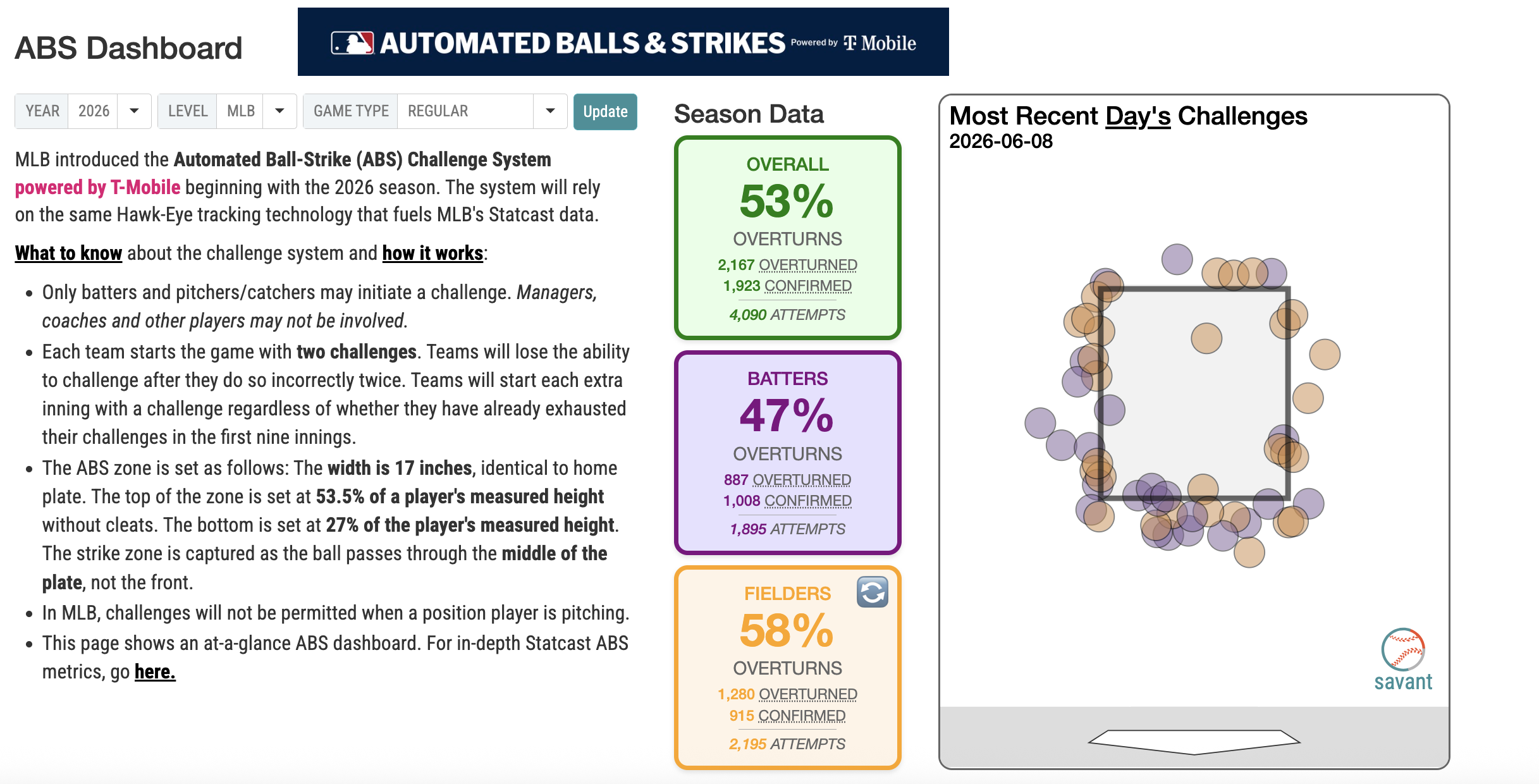
For those uninitiated with the challenging procedure, teams are granted two overturns a game through a technology-driven system, thoroughly tested in the minor leagues over the last three seasons. Challenges can be requested by either a pitcher, a catcher, or a hitter. Baseball Savant summarized the season’s ABS data rather succinctly.
The club does not have a Patrick Bailey donning the orange-and-blue to buttress their defense behind the plate. But they do have Luis Torrens. A gifted defender, Torrens stepped into the starting role after Francisco Alvarez tore his meniscus midseason.
Both Alvarez and Torrens provide value behind the plate. This season, Torrens has racked up eight defensive runs, which ranks second in the majors, while Alvarez has made strides in his defensive repertoire.
Each backstop debuted in the majors before the challenge system became widespread in the minors. Despite their limited experience, both Torrens and Alvy have tackled the new endeavor with aplomb. Torrens gained four more overturns than expected, while Alvarez’s challenge record sits over .500.
Both backstops do well to challenge at impactful times.
Of course, not all challenges are the same. Challenges in the first inning with the game tied don’t equate to a blowout in the eighth. The former could decide the game’s end while the latter could result in a few grinded teeth in the stadium’s grandstands.
Catchers need to play the game – challenge early enough so the tap on the noggin is impactful, but not too early to burn the two overturns that teams are allocated.
A simple way to visualize this data is to check which innings the Mets tend to challenge.
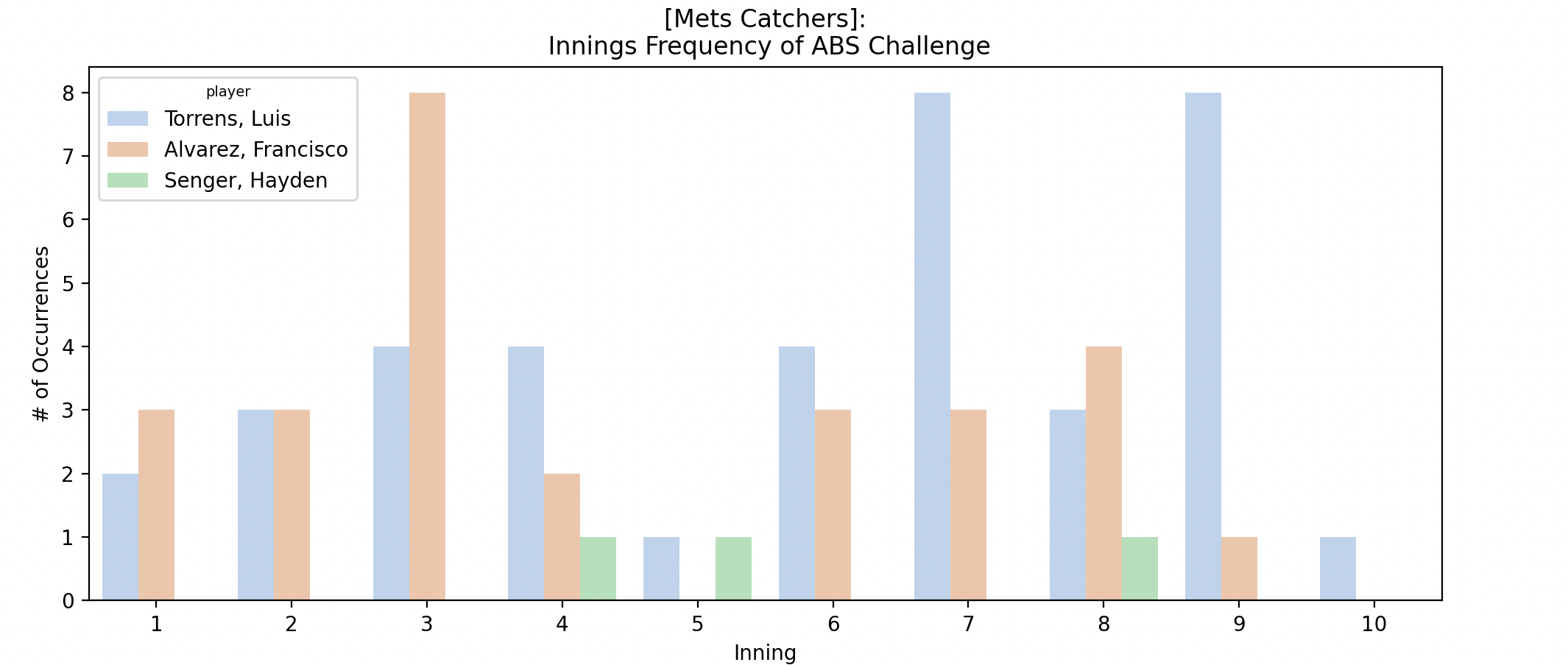
On average, Alvarez tends to challenge early in the game while Torrens is a bit more conservative.
One can already find faults just by visualizing the data through this lens. It ignores the score, a somewhat important factor in a game’s outcome.
That’s where leverage factors in.
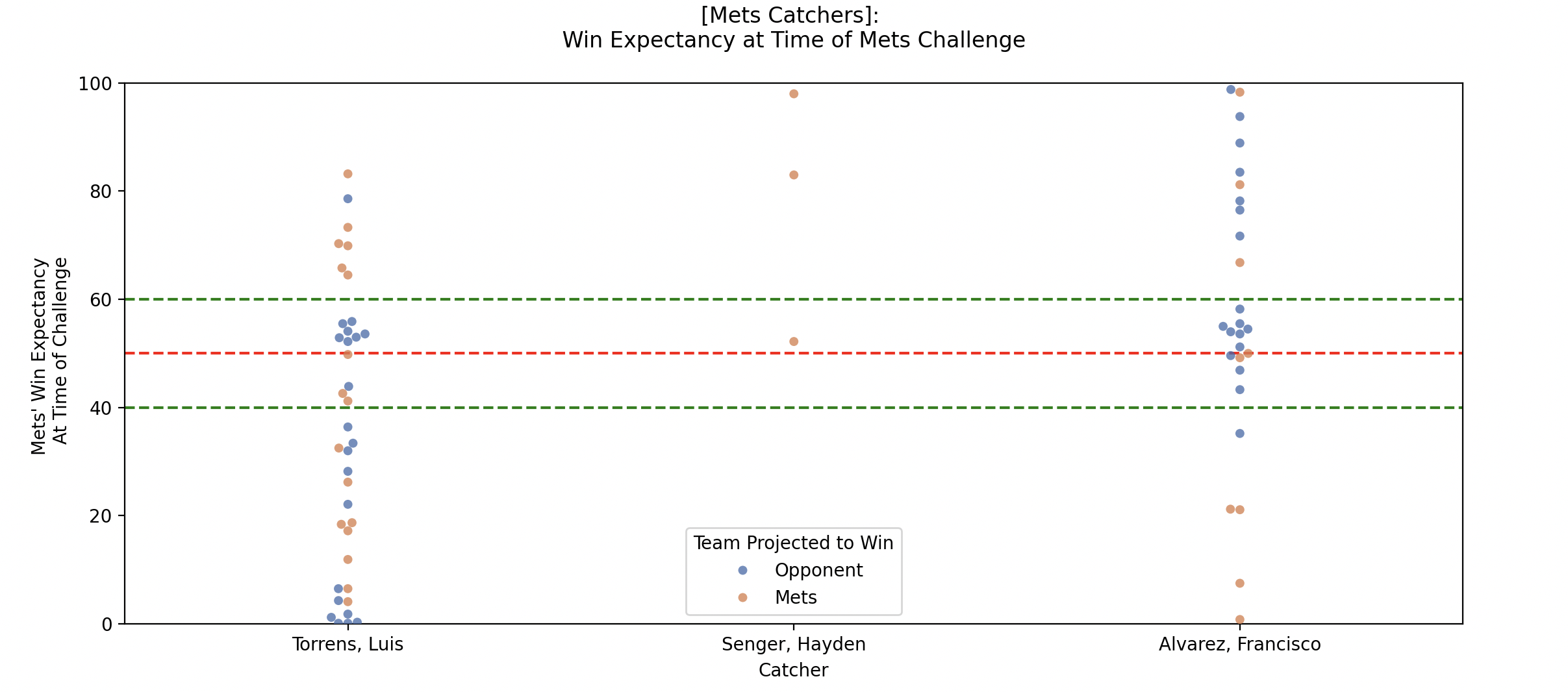
On an aggregate level, Torrens challenges when the Mets have a 38% chance to win, which pales in comparison to the Mets’ 57% WP when Alvarez challenges. Both Torrens & Alvarez requested an overturn a similar number of times while the game was close, a threshold defined by my own arbitrariness, as highlighted by the green, dotted lines. The red line represents a 50% win probability.
The pair takes different paths to challenge when the game isn’t close. When the Mets stand a high chance of emerging victorious, Alvarez calls for a review. Torrens, on the other hand, tends to request a challenge when the game is out of hand for the Amazin’s.
His most valuable challenge, as calculated via the difference in win expectancy before and after the at-bat when the challenge took place, came on a 0-1 pitch in the ninth inning to Seiya Suzuki with the speedy Scott Kingery bouncing off first, representing the tying run. The at-bat, aided by Torrens’s collected call, added 3% to the Mets’ win probability.
Torrens’s defensive story is worth retelling; his defensive chops received the “Ben Clemens” treatment in a 2025 Fangraphs article, he was a finalist for a Gold Glove the same season, and he recently received a two-year contract extension. His value behind the dish also extends to ABS, where the defensive savant excels at challenging when the Mets’ chances at winning the game are within reach.
Tenure may explain the difference in challenge strategy.
Alvarez may feel unconfident tapping his head while donning the tools of ignorance due to a lack of experience. After all, his rapid ascent up the Minors culminated in the 24-year-old only spending 253 games in the Minor Leagues. Further, Alvarez may not have the game knowledge that Torrens, the grizzled vet, does.
If Alvarez’s first rehab game with the Triple-A Syracuse Mets, where he overturned a two-strike ball call with ducks on the corners in the first inning, provides any indication, he’s well on his way to eclipsing Torrens’s defensive impact.
Data as of 5/8/2026. Only include challenges initiated by the catcher while on defense. Further analysis could include finding the delta in Run Value on a challenge based on RE288 calculations.
Code Repo:https://github.com/MancusoM/ABS_Studies