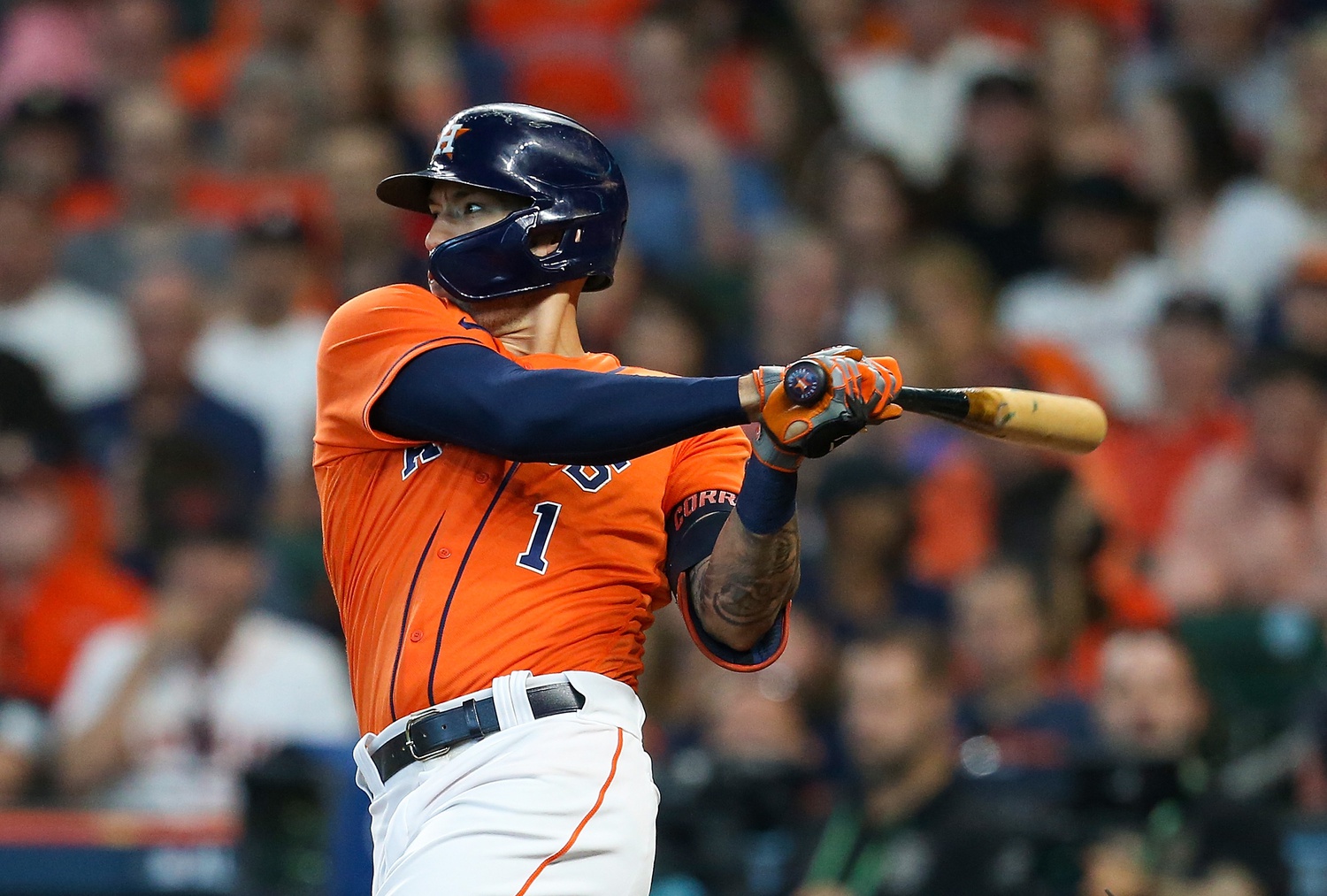
Mandatory Credit: Thomas Shea-USA TODAY Sports
MLB’s Hot Stove season is officially upon us, folks. Impending free agents are now officially free agents, qualifying offers have been extended, and soon enough, lots of money will be spent in advance of pitchers and catchers reporting in February.
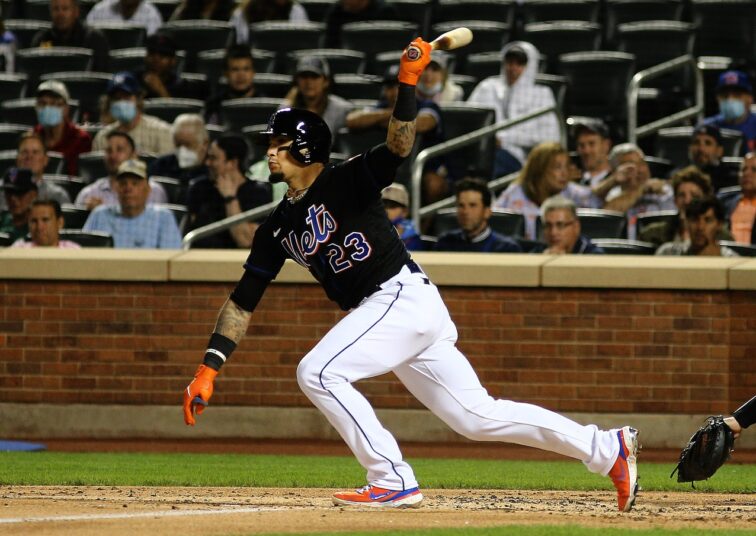
It’s still early, but it seems like one of the most frequently discussed topics regarding the New York Mets and free-agent acquisitions revolves around Javier Báez and Carlos Correa. Specifically, there’s this dream floating out there on #MetsTwitter about an infield featuring Pete Alonso, Francisco Lindor, Correa, and Báez.
Don’t get me wrong — that sounds incredible, especially because we know it’s something team owner Steve Cohen could afford. I won’t believe that’s a real possibility until I see it happen, though. If the Mets are fortunate enough to legitimately have a choice between these two, there is no wrong answer — they’re both top-tier players that can make an impact on a daily basis.
However, if given that choice, I think Báez is the better fit for this team in the upcoming year and the foreseeable future.
Why The Ideal Scenario Likely Doesn’t Work
Mark Berman of FOX 26 reported over the weekend that the Houston Astros offered a five-year, $160 million offer to Correa. That’s probably not getting the job done, especially since Houston offered him a five-year, $125 million deal this past spring. After posting a career-high 5.8 fWAR in 2021, Correa likely believes his value is much higher than that, and the projections from FanGraphs and MLB Trade Rumors are probably more in line with what he’s looking for.
We know Cohen is willing to do blow past the luxury tax threshold in the right situation, but if last winter taught us anything, it’s that the Mets won’t just throw money around because they can. If that were the case, George Springer would probably be a Met right now. So, unless he decides to burn everything to the ground and sign as many top free agents as possible, they’re going to have to pick and choose in order to field a competitive team with a deep roster.
Giving the Lindor-Báez Connection More Run
We just saw a preview of what a Lindor-Báez connection up the middle could mean for a prolonged period of time, and the initial results were terrific. It was a treat watching them turn a double play.
The always beautiful Baez to Lindor double play. 😍 pic.twitter.com/3DcQGjjQNW
— Metsmerized Online (@Metsmerized) August 29, 2021
Outside of that, they each put together an excellent September at the plate, which was the only full month they were both healthy and on the field together.
In his final 115 plate appearances of the season, Báez slashed .347/.426/.554 with five home runs, 14 RBI, and 21 runs scored, which was good for a 169 wRC+. In Lindor’s final 130 plate appearances, he slashed .257/.346/.549 with nine homers, 25 RBI, and 23 runs scored, which was good for a 138 wRC+. Báez accumulated 1.4 fWAR over this time, while Lindor was right behind him at 1.2, putting them among the top 30 position players in baseball over the final month of 2021.
Yes, I know this was just one month. However, between seeing their obvious chemistry in the field and how they each had their best month of the year while playing together, I can’t help but think about what a full year with those two could look like. Another great area about Báez’s game is his base running. The Mets once again ranked among the league’s worst in stolen bases and BsR (FanGraphs’ base-running metric). Between New York and Chicago, Javy stole 18 bags — his fifth year with at least 10 steals — and his BsR was 3.0. Outside of 2020 (when it was -0.4), Báez has never finished a season with a negative BsR. As for Correa, he hasn’t stolen a bag since 2019, and his BsR has finished on the wrong side of zero in three of the last four years.
Am I nitpicking here? Yes, but improving on the base paths — not just stealing bases — is something the Mets have badly needed in recent years. In addition to solid defense and an above-average bat, Báez also provides some much-needed competency while on the bases to New York.
Putting it in Perspective
Despite these hypothetical discussions and dream scenarios for the Mets infield, it will all depend on how the market plays out in the coming weeks for the 27-year-old Correa. In a very unofficial poll in the middle of September, MLB insider Jon Heyman asked a bunch of executives which free-agent shortstop would command the biggest payday and Correa won that battle.
I polled 25 MLB executives as to which great shortstop would get the biggest deal this winter for @MLBNetwork Here are the results. #MLBCentral pic.twitter.com/2oI0sdErs0
— Jon Heyman (@JonHeyman) September 10, 2021
It’s still early, but at the moment, the Detroit Tigers (let’s not forget Correa’s former manager, A.J. Hinch, is there now), and the New York Yankees are two potential suitors, according to another poll of executives, this one done more recently by ESPN’s Buster Olney. If a team like the Yankees comes calling and is willing to come close to his asking price, my guess is Correa’s preference is to be someone’s starting shortstop.
Whenever there’s talk involving the Mets making a huge splash by signing the top free agents, I think about what Cohen and Sandy Alderson said a year ago during their introductory press conferences — they want to build a perennial contender and an iconic franchise. That doesn’t happen by simply throwing a bunch of money at the organization’s problems. It happens by flexing financial muscles strategically while also building up a deep and productive farm system (like, you know, the Los Angeles Dodgers).
I’d love to have both in Queens, but if I was the one choosing, I’d prioritize Báez over Correa. He’ll come on a cheaper contract that’ll allow the Mets to address the many other issues facing them this winter, and he’s already experienced the ups and downs in New York. Even with a slow start, a stint on the injured list, and temporarily being enemy No. 1 because of the thumbs-down fiasco, Báez still found a way to shine on the field.
Both of these players are among the league’s best, but if we boil it down to overall production, are they that different? Since 2016 (the year Báez become an everyday player), Correa has slashed .276/.358/.476, with a 127 wRC+ and 21.7 fWAR. Báez has slashed .271/.312/.490, with a 107 wRC+ and 17.8 fWAR.
Projections have one commanding $250-300 million this winter, and the other could be around $80-100 million. That’s a huge difference, and maybe they’re not as different from a production standpoint as many think.