
Mandatory Credit: Brad Penner-USA TODAY Sports
The Mets swept a three-game series with the Arizona Diamondbacks over the weekend, notching their fifth straight win in the process. They sit at the top of the NL East again with a 16-13 record.
This series featured much of what previous series did — wonderful pitching and offense that left runs to be desired. But the Mets scored four runs in three straight games, and they’ve now scored at least four runs in eight of nine May games.
Things are trending in the right direction, though, with a couple off days (much needed for the pitching staff) and a short series with Matt Harvey and the Baltimore Orioles at Citi Field starting on Tuesday.
3 Up
Team Chemistry
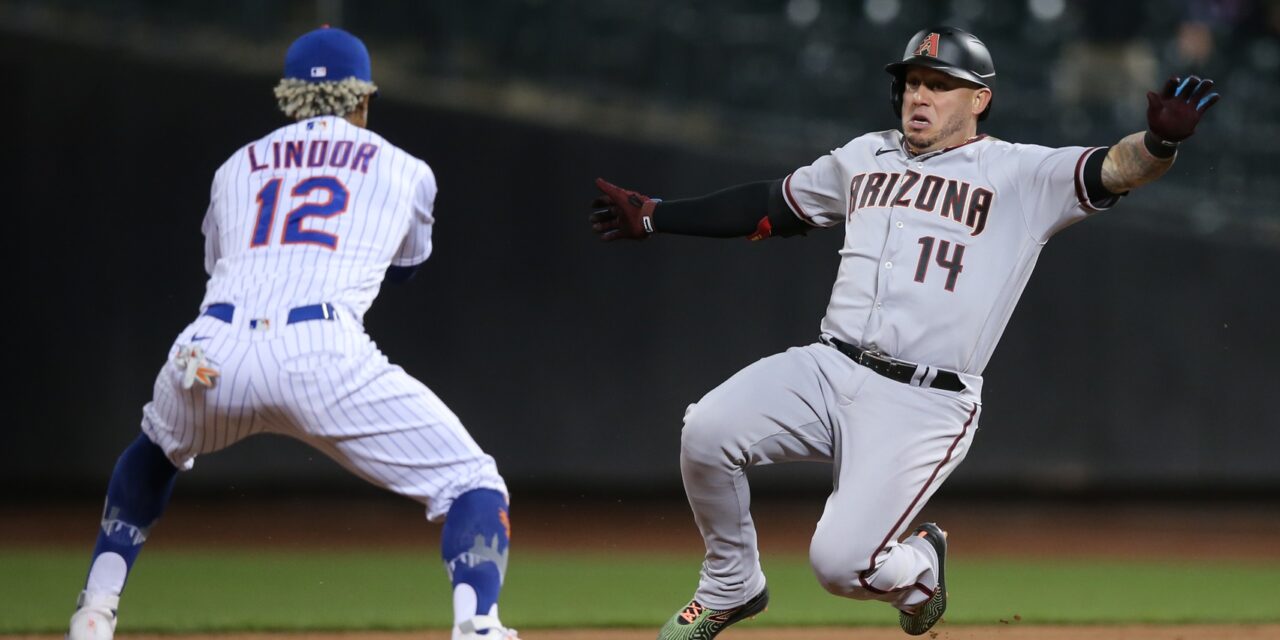
The keynote of the series (allegedly) featured a tussle in the tunnel between Jeff McNeil and Francisco Lindor, stemming from a miscommunication on a ground ball up the middle. (More on that later.) Whatever came of it, Lindor hit a two-run homer to tie Friday’s game, which wound up as the Mets’ best win of the year.
The team clearly decided they were going to make up a bizarre-rat-or-raccoon-in-the-tunnel story to cover for Friday’s events, and by the end of Saturday night’s game, Lindor and McNeil were all smiles with each other.
"That was a ratcoon. A ratcoon."
Francisco Lindor gives Jeff McNeil a big hug and congratulates him on his night 😂 pic.twitter.com/xRsf8HmpN1
— SNY (@SNYtv) May 9, 2021
Lindor admitted after Friday’s game the miscommunication on defense was his fault, too. The Mets’ team chemistry has clearly come together over the last couple of weeks between Donnie Diesel and now this. These keep-it-in-the-clubhouse moments help with that. But let’s be honest: so does winning.
Francisco Lindor Is Percolating
Francisco Lindor finally broke out of a lumbering 0-for-26 slump in his final at-bat of the St. Louis series with a single. That, along with three walks Thursday, seemingly catapulted Lindor into the Arizona series with a better mindset at the plate.
He ended the three-game series going 5-for-11 with a walk — his best offensive series of the year. His averaged jumped 37 points and his on-base percentage jumped 39 points since the start of Thursday’s game.
Oh, and there was this home run in a mammoth moment.
An absolute BOMB pic.twitter.com/DIiAqOmzal
— Metsmerized Online (@Metsmerized) May 8, 2021
Lindor is certainly trending in the right direction. Now that he’s gotten some good swings on balls, it’s time to get the power going.
Jeurys Familia‘s Performance
Jeurys Familia was been flat-out awesome so far in a fourth- or fifth-arm role out of the bullpen. After a topsy turvy first two years of his three-year contract, Familia has re-discovered his ability to get outs via the strikeout and on the ground.
As Mathew Brownstein points out, Familia is throwing more pitches in the zone, resulting in fewer walks — the crux of Familia’s game the last couple years. His walk rate sits at 9.1 percent, the lowest since 2015.
Familia is also inducing a ton of weak contact. He ranks in the top two percent of the league in average exit velocity (83 miles per hour), and he hasn’t allowed a single barrel on 30 batted balls, according to Statcast. His ground-ball rate sits at 60 percent, too, which is a top-10 mark among relievers.
His improvement has resulted in a 0.93 ERA and a nearly identical xERA and FIP (2.27 vs. 2.28).
This speaks to a larger improvement of the bullpen, and really the pitching staff, as a whole. The bullpen is sitting at a 3.04 ERA, one of the best in baseball. This series, the bullpen allowed three runs in 19.1 innings (not counting Tommy Hunter‘s scoreless “start” on Saturday). What many thought may be the team’s biggest weakness coming into the year has turned into its biggest strength so far.
3 Down
Using the Injured List
Well, well, well. Here we are again with the Mets not using the injured list.
Jacob deGrom having to leave the game with a right side issue — the same side issue that forced deGrom to push back his start from Wednesday to Sunday — is the latest in a stretch of the Mets not utilizing the injured list to their advantage.
J.D. Davis and Brandon Nimmo both hit the injured list a couple of days later than they probably should’ve, too, and the Mets at times this year have played with as many as three men down in games.
We can chalk deGrom’s re-aggravation in hindsight as something that was bound to come. Lat and oblique issues are known to be finicky and don’t always resolve themselves with one or two days of extra rest. The Mets could’ve placed deGrom on the injured list, had him miss a start (especially with two off days coming up), called up a spot guy and made sure his lat is fully healed before sending the best pitcher in baseball back out there.
Luis Rojas said the issue that caused him to leave Sunday’s game (more of an issue with his lower back) is different than the issue that caused him to miss his start Wednesday (lat soreness). But it’s not hard to see how an overcompensation of protecting the formerly hurting area caused an injury elsewhere.
Perhaps this time around they should use the upcoming 10 days of the injured list, three of which the Mets have off anyway, to give deGrom’s soreness a couple of extra days to calm down.
David Peterson‘s Wildness
For every two good David Peterson starts, it seems the Mets get one like they got Friday.
Rojas quickly pulled the plug on Peterson, who allowed six base runners in 1.2 innings. Three of them scored. Only 56 percent of his pitchers were strikes. He wasn’t really getting any swings and misses, either, with just four misses over 21 swings.
Peterson’s biggest problem was his wildness. Just under 33 percent of his pitches landed in the zone — more than 10 percentage points below his yearly average. Here’s a look at the pitch chart from Friday’s start:
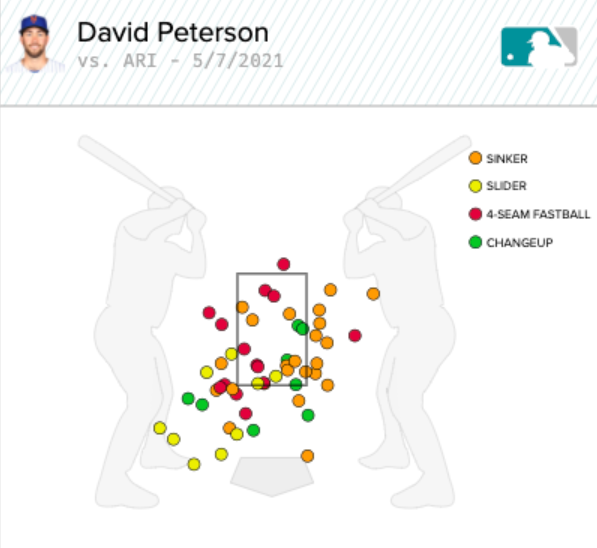
And his best start of the year so far (April 14 versus the Phillies) is below so you can see the difference:
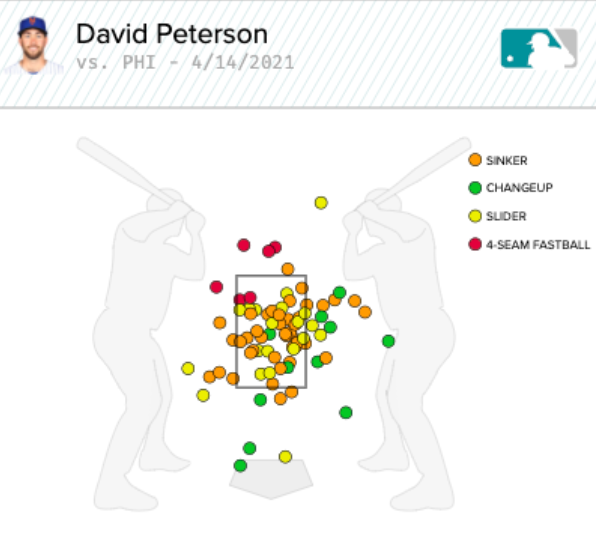
Rojas was right to pull Peterson quickly Friday, even knowing the following day he’d need to use his bullpen a lot, and it may have saved the Mets’ chances for the series opener. The lefty will look to rebound next weekend when the Mets head to Tampa to play the Rays.
Communication on Defense
The defense has been much improved this year, but there are always areas to fine tune things.
This series showed the communication on some 50-50 balls can use some tweaking, primarily with who’ll take charge.
There’s obviously the play that caused a tussle in the tunnel between Lindor and McNeil. It’s not the first time it’s happened to them this season, too, and Lindor admitted that the miscommunication is on him. That makes sense given Lindor should be the one taking charge of balls where he’s ranging to his left rather than McNeil taking the ball when ranging to his right.
But then there was a near collision in right-center field on Sunday between Kevin Pillar and Michael Conforto, and there was Edwin Diaz assuming Jonathan Villar or James McCann would take control of a pop-up that landed 30 feet in front of home plate. The Mets avoided disaster following on all three plays, but hopefully they are catapults to clarity in games to come.