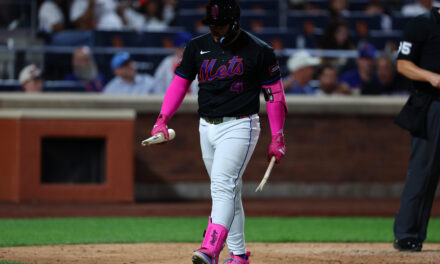

Add New York Mets pitcher Steven Matz to the endless list of people who are happy to see 2020 nearly in the rearview mirror.
Before the season was put on hold 20 years ago in March, there was reason for optimism regarding Matz. He finished 2019 strong, and after working with pitching coach Jeremy Hefner last winter, he flashed a mid-90s fastball with more regularity. His first start of 2020 was even more encouraging. Matz showed off that increased fastball velocity in a no-decision against the Atalanta Braves, allowing just one run on two hits, one walk, and seven strikeouts in six innings.
It all went downhill from there, as his Game Score of 69 (nice) was his best of the year. That appearance was also his only quality start of the season. Between underperformance, a trip to the Injured List, and time spent in the bullpen, it had to have been one of the more frustrating seasons in his lifetime.
Baseball is a game and it’s supposed to be fun, but it’s awfully hard to have fun while posting a 9.68 ERA and -0.7 fWAR in just 30.2 innings. It was likely mildly surprising to see the Mets tender the lefty a $5.2 million contract, but with Steve Cohen now in charge, the pros of keeping him in Queens clearly outweighed the cons from a financial perspective.
Things are already looking up for Matz from a comfort standpoint with James McCann becoming the squad’s starting catcher. McCann brings a great reputation behind the plate, as well as experience catching Matz’s bullpens the last couple off-seasons. One of the many positive attributes McCann will be bringing behind the plate is the ability to frame borderline strikes at the bottom of the zone. I’ve linked the below tweet from our own Mathew Brownstein before, but it’s important for today’s discussion once again.
James McCann’s strike rate in the bottom of the shadow zone (borderline strikes) since 2019:
35.8%
Wilson Ramos’s strike rate in the bottom of the shadow zone since 2019:
25.1%#Mets #LGM @Metsmerized pic.twitter.com/rXojKhwZyc
— Mathew Brownstein (@MBrownstein89) December 9, 2020
Although Matz struggled to a 4.89 ERA through his first 81 frames of 2019, his final 79.1 produced a 3.52 ERA. Between these two halves, the majority of the Mets’ rotation saw a significant spike in slider usage, Matz included. After tossing that offering at a 9.6% clip prior to the All-Star Game, his usage jumped to 19.8% in the second half. It’s not just the usage that increased, though — so did the value of the pitch. On a per-100-pitch basis, FanGraphs valued Matz’s second-half slider at 0.38. Its value was -1.14 in the first half.
This shift in pitch mix also included a significant drop in fastball usage from the first to the second half (51.4% to 46.7%). While being a successful big-league pitcher isn’t nearly this simple, it wouldn’t have been outrageous to assume Matz was planning to continue leaning a little more on his slider. After all, he tossed it a career-high 14.4% of the time in 2019 and the results were favorable as he increased the usage for the second straight year (4.3% in ‘17, 8.4% in ‘18), right? Not quite.
Instead of mixing all four of his pitches somewhat evenly, Matz became more of a fastball-changeup kind of hurler. Spending some time in the bullpen could’ve skewed this, but he only pitched five innings in relief. Either way, his slider usage dropped nearly 10 percentage points, as it went from 14.4% all the way down to 4.7%. Despite limited usage, the value of this pitch in 2020 was quite awful, too, checking in at an unsightly -3.60 on a per-100-pitch basis.
I mean, I don’t blame him for not throwing it as much when seeing that kind of number. When a pitch performs that badly, it’s easy to quickly lose confidence in it. What fascinated me, though, was that FanGraphs didn’t register him tossing a slider until his third start of 2020. Of the six starts he collected, he didn’t throw a single slider in three of them.
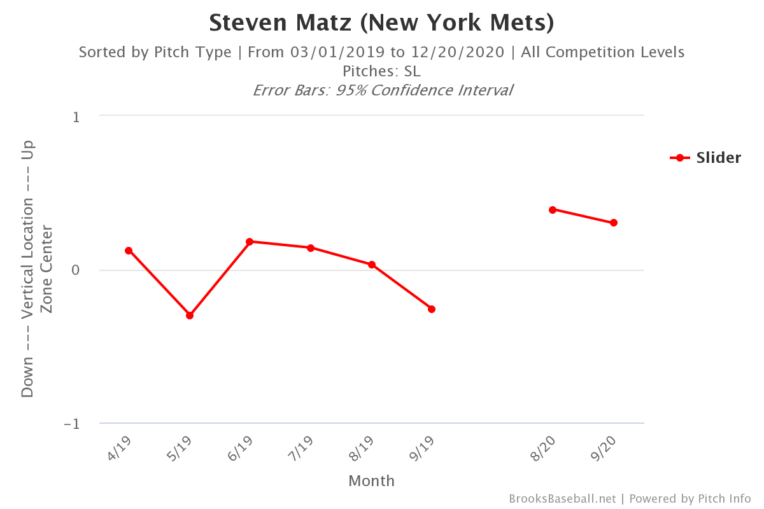
So, that would make me wonder if there was something else going on. You know, like if he didn’t feel comfortable throwing it down in the zone with Wilson Ramos behind the plate. This handy graph from Brooks Baseball shows that the pitch itself was landing higher in the strike zone than it did the year before.
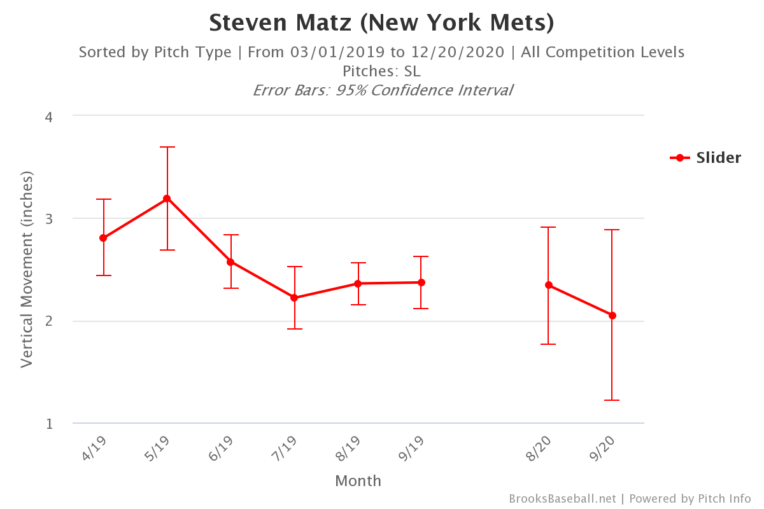
The same could be said about the movement of Matz’s slider. Here’s a look at how the vertical movement changed from 2019-20.
And here’s how the horizontal movement changed from year to year.
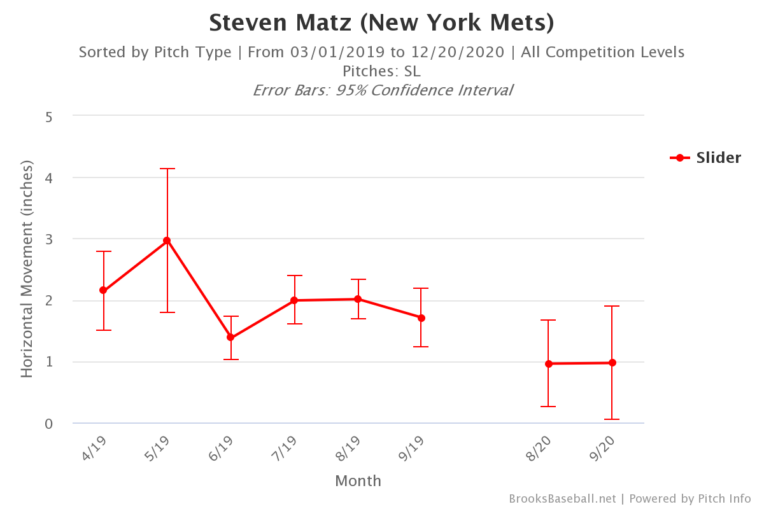
This is pure speculation, obviously, but if he really didn’t have enough confidence in Ramos’ ability to handle the pitch, it’s not at all shocking to see why his usage and execution of the pitch itself plummeted. Throwing more pitches that aren’t straight (i.e. fastballs and changeups) will be helpful in keeping opposing hitters on their toes more often. Having a catcher Matz knows and trusts behind the dish in McCann will allow him more brain space to solely focus on executing the pitch.
Plus, there’s plenty riding on 2021 for Matz on a personal level. He’ll likely be fighting for a spot in the rotation throughout Spring Training, and he’ll need to put it all together enough before hitting free agency next winter. With a new catcher behind the plate, this seems like the best shot the lefty has at rebuilding his value prior to hitting the open market.