

New York Mets ace starting pitcher, Jacob deGrom, is really good at throwing baseballs. That’s been established countless times on these very internet pages, but we’ll try to do it again because, well, we’ve been watching something special in Queens.
Technically, deGrom had a shot at earning his third straight National League Cy Young award last week because he was named a finalized, but most of us knew there was only a slim chance he’d actually win. His fellow finalists — Trevor Bauer and Yu Darvish — put up terrific numbers, and in the right-hander’s last chance to state his case during his final start of 2020, he simply just didn’t do enough to keep up. Sure, the 10 strikeouts were legit, but it was allowing three runs in just five innings that likely ended up tipping the scales toward Bauer.
Either way, it doesn’t make what he accomplished any less impressive, even if he was disappointed by not coming up big in that final start to secure hardware for the third straight year. The one thing that didn’t change, though? The fact that deGrom was once again the most valuable starting pitcher the Mets had on their roster. This was even more prevalent than in recent years because of the overall disappointing performance from the remainder of his rotation mates this past year.
It’s not surprising to hear that deGrom was also New York’s most valuable starter — when using fWAR as the measuring stick — in 2018 and 2019. If he was voted as the best pitcher in the league, also being the best hurler on his own pitching staff seemed like just a formality, and after taking another look at the numbers, that argument wins rather easily.
However, it’s interesting to see that long before he was viewed as one of the best (or, ya know, deBest) pitchers in baseball, he was already consistently the best in Queens — even from the moment he made his MLB debut in 2014. Upon remembering how the Mets’ rotation production had been top-heavy in recent years, I was curious as to what percentage of the overall total was a direct result of what deGrom produced on his own. Since only looking back a handful of years didn’t make sense or seem too fun at the time, I went all the way back to 2000 for this exercise.
The below table shows New York’s total rotation fWAR from each season and the top producer (with their fWAR in parentheses), along with exactly what percentage their production accounted for.
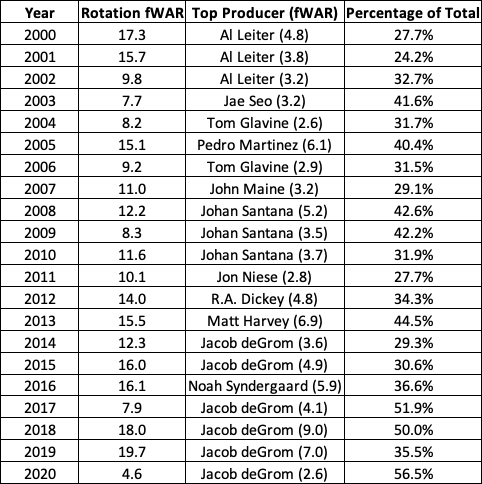
As we can see, there have been four occasions since 2000 where one pitcher has led the starting staff in fWAR for consecutive seasons: Al Leiter (2000-02), Johan Santana (2008-10), and deGrom (2014-15 and 2017-20).
What obviously sets deGrom apart from Leiter and Santana in these instances is how much his fWAR accounted for when compared to the entire rotation. For Leiter, he never accounted for more than 32.7% of the Mets’ total fWAR, and while Santana topped out at 42.6%, that percentage went down each of the two years that followed. DeGrom, on the other hand, has accounted for at least half of New York’s entire rotation production in just three of the last four years alone. It helps that he’s accrued an fWAR of at least 4.0 on four different occasions, which is more than Leiter and Santana combined (two — one each).
Noah Syndergaard certainly earned the Top Dog honors for the 2016 season, as he beat out deGrom by three full wins. However, who knows how he would’ve pitched if he was fully healthy and didn’t have his campaign ended prematurely because of nerve damage in his right elbow that needed to be repaired surgically.
When looking at the career fWAR leaderboard for pitchers in Mets franchise history, deGrom currently sits fourth behind Tom Seaver (68.0), Dwight Gooden (52.1), and Jerry Koosman (41.3) with 34.1 fWAR of his own. The shortened 2020 season didn’t help him make a huge move toward the top three like he probably would’ve, but he’s certainly within striking distance of passing Koosman if 2021 is a normal season (from the standpoint of games played, at least).
Will he eventually be able to catch The Franchise or Doc? The next couple years will be crucial for that as he enters his age-33 campaign next spring. Either way, the stretch of dominance outlined above from the right-hander is something similar to what Doc did in the 1980s when he burst onto the scene, as well as Seaver in the late 1960s/early 1970s. Accumulating fWAR in bunches is what’s going to get deGrom into the rarified Mets air when comparing his eventual numbers to theirs, but his perceived dominance — both to opponents and being head-and-shoulders above his own teammates on a consistent basis — is what’s already getting him a seat at that table.