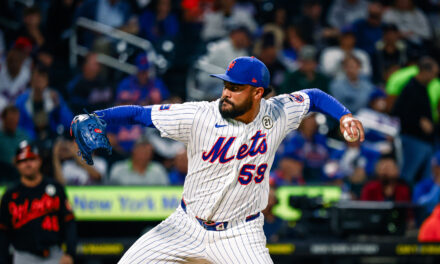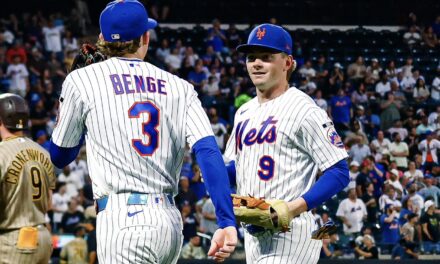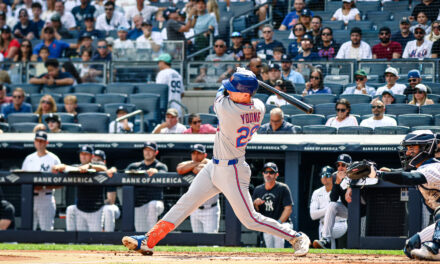

With the announcement that a Mets player and staff member have tested positive for COVID-19 and the cancellation of the Mets games on Thursday and Friday (at minimum), the realities of the 2020 season hit home for Mets fans.
Immediately after opening weekend, several Marlins tested positive. Then, several Cardinals tested positive the following weekend. On August 15th, the Cincinnati Reds were impacted, as one player tested positive. And now, it’s the Mets.
To date, 34 MLB games have been lost to COVID-19. In addition to the Mets, Marlins, Cardinals, and Reds, the Blue Jays, Orioles, Yankees, Nationals, Pirates, Tigers, Cubs, White Sox, Royals, and Phillies have now all lost games to the pandemic.
There are some scheduling anomalies that have resulted from the COVID-19 fallout. For example, the Cardinals will attempt to play 53 games in 44 days (including 11 doubleheaders) from mid-August to mid-September. MLB, at this point, plans to try to make up all the impacted games. As the number of canceled games increases, the viability of this strategy gets further called into question.
If teams do not play the same number of games, MLB could award post-season positioning on the basis of winning percentage. Teams playing unequal numbers of games is not unprecedented. In the strike-shortened season of 1981, teams did not play the same number of games. However, the season was divided in two halves, with post-season spots awarded to division winners from each half.
This resulted in some unfortunate results. The Cardinals had the best overall winning percentage in the NL East in 1981 (.578), but did not win the division in either half (the Phillies and Expos did). The Cardinals watched as two teams with lower winning percentages (Phillies .556 and Expos .551) battled in the first round of the post-season.
The NL West saw similar anomalous results in 1981. When the season stopped because of the strike, the Reds’ record was 35-21, while the Dodgers were 36-21. The Dodgers were declared first-half champions because they played (and won) one more game. The Reds’ bad luck continued in the second half, as they posted a 31-21 record, and finished second to the Astros at 33-20. The Reds went home as the Dodgers and Astros met in round one of the playoffs.
The American League’s story was similar. The Royals had a dreadful first half, but were given new life by the strike, They won the second half AL West title, went to the post-season, but their overall record was 50-53. The 57-48 Rangers and 54-52 White Sox had to dust off their golf clubs the day after the regular season ended. Oakland won the division in the first half.
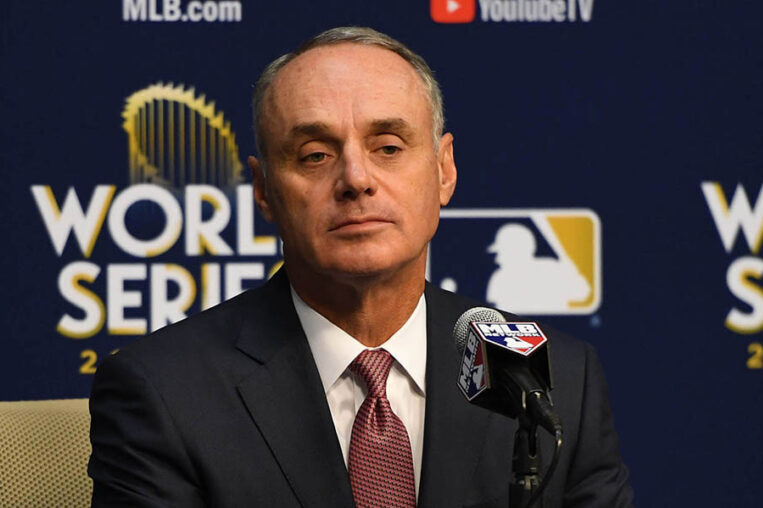
What this all means for 2020 is clearly TBD. If outbreaks continue and high numbers of games are lost, the integrity of the season will be questioned and Commissioner Rob Manfred may have to shut the game down. Manfred has expressed his firm desire for the season to continue, but at what cost, and when will the number of impacted games be too many?
Will MLB have to resort to winning percentage to award the eight playoff spots in each league? What if a team that played 10 fewer games than other teams has a higher winning percentage? Is that integrity?
If the season is played to conclusion, MLB is considering a playoff bubble, as the NHL and NBA are doing. This makes sense for many reasons. First, with expanded playoffs, travel would be eliminated. Next, if teams truly isolate in the bubble, the likelihood of COVID-19 outbreaks is reduced. The worst possible outcome if the post-season begins would be for it to end before a champion is crowned.
This may be the crossroads point for MLB. If the Mets’ cases remain at two, and there is limited impact on games with no or few additional positives in MLB for the next five weeks, the season may be able to be played with all teams completing close to same numbers of games. However, if the outbreaks continue and more teams and games are significantly affected, the Commissioner may have a hard choice to make.
As fans, all we can do is watch, and hope for the safety and health of the players and all involved.