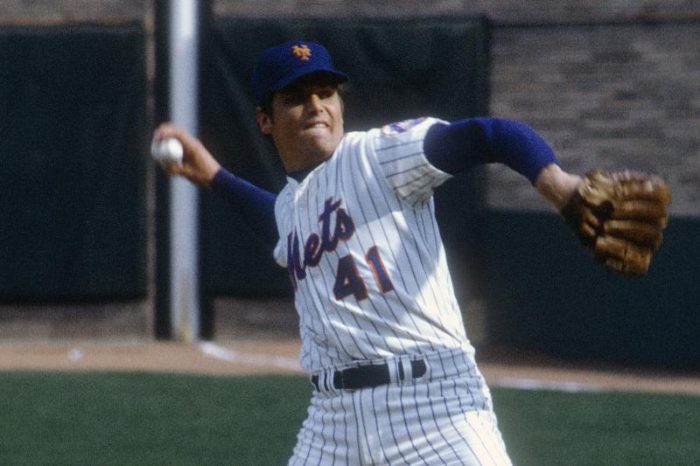

Five-and-two-thirds innings into his outing on April 22, 1970, Tom Seaver had faced 22 batters. Two managed to get hits and nine were strikeout victims. For any ordinary pitcher, it was a great day. For Seaver, who in three seasons had established himself as arguably the best at his position, it was a rather ordinary day.
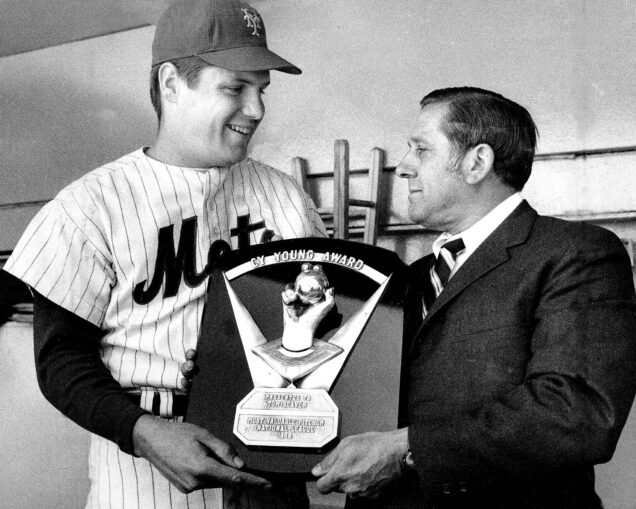
Prior to this mid-week afternoon encounter with the San Diego Padres at Shea Stadium, Seaver received the plaque for his 1969 Cy Young Award, the annual symbol of pitching superiority. Seaver would eventually deliver a performance befitting that honor – then took it to new heights, reaching a distinction no pitcher has achieved before or since.
We often hear of peak mound excellence described as “untouchable.” And often it’s done with embellishment. In the case of Seaver some fifty years ago, specifically for those final 3 1/3 innings, this was no overstatement.
During that span, nobody reached base. Nobody put the ball in play. It was a crescendo of power and precision unlike any in baseball history. When Seaver got Al Ferrara swinging to end the ninth, it was an exclamation point on one of the most brilliant chapters of his Mets career. The 19 strikeouts tied a major league record at the time. The 10 strikeouts in a row is a record that still stands. The fact that those ten ended the game only elevates the accomplishment.
“I might as well have played without a glove,” said Bud Harrelson. That wasn’t an exaggeration, either. The Gold Glove-winning shortstop never saw a ball come within his reach all day.
Harrelson was able to help out with his bat. A third inning triple delivered a go-ahead run and a slim 2-1 lead that Seaver went on to protect with impenetrable security.
He refused to give the Padres – an expansion club in its second season of existence – any hint of mounting a threat. The rhythm predicated upon his drop-and-drive delivery, which is forever his trademark, was operating at its most supreme level as the game reached the late stages.
“He got into a groove,” Ferrara told Newsday. “He couldn’t wait to get that ball and throw it at us. The guy deserved all the credit in the world because he was rushing it up there. He was about as fast as I’ve ever seen.”
Ferrara was the only Padre to give Seaver any trouble. He led off the second inning with a tying home run to deep left field and drew a walk in the top of the fourth. Dave Campbell soon followed with a two-out single which deflected off the glove of third baseman Joe Foy.
“Actually, he wasn’t that strong in the early innings,” his catcher, Jerry Grote, said. “He just kept building up as the game went on. The cool weather helped and by the end of the game he was stronger than ever.”
Campbell’s hit was the second and final one for San Diego. When Cito Gaston flied out to Art Shamsky in right field, no one knew there would be no more fair balls from the Padres lineup.
Seaver avenged his earlier struggles with Ferrara by getting him on a swinging strike three to end the sixth. He breezed through the seventh by fanning Nate Colbert, Campbell, and Jerry Morales. He did the same in the eighth, punching out Bob Barton, Ray Webster, and Ivan Murrell to surpass Nolan Ryan’s franchise single-game record of 15 K’s – which lasted all of four days.
“Everybody congratulated me when I got No. 16 in the eighth inning,” Seaver said to the New York Times. “I just told them, let’s get some more runs.”
He saw first-hand that Steve Carlton, who set the single-game strikeout record nearly seven months earlier against his Mets, lost 4-3 thanks to Ron Swoboda‘s two homers.
The Mets failed to provide any insurance. And as it turned out, Seaver didn’t need the help. The paid crowd of only 14,197 generated a building noise that made Shea feel as if it was at capacity. It got louder as Seaver swiftly dispensed with his ninth inning opponents. First, Van Kelly – set down on three successive fastballs. Then, Gaston – caught looking.
Only Ferrara – a Brooklyn native and classical concert pianist – stood in Tom’s way. But there was only room for one maestro.
On top of the Mets’ single-game record, Seaver had already set the mark for most consecutive strikeouts and tied the mark for most K’s in a nine-inning day game, while just one away from matching Carlton’s magical 19.
Preserving the one-run lead while facing the man responsible for the Padres’ only score, the margin for error remained small.
“I was still worried I’d make a mistake and Ferrara might hit it out,” Seaver said.
He used a pair of sliders and a fastball to bring the count to 1-2. Up to this point, Seaver had thrown 135 pitches, 95 for strikes. Eighty of those pitches were fastballs. Sixty-four of those fastballs were strikes. Seaver, with a mind as brilliant as anyone who ever took the mound, understood that he had to go with his best – even if it meant using the pitch Ferrara took deep earlier in the game.
“Then I thought, ‘What the heck. I may never come this close again. I might as well go for it.’”
Seaver went with his fastball. Ferrara was well aware of what was coming.
“I knew I was going to get the heat,” he said.
The pitch came toward the plate knee-high. Ferrara took a swing. But, really, he never had a chance.
“It was his best shot against my best shot,” Ferrara said. “He challenged me and he won.”
Grote ran towards the pitcher’s mound to shake the hand attached to Seaver’s golden right arm. The rest of his teammates, all of whom were witnesses to history, rushed to greet him as well.
Everyone was in a frenzy. All were in awe. All, except for Seaver — who downplayed the moment against a team on its way to a 99-loss season in comparison to his brush with perfection against the Chicago Cubs in July 1969.
“I’m not blasé,” he said in the locker room. “I’m very happy about it. But 19 strikeouts doesn’t exhilarate me as much as a perfect game.”
There are many methods by which to measure pitching greatness. The handful who’ve thrown perfect games and the select pitchers – Seaver included among them – who’ve tossed no-hitters have their deserved spot in baseball history. But what Seaver accomplished on a Wednesday afternoon against the Padres is uniquely his.
It’s a performance which even a half-century later, like Tom Seaver himself, continues to stand the test of time.