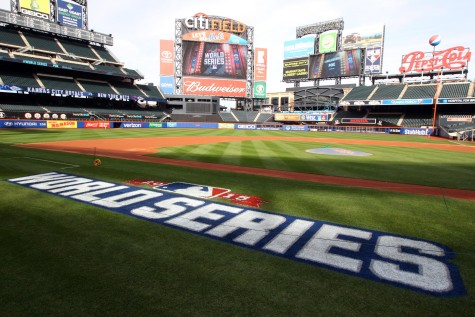
By Jack Hendon
The experience of watching the World Series every fall following the Mets’ run in 2015 is just as interesting now as it was in years past, but the stars of euphoria are still aligned a little more emotionally around this time every October. Something about seeing veterans leave it all out there, young studs make a name for themselves, and pitchers light up the stage in baseball’s final week registers differently, and the only rational explanation I can offer is that I’m not over the Mets falling to the Kansas City Royals.
It was exactly this time four years ago that I woke up to my team being down 2-0 in the series, coming back to New York desperate to make any sort of noise in front of their home crowd, just to creep back into the picture.
To this point, though, they looked pretty overmatched, and it just didn’t seem like it was meant to be: Jacob deGrom had gotten lit up like a Christmas tree that night before, and the whole group had let their first shot (and to that point, their clearest opportunity) slip in the 14th inning the night before that. Yoenis Cespedes was kicking baseballs and hitting into double plays. Travis d’Arnaud wasn’t throwing anybody out. Jeurys Familia was giving up runs for the first time in over a month.
It wasn’t that the season felt over, but rather that there were still two losses to get through before I could say “the season’s over” with a clear conscience. Needless to say, we got through those two losses – before most of us could go back to work on Monday, at that.
It seems painless enough, but climbing back inside those last couple of days in a storybook season, even today, stings a lot more than it maybe should… because somewhere along the way waking up that Friday, waiting what felt like an eternity for the third game, and eventually putting the anxiety to bed with the season, I saw a series turn on its head, albeit for a moment.
The thrill is a short-lived one, shrouded in the memories of Daniel Murphy botching grounders and Terry Collins mismanaging his bullpen. But it comes around again this time every year, and when teams are embroiled in a do-or-die dogfight as the Astros and Nationals presently are, everything in baseball reminds me of that weekend we saw a World Series in Queens… not so much a weekend the Mets lost, but more so a weekend that forever changed the way I pictured winning and losing.
The most appropriate place to start would be the first pitch, 8:08 EST, when Noah Syndergaard chucked a fastball over the head of Alcides Escobar. It landed in the netting of the backstop, but not before dropping the free-swinger on his ass and sending the crowd into a frenzy. All 45,000 fans collectively understood that a 23-year old rookie pitching in the Fall Classic didn’t just get nervous and miss his spot upstairs.
They all thought it was incredible, and as the roaring and banging grew louder and the camera conveniently panned to a once-composed Royals dugout now indignantly shouting profanities, I couldn’t imagine anything more daring. It was an unbridled, 98 mph challenge waged by a team that had gone without challenging anyone for too long, and a guy who’d had his lunch thrown away by veteran just months ago was ringing the bell.
Needless to say, if you weren’t paying attention to the series before that first pitch, you certainly were now. You wanted to see how Escobar swung the bat after getting his cage rattled. You wanted to see if it would change anything. Escobar buckled at the 1-0 curveball, barely fouled off the same offering on 1-1, and then stumbled out of the box swinging at a 99 mph fastball that ran about six inches inside.
One batter in and the place was buzzing like Syndergaard had just wrapped up a complete game. The Mets somehow came up to bat down 1-0 because the Royals were a factory that manufactured runs without skipping a beat, but the foundation had been laid for the first time: maybe the Mets can stand their ground and keep it competitive.
The next half inning is obviously memorable due to David Wright hitting his first home run in his first World Series at-bat in front of a home crowd – which was arguably the most captivating moment of his 15-year career as the offensive centerpiece of this organization. That much is known and perhaps worth its own feature.
There are all sorts of sentimental ingredients laced within that moment – at least in terms of the player himself: you have a captain coming back from possibly the worst upper and lower-body injuries of his career – to that point – and answering critics of his lackluster postseason numbers – also to that point.
His blast gave the Mets a 2-1 lead in a game that was in danger of running away on them if they didn’t immediately get back in the ring and start hitting. The fact of the game, the team, and in a larger sense that series, however, is that this match would take a lot more rounds. Whipping up base hits and stealing bases like the unit they were, Kansas City was ahead 3-2 by the middle of the third inning.
Just like the narrative couldn’t have been stolen by a blonde and brash rookie or saved by everyone’s captain, it was going to take the team rebounding and sucking us back in. Surely it becomes clear in the end – if it hadn’t already – that the Royals have the better team, but as a fan exposed to an entirely new emotionality of the sport within an entirely new stage of baseball on October 30th, I’ll keep watching – and maybe if I feel it, I’ll start believing.
This is a good time to talk about Curtis Granderson – who in some respects led in that series in ways that Wright and Murphy couldn’t, with three extra-base hits, four steals, eight walks, and eight RBI to this point in the postseason. He promptly followed a Syndergaard base hit by homering into the right field corner and giving New York a 4-3 lead. It was the second time in the game that the Mets had managed to tie and take a lead in the same inning. It was also the second time all series. It would also be the last.
Staked to another lead and backed by an elated, thunderous stadium, Syndergaard went on to retire the next eight Royals hitters in a row. Matt Harvey had accomplished a clean eleven between the second and fifth innings of game one, but the series had since turned against everyone in orange and blue. Conditions had changed, and Noah was merely bringing things back to equilibrium from the direst of straits, down 2-0 in a World Series.
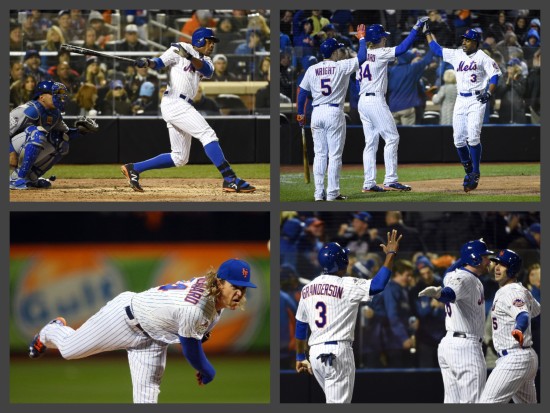
Lucas Duda and Travis d’Arnaudsingled and doubled in the bottom of the fifth before Michael Conforto squeaked out an infield hit for an insurance run. The Royals threatened by loading the bases with two out in the sixth, but Noah kept the lid on for one more hitter, working a 6-3 groundout from Alex Rios that, with Wilmer Flores lumbering around short on a windy, sub-50 night, could have gone downhill with even one misstep or extra bounce.
The Mets proceeded to score four in the sixth. Game four was tomorrow.
With some newfound momentum at home thanks to a gutsy start from a rookie and a rekindled offense, the Mets were alive and competing… all they had to do was hold on tight for a second-straight game. It was nice to wake up the following day knowing the series wasn’t over, but it was little consolation against the foreboding possibility of it unofficially ending again. They were going to need a quality performance from their hometown rookie in Steven Matz, and the offense was going to need another jumpstart.
We got just that in the bottom of the third inning, when Conforto took all 87 mph of Chris Young and launched him into the second deck in right to get New York on the board first. Granderson added a second run on a sacrifice fly, and Matz, through his first four innings had allowed just two hits while striking out four.
On the backs of an endearing lefty with six big-league starts, a second-generation athlete just one year removed from raking in the College World Series, and perhaps the clutchest, most charitable veteran on the team, my attitude had gone from emptiness to dread, then to curiosity, and now to love over 24 hours.
I saw love unveil itself in the form of waving towels, a bouncing stadium, and a resilient, eclectic team of veterans, personalities, superstitions, and above all else, heroes. I will always remember and cherish that high, and can even associate a lot of this current group with the Mets we’ve had the privilege of watching in 2019, from Brandon Nimmo to Marcus Stroman to Amed Rosario to Pete Alonso, to name just a few.
But love is only so fulfilling when you can win. The feeling you derive from watching something you love work out or watching someone you love succeed is something all the more empowering.
Suffice to say, when the Royals knock at the door in the fifth inning and go so far as to strand the tying run at second base as that vaunted top of the order gets closer to turning, winning means more than holding on. It means answering back, stepping on throats, pulling away… and for one point in time, the Mets looked like they were primed to do that. Michael Conforto leads off the bottom of the inning by flicking a low 2-2 curveball in the air to right field, and the ball never stops travelling. He got fooled out in front and still hit it into the bullpen.
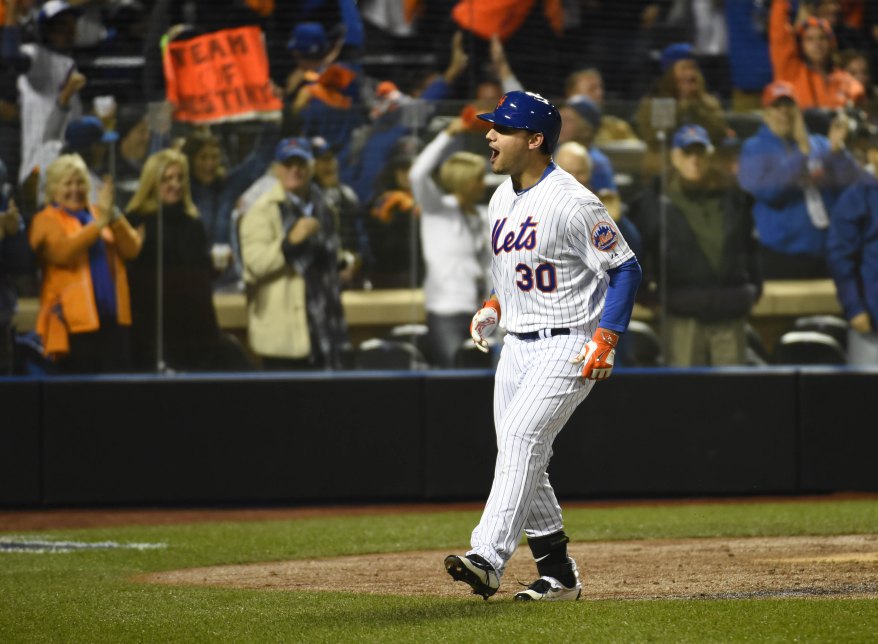
That was the answer back. That was the moment it felt like the Mets were going to win the game, tie the series, and with one more game to play in a completely delirious city, they were going to go back to Kansas City one win away. This was the team’s most inexperienced face putting a stamp on the series as something that nobody else was going to run away with. I had gotten a taste of winning in those final two innings of the Mets leading game four.
The Royals, of course, came back and stole the game by exploiting everything we needed to finish the job, but didn’t have. We didn’t have an infield, a well-managed bullpen, or a means of controlling the running game, and once they took the lead in the eighth, the clock ran out.
They snatched what had faintly appeared to be winning, and left me waiting. I waited in 2016, and then through two frustrating years in 2017 and 2018. Some fans, God help them, have been playing the same waiting game for 33 years. Hopefully, I will never have to experience that kind of torture. But I digress…
The World Series ends tonight. One team and its fanbase will have a concrete moment where the final out is recorded and they’re the last players standing on the season’s final frontier. The Mets are not going to be that team this year, though there’s a lot going for them now that was functioning the same way in 2015.
They are a Cespedes-level acquisition from having the talent. They have the experience with heads ranging from deGrom and Conforto to Robinson Cano. Now they need to chase the energy that followed them into the heat of that fourth game, and there is more than enough cause for them as a dynamic, lovable group of players.
But as fans, whether it’s the beginning of that deciding game or the day after when we wait for spring, all we can really do is watch. We may talk about it to alleviate the stress that comes from watching, maybe write or theorize to work around what winning would look or feel like, and hope that things change.
It was on this day four years ago that I first learned what it meant to watch, and with time I got to see what it meant to believe. But some things just need to be seen, and I miss the days when I could believe by seeing.