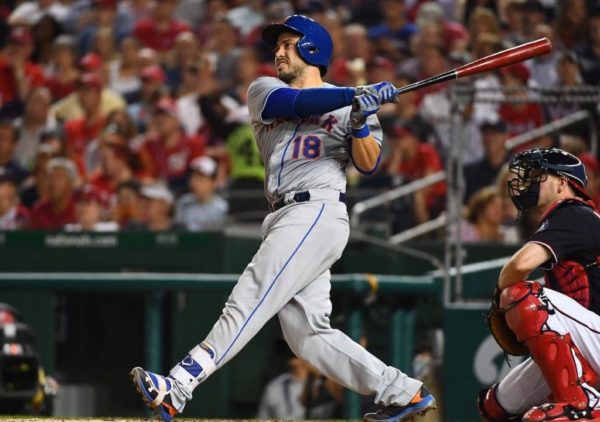
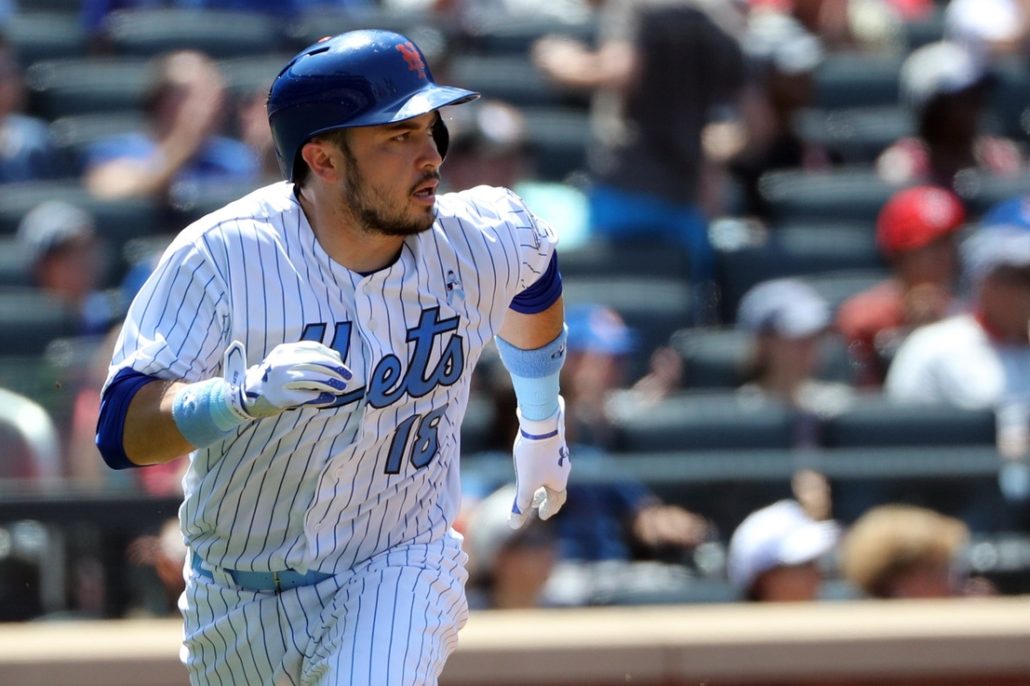
The knock on Travis d’Arnaud has always been his health, and it’s proven to be something he can’t seem to shake.
The Mets had high expectations for d’Arnaud since he was the signature piece in the deal that also included Noah Syndergaard for R.A. Dickey. But the catcher never quite lived up to the promise he had when he was one of the best catching prospects in the minors.
For the 2012 season, d’Arnaud was ranked as the No. 11 prospect in baseball by MLB.com, the No. 16 prospect by Baseball Prospectus and the No. 17 prospect by Baseball America and was widely considered the best up-and-coming catcher in the game.
That skill set never translated to the majors, as d’Arnaud has only played in over 100 games once in his career and holds a slash line of .243/.308/.401 across five big league seasons.
This season has been no different, as d’Arnaud is hitting a meager .218 with eight home runs and 24 RBI and has yet again missed time due to injury.
While d’Arnaud has turned out to be a disappointment for the Mets overall, the 28-year-old backstop could still be a valuable commodity for the team, but in a different capacity.
With d’Arnaud going 0-for-4 on Saturday you have to think one of the main priorities this coming offseason for the Mets is to get a reliable starting catcher and to relegate d’Arnaud to a backup role or move him altogether.
What do the Mets have beyond d’Arnaud currently?
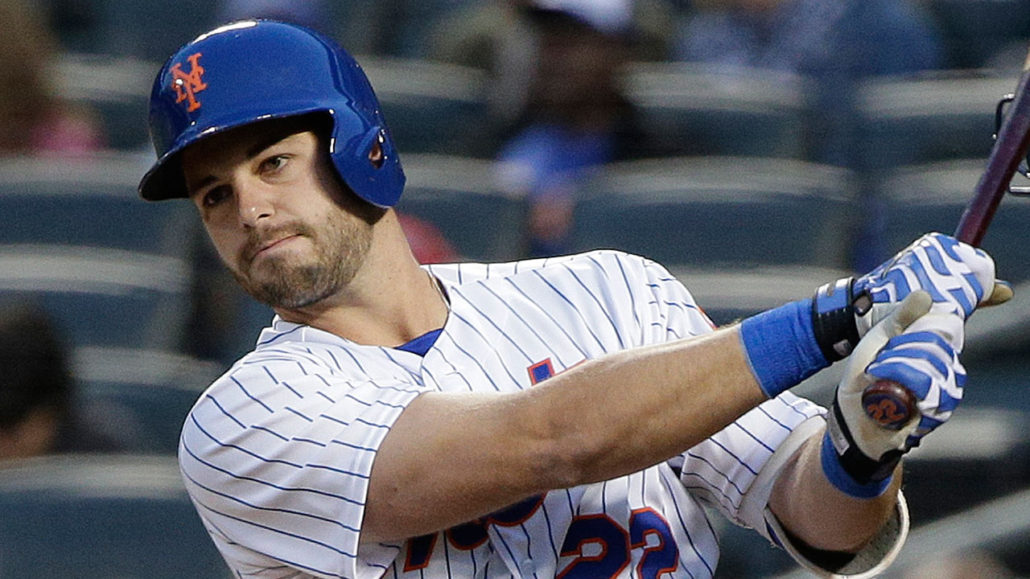
Photo courtesy of MLB.com.
Kevin Plawecki, a former first round pick like d’Arnaud, and has spent parts of three seasons in Flushing but has managed to hit just .206/.282/.278 with four homers and 36 RBI.
In 2014, MLB.com had Plawecki as the No. 2 Mets prospect behind only Noah Syndergaard.
Between Double-A Binghamton and Triple-A Las Vegas that season, Plawecki hit. 309 and looked as though he was on a fast track to the majors.
The 26-year-old is hitting a solid. 324/.354/.552 with the 51s in 2017, but hasn’t been able to translate that type of hitting at baseball’s highest stage. He is still young and could potentially have success in the majors, but it doesn’t seem like the Mets view him as a long-term option.
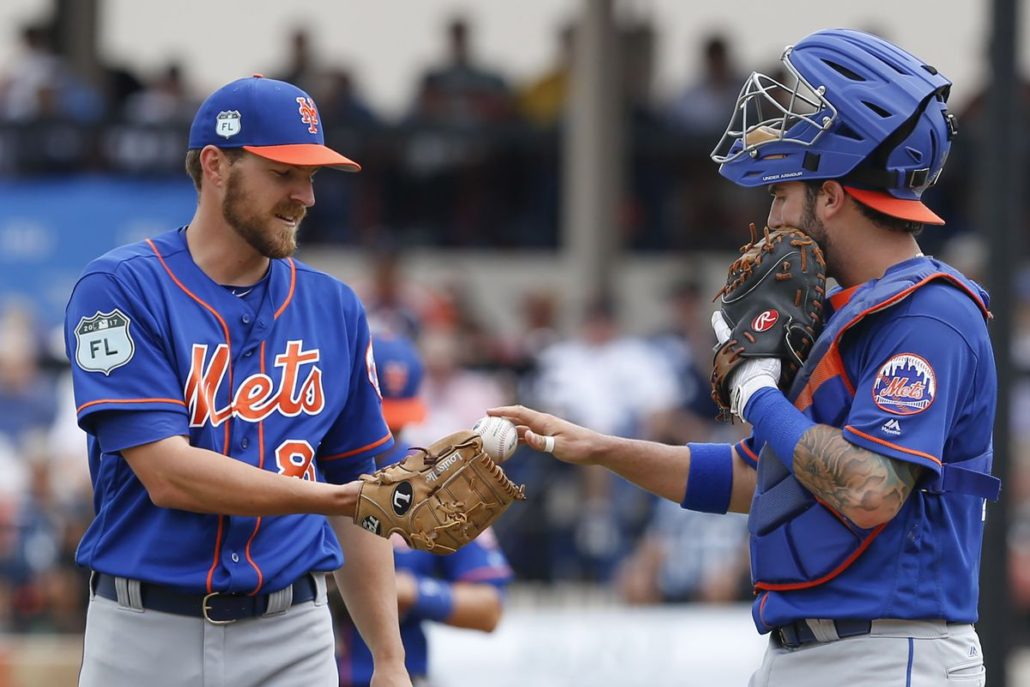
Photo courtesy of USA Today Sports.
Tomas Nido is currently the highest ranked Mets catching prospect according to MLB.com coming in at No. 10, and he has steadily rose through the Mets farm system the last couple seasons.
Nido, 23, was the Florida State League batting champion in 2016 with Single-A St. Lucie, hitting .320/.357/.459 with seven homers and 46 RBI in 90 games.
Nido has promising raw power, and will most likely be comparable to Michael Conforto in that he can drive the ball to all fields.
Defensively, Nido threw out 42 percent of potential base stealers last season and had a .987 fielding percentage behind the dish in 2016.
MLB.com has Nido’s ETA at 2018, which is in line with the progress he has made in the minors, but I would guess that the Mets aren’t going to thrust him into a starting role right away.
Additionally, he likely won’t be major league ready until the latter portion of 2018 at the earliest, meaning the Mets should look to sign or trade for a veteran on a short-term pact while using d’Arnaud as a backup.
Apart from Plawecki and Nido, the Mets don’t have any catching prospects that will be ready sooner rather than later. For the future, a couple names to keep your eye on are Ali Sanchez and Patrick Mazeika.
Are there any current external options?
D’Arnaud will likely stick as the starting catcher the remainder of the season as the Mets look to retool for 2018 while being sellers at the deadline, but there are a couple options the Mets can consider that are available right now. However, they are few and far between.
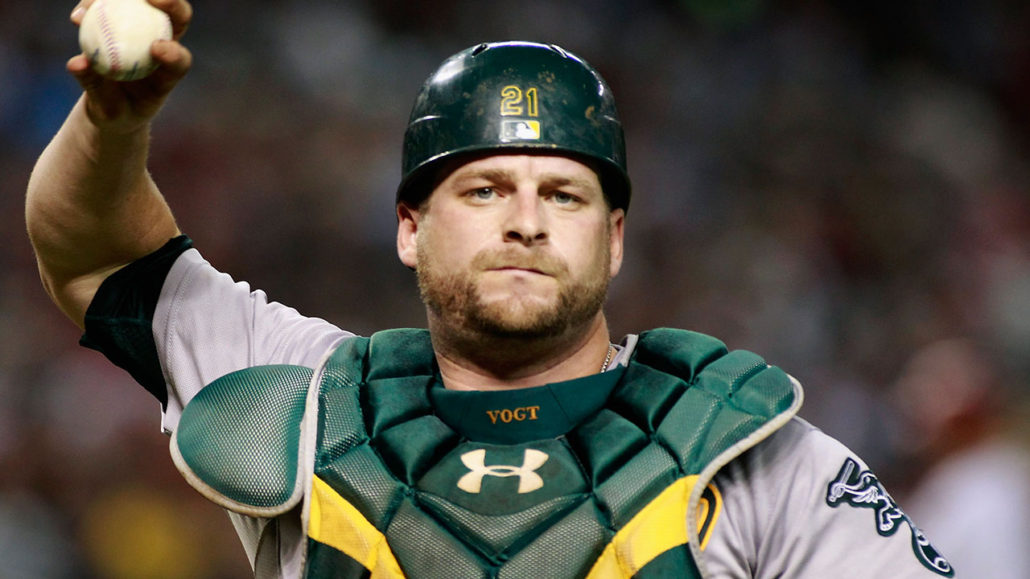
Stephen Vogt was designated by assignment by the Oakland Athletics on June 23 after hitting just .217/.287/.357 with four homers and 20 RBI in 54 games this season.
Vogt, 32, is having a down year after appearing in back-to-back All Star games. However, he could maybe just use a change of scenery and be productive for another team.
The veteran catcher has spent the last five seasons with Oakland and hit .261/.341/.443 and .251/.305/.406 in his 2015 and 2016 seasons, respectively.
Defensively, Vogt’s caught stealing percentage in 2017 is 15 percent, below the league average of 28 percent, but in past seasons, has mostly been in line with the league average.
While Vogt spends most of his time behind the plate, he has also played outfield and first base for the A’s the last few seasons, so he can be used at those positions in a pinch if need be.
The veteran backstop is currently in DFA limbo and will be moved soon.
He could be appealing to the Mets since he is arbitration eligible the next two years and can be controlled through 2020.
Acquiring Vogt could be a low risk, high reward move for the Mets, and could bridge the gap to someone like Nido while splitting time behind the dish with d’Arnaud for the short term.
Update: Vogt has been claimed off waivers by the Milwaukee Brewers.
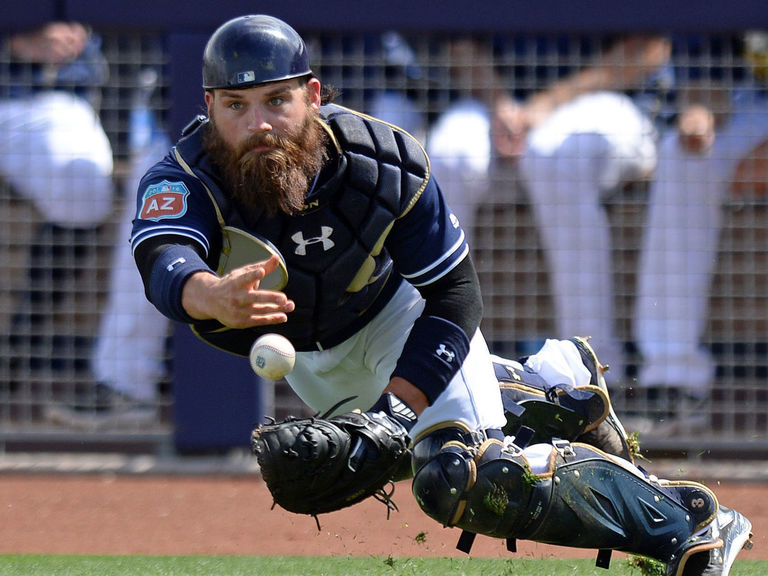
Photo Courtesy of USA Today Sports.
A former teammate of Vogt in Oakland, the Tampa Bay Rays recently designated Derek Norris for assignment.
Norris has hit a rough patch the last two seasons, hitting .186/.255/.328 in 2016 and .201/.258/.380 this year at the time of being DFA’d.
The 28-year-old veteran’s best season came in 2014 when he appeared in his first and only All Star game and hit .270/.361/.403 with 10 homers and 55 RBI in 127 games.
While Vogt is the more appealing option, Norris is several years younger and has decent power, with nine home runs on the season so far and at least 10+ the last three seasons.
If Norris can perform like he did from 2014 through 2015, he would provide an upgrade over what the Mets currently have, but it’s a shot in the dark, which is why I think the Mets likely won’t pursue him.
Norris is arbitration eligible for 2018 and can become a free agent after 2019.
What can the Mets do to upgrade this offseason?
The free agent class of catchers is pretty slim, but there are a few options the Mets could consider.

Photo courtesy of Getty Images.
Jonathan Lucroy headlines the names of catchers hitting the open market this winter.
Lucroy, 31, was linked to the Mets at the trade deadline in 2016, but was ultimately shipped to the Lone Star State.
In 2016 between the Milwaukee Brewers and Texas Rangers, Lucroy clubbed a career high 24 home runs with 81 RBI and a .292/.355/.500 slash line.
Lucroy is in the final year of a five-year extension with a club option for 2017 he signed before the 2012 season, and is a two-time All Star and .283/.340/.438 career hitter across eight big league seasons.
While the Houston Astros are running away with the American League West, the Rangers sit at 37-37 (UPDATE) and just two games back of a wild card spot in the American League.
What they do the next month will dictate whether they trade Lucroy at the deadline.
Regardless, he will be available in the winter and the Mets should seriously consider signing him, as he would provide an immediate upgrade over the current Mets catchers and will provide some pop behind the plate, while also being the best option on this list.
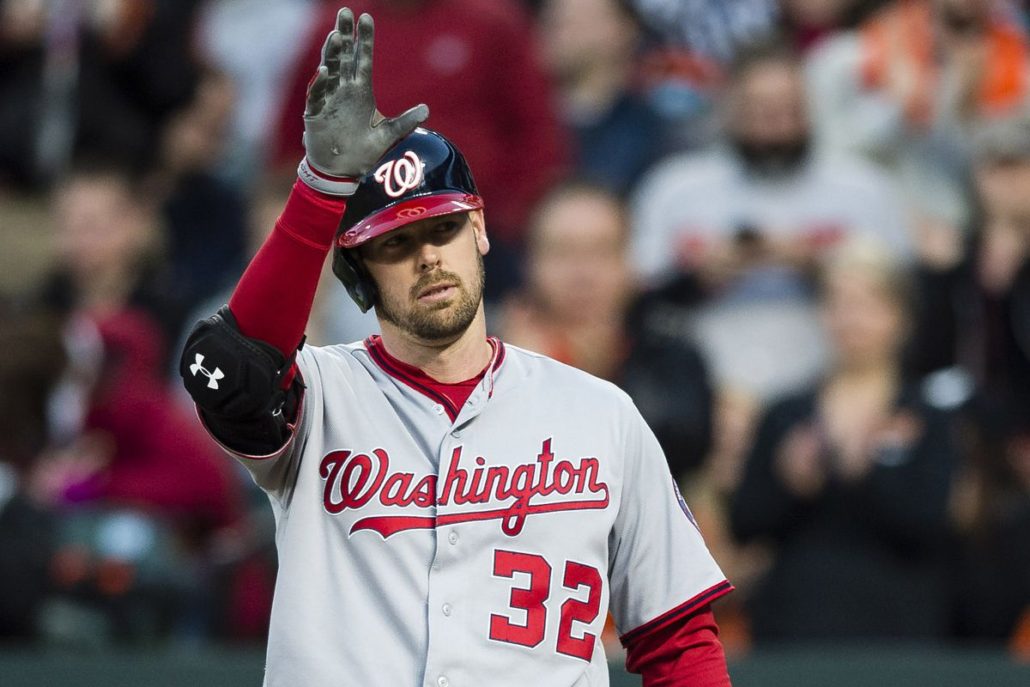
Photo courtesy of USA Today Sports.
Matt Wieters signed with the Washington Nationals very late in the offseason to a one-year deal with a player option for 2018.
If Wieters chooses to opt out of his contract with Washington, and that’s a strong “if,” he could prove to be a viable short-term option for the Mets.
Choosing to put their trust in d’Arnaud, the Mets bypassed signing Wieters this offseason, but hindsight is 20/20 as they say.
While Wieters hasn’t be spectacular, hitting .249/.304/.385 this year, he is a four-time All Star and two-time Gold Glove winner who has 20 home run potential and soft hands behind the dish.
Lucroy is the more appealing option by far, but if he is snagged and Wieters is available, the Mets should scoop him up on a deal similar to what he signed with Washington.
Another free agent the Mets could consider on the short-term is veteran Miguel Montero while keeping their eye on Yasmani Grandal, Devin Mesoraco and Wilson Ramos, all of whom will be free agents after 2018 and could fit with the Mets via trade.
Are there teams that could trade for d’Arnaud?
While d’Arnaud’s stock is not what it used to be, his age and former top prospect status could be appealing to a team looking to work their magic.
The Detroit Tigers, Oakland Athletics, Seattle Mariners and Atlanta Braves could all be possible suitors, as they could each use an upgrade at the Major League level with slim reinforcements in the minors.
With d’Arnaud in his fifth season with the Mets and the results not being what they would have liked, it is a position the Mets need to thoroughly consider upgrading this offseason.
D’Arnaud isn’t getting any younger and the chances of him becoming what many have thought are looking slimmer and slimmer.
The Mets have some work to do this offseason at a variety of positions and this one should be no different.