
A lot of consideration is made on how a pitcher performs independent of his defense. If two pitchers produce the exact same ball in play – a ground ball to the right of the shortstop – the outcome may differ depending on how adroit that shortstop is at making the play. Therefore, statistics are calculated to identify things that the pitcher can control, independent of defense, mainly walks, strikeouts, and home runs.
But what happens when you compare mound dwellers who are surrounded by the same defense?
We can look at statistics independent of defense – walks, strikeouts, and home runs – or we can consider the fixed defense of pitchers on the same team.
For the Mets, we can consider areas on the field that are known weaknesses versus known strengths. Or, more specifically, we can look at which pitchers take advantage of the defensive brilliance of Juan Lagares versus which ones take a chance with the middle infield defense of Daniel Murphy and Ruben Tejada (or now Wilmer Flores).
Let’s focus on the starters, and first look at their ground ball and fly ball tendencies.
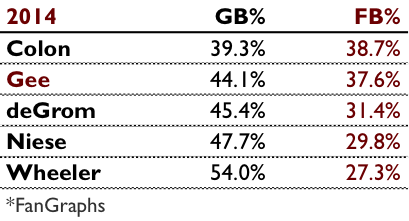
Dillon Gee, who has survived trade talks thus far, sticks out as an interesting case. He produces the second most fly balls of the starters, with him and Bartolo Colon clearly leading the pack in 2014, but also generates ground balls at a similar rate to a pitcher like deGrom who generally keeps the ball out of the air.
We are trying to identify the starters who create fly balls, so we can then see which ones take advantage of having one of the best defensive center fielders in the game behind them.
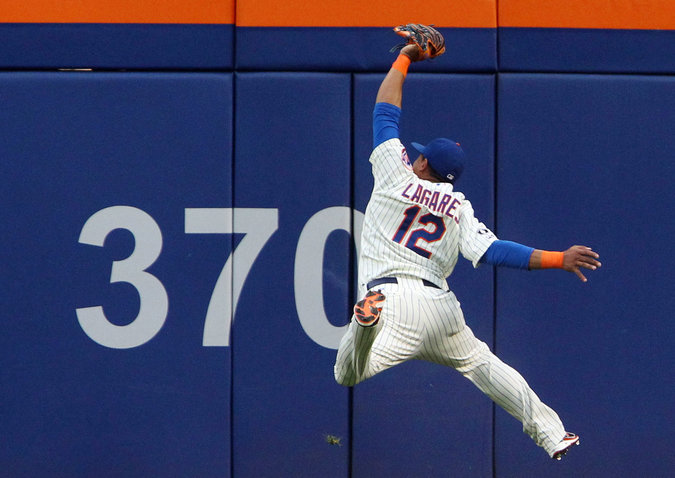
In case you forgot how good Lagares is at tracking down fly balls:

Of course, we have data to back up his mad skills too. Inside Edge is a scouting company that evaluates every ball in play to grade how easy or difficult it is to successfully field that play on a percentage scale, with 0% being impossible and 100% being certain.

Center fielders don’t get a lot of opportunity to make less than routine plays, but when he does have to make a tough play, Lagares usually makes it. And he is pretty much, no wait, he is a guaranteed out converter on routine plays.
On the opposite end of Lagares’ fine skill, there is the Mets middle infield defense.
With Wilmer Flores the likely shortstop heading into the season, question marks abound on whether he can field the position.

Not a lot of chances for Flores on less than routine plays, but he didn’t exactly perform to league average on those opportunities. We also know from scouting reports that his defense is cause for concern.
For Daniel Murphy, the Inside Edge data is not much better.

Let’s pull all of this information together.
Looking at last season’s data, we can see how often each starter served pitches to the strength of the Mets’ defense versus their weakness. The percentage values in the table below indicate the percentage of pitches resulting in a ball in play to that position of the field.
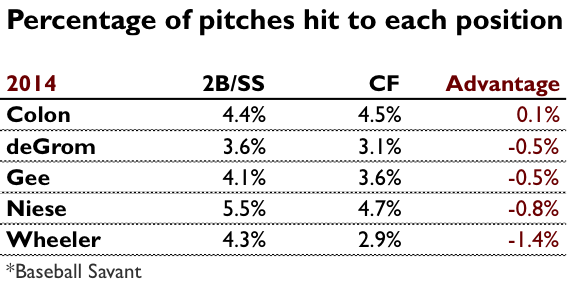
What we find is that Bartolo Colon is the only starter to have more batted balls end up near Juan Lagares than a middle infielder. Dillon Gee, who produces the second most fly balls of the starting group to Bartolo Colon, is not as effective in forcing balls in play to center field.
The starter who takes least advantage of the Mets’ center field strength and middle infield weakness is Zack Wheeler.
The Mets are building their organization around young pitching depth. It would seem to make sense to support that with strong defense. What will be interesting is to see how much the strength of Lagares in the outfield can offset potentially other weak defenders lined up next to him (something to consider for another post), as well as the relatively weak defense in the middle of the infield. And how all of that impacts the success of those young pitchers.
Statistics courtesy of FanGraphs and Baseball Savant.
Another original article from Metsmerized Online!