

If there is one thing the 2026 New York Mets have shown early this season, it’s that no lead feels entirely safe. That theme surfaced again Thursday night in a back-and-forth game where the Mets’ offense was able to produce enough to overcome a late collapse and still come away with a 10-8 win over the Minnesota Twins.
The evening started precariously for starter Christian Scott, who struggled with command from the jump. After four walks in the first inning allowed the Twins to take a 1-0 lead, the Mets’ offense immediately went to work to bail out their young righty.
New York answered in the bottom half when Brett Baty drove a three-run home run to right, giving the Mets the lead. The onslaught continued in the second inning. After Marcus Semien and Carson Benge both doubled, a passed ball and a Luis Robert Jr. RBI double pushed the lead to 6-1. Benge added a solo shot in the fourth, and the Mets looked to be cruising with a five-run cushion.
This cruising phase didn’t last for very long. The Twins clawed back, eventually loading the bases against veteran Craig Kimbrel. Minnesota’s Ryan Jeffers delivered with a towering grand slam to left field that tied the game at 7-7 with one swing
In the bottom of the eighth, New York loaded the bases again and brought up Bo Bichette. The shortstop, who has faced criticism since arriving in Queens, finally delivered in a key spot, driving a high breaking ball to left field for a bases-clearing double. He turned a tie game into a 10-7 lead, giving the Mets control again late in the game.
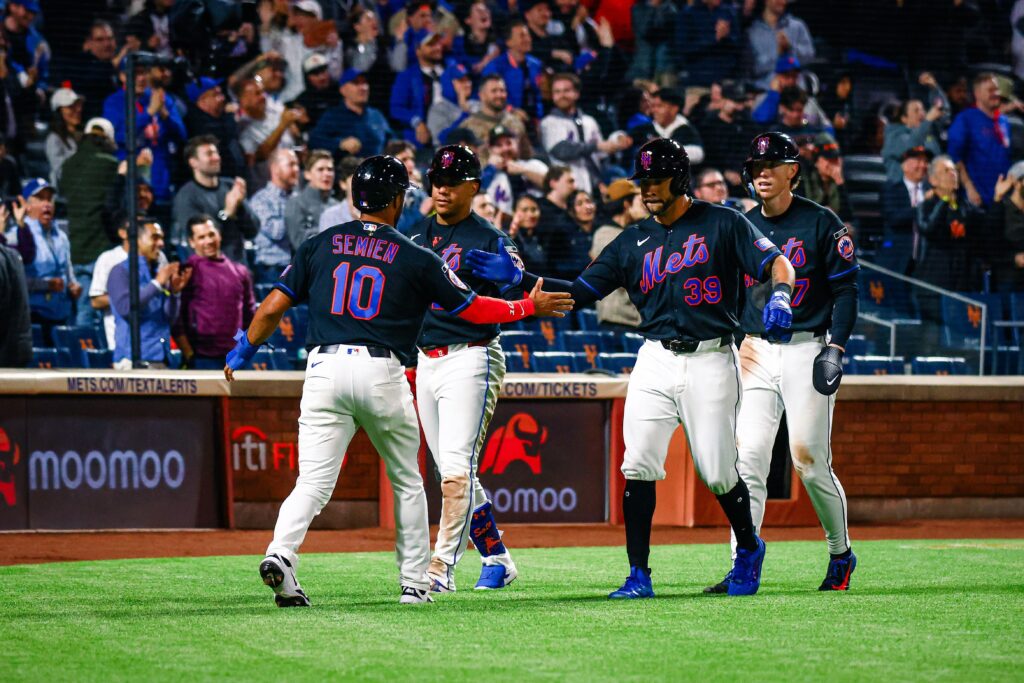
Photo By: Roberto Carlo
“I think he’s been looking for that moment, especially here at home,” manager Carlos Mendoza said after the game. “It’s meaningful to do it here in front of our fan base.
Despite Devin Williams surrendering a run in the ninth, the Mets held on for the win. Scott was the first to acknowledge the help he received from the hitters.
“I didn’t do my job, but they did their job,” Scott said. “It’s why we’re here with a win today.”
As for the man of the hour, Bichette remained humble about his game-winning heroics.
“The desire to help a new team, the desire to perform at the level you know you can perform at… I don’t know if any of that was weighing on me,” Bichette admitted. “Still need to get better, make adjustments and get to the player I need to be.”
It’s been a difficult stretch for the Mets’ offense, which have averaged 3.52 runs per game, ranking 29th in the majors. During the team’s 12-game losing streak, they were held to two runs or fewer in nine of those contests, which shows how inconsistent the lineup has been at generating sustained production.
Thursday was a great sign, even if it’s only one game. Several slumping batters broke out in the same day, something the Mets have rarely managed so far this year. Bichette finished 3-for-5 with the bases-clearing double that ultimately decided the game, while Baty had a 2-for-4 night that included his aforementioned home run. Benge went 2-for-3 with multiple extra-base hits against a quality starter in Joe Ryan.
It was also Juan Soto’s second game since returning from a calf injury. Although he didn’t record a hit, he still reached base twice in five plate appearances on a pair of walks. Having a hitter with his level of plate discipline and power back in the middle of the order strengthens the lineup beyond his individual results, as it creates more favorable situations for those batting around him.
On Thursday, that effect was clearly visible. Pitchers are less willing to face Soto in high-leverage spots, which leads to them being more aggressive to the hitter in front of him. That hitter in this case was Bichette, who capitalized on those situations and finished the night with a strong performance at the plate, benefiting in part from the pressure Soto’s presence creates throughout the lineup.
The overall takeaway for the Mets isn’t that the offense has fully turned a corner, but that they at least clicked together on the same night, something they’ve struggled to do early in the season.