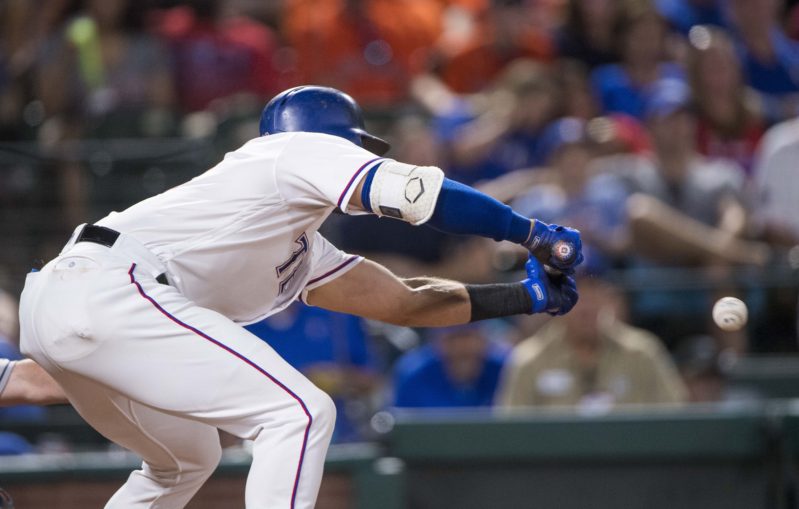
The debate about whether or not hitters should bunt is becoming widespread. Joey Gallo is the poster boy of this debate. For those who don’t know Gallo, he is essentially the definition of an all-or-nothing hitter. The Rangers played the Astros in May and Astros employed this shift on him:
.@astros positioning vs Gallo. Wow. pic.twitter.com/XCOy0VfKeL
— Daren Willman (@darenw) March 29, 2018
(Yes, that is, in fact, Alex Bregman in the outfield along with three other guys).
So why would the Astros be willing to give up an easy bunt single? Sports Day in Dallas wrote, “Hinch said in situations such as when the pitcher falls behind at 2-0, he would welcome Gallo bunting for a hit rather than taking a swing for a homer.”
When you have a hitter like Joey Gallo, you would much rather let him stand on first than have him round the bases and the Astros clearly agree. They are more than happy to give up a single rather than give up a homer.
According to the Baseball Prospectus run expectancy chart, MLB teams have a run expectancy of 0.8945 when they begin the inning with a runner on first and no one out. That number drops to 0.5407 when there is one out and 0.2349 when there are two outs. Also seeing how the lineup behind Gallo, the odds of the Rangers scoring a run when Joey Gallo reaches first is quite small. So Hinch is dead on when he says he wants Gallo to bunt.
While it is a nice idea in theory, stringing together hits is a very difficult concept. Justin Verlander gives up a hit only 15.27% of the time. That means there is roughly a 0.356% chance of stringing together three straight hits off Verlander. The odds of someone getting three hits in an inning of Verlander is slightly more doable, the odds of that are 4.33%.
So in the event you do end up getting multiple baserunners in a single inning of Verlander, then getting just one run does not like a huge victory because you won’t have many more chances in a game against him. That is why AJ Hinch is more than fine letting Joey Gallo bunt. He will take his odds that the Rangers can’t string together some singles against Verlander as opposed to letting Gallo hit a home run.
The Red Sox were a singles hitting team in 2017 but they got rocked in the playoffs by the Astros and did not have a chance. You might be pointing to the 2015 Royals at this point as a singles hitting team but the Royals ranked 11th in slugging and 11th in wOBA while the Red Sox ranked 26th in slugging and 20th in wOBA. I’ll say this, I wish Alex Gordon tried to lay down a bunt against Jeurys Familia in Game 1 of the World Series instead of trying to homer.
The strategy might work well when a team is facing Andrew Cashner but there is no chance that Cashner will be starting against a team when it matters the most.
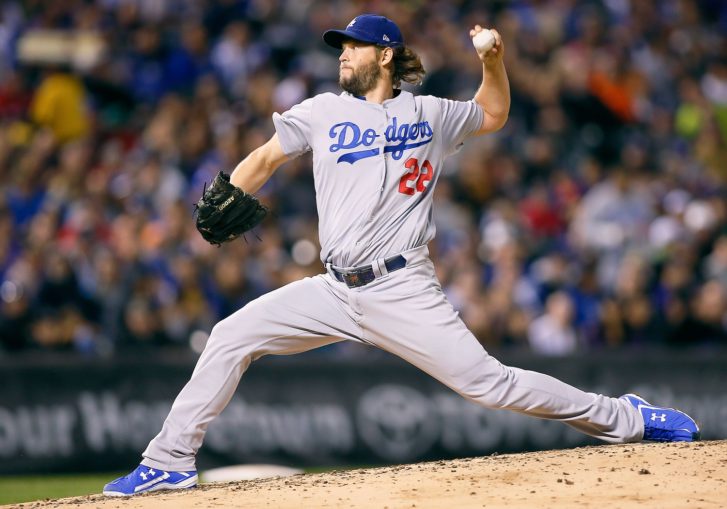
That said, if you are a team that hits homers, then you have a chance to beat these great pitchers. I take you back to Game 5 of the World Series. The Astros were trailing big time to the greatest pitcher of this generation and one of the best ever, Clayton Kershaw.
The odds of someone getting a hit off Kershaw was just 20% last year but the odds of reaching base were slightly better at 24.4% of the time. The odds of having three people reach base in an inning against Kershaw was a modest 18.8%. Slightly better than trying to get three hits in an inning off Verlander but still not very high. Not to mention, chipping away one run at a time with a sacrifice fly just was not going to cut it. Especially since the Astros bullpen was serving up long balls to the Dodgers like they were eggs at breakfast.
The Astros though had multiple three-run homers in that game and they ultimately won it. You can make a case that the team should have players bunt against the shift and let the subsequent try and get the job done. The problem is, the person hitting behind that hitter is more than likely to be a weaker hitter. For example, many say Dominic Smith should have bunted against the Dodgers on Sunday. But Kevin Plawecki and Jose Reyes were hitting behind him and neither are the kind of hitters you want with the game on the line (Plawecki’s homer earlier in the game aside).
Sure, every offense could be like the Astros. A team that hits homers, hits for average, doesn’t strikeout, and gets on base a lot. They led the league in BA, OBP, and SLG. But very few teams have the luxury of having players the caliber of Alex Bregman, Carlos Correa, Jose Altuve, and George Springer. The Los Angeles Dodgers ranked 22nd in batting average (behind the Mets, Orioles, and Braves) in 2017 but ranked sixth in OBP and eighth in slugging. The Dodgers and Astros are running laps around other teams by using analytics and making their team better. Don’t believe me? The Astros analytics department is called the “nerd cave.”
I’m not suggesting that situational hitting and small ball has no place in baseball but getting extra base hits is significantly more impactful. Sacrifice flies are better than strikeouts with runners in scoring position from a team perspective. A lineup of eight Joey Gallos is not what I am suggesting either. Gallo has a sub .300 OBP. But having a lineup that tends to be over-reliant on the big hit tends to be a bad strategy.
That being said, you can’t build teams around relying on the sacrifice fly or playing small ball, and MLB teams agree with that thought process. That is why AJ Hinch wants the opposing team to drop down bunts and that is why Dee Gordon, a singles hitter, was basically handed away in the off-season. As I mentioned with Verlander, the odds of trying to attack him or any other of the greats with a singles barrage seems next to none. The best chance you have of beating someone like him is to try your best to get on base and then hit a homer.