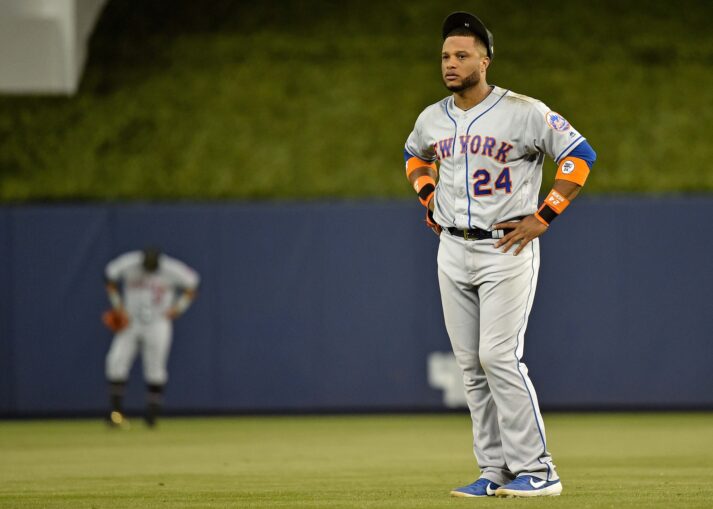
Although he was excited about returning to New York City to play baseball, Robinson Cano’s Mets career hasn’t gotten off to the best of starts. While it’s too early to write off a player with his kind of track record, it’s not helping the 36-year-old silence concerns about him being under contract through his age-40 season.
Any way you slice it, having your three-hole hitter slashing .241/.287/.371 with three home runs and 13 RBI through 181 plate appearances isn’t optimal. That performance has led to an 82 wRC+ and -0.1 fWAR. And now he’s been placed on the injured list with a quad strain.
With Memorial Day approaching, where does the veteran second baseman need to make adjustments after looking at what he’s done throughout a pretty successful big-league career?
Batted-Ball Profile Looks Good
With regard to how Cano is putting the ball in play and the quality of contact he’s been making in 2019, there aren’t too many differences upon comparing it to his previous two seasons with the Seattle Mariners. Heck, there are even some improvements.
| Year | LD% | GB% | FB% | Soft% | Hard% | wRC+ |
|---|---|---|---|---|---|---|
| 2017 | 19.4% | 50.0% | 30.6% | 12.7% | 36.9% | 113 |
| 2018 | 22.6% | 47.9% | 29.4% | 11.3% | 41.5% | 136 |
| 2019 | 20.3% | 48.9% | 30.8% | 17.9% | 39.6% | 82 |
Cano’s percentages of batted-ball events are almost exactly in line with what he’s done throughout his career. His current soft-hit rate is obviously a little elevated, but at least it hasn’t come at the expense of his hard-hit rate. For a hitter that racks up as many ground balls as he does, it’s important to have as much solid contact as possible.
Why could that soft-hit rate be as high as it is, though? The last time it was this high was in 2016 (17.9%). This can likely be attributed to where he’s making his contact, and it also goes hand-in-hand with his plate-discipline numbers.
Plate Discipline Could Use Some Help
Cano has never been one to draw an insane number of walks upon stepping into the batter’s box, but he’s also never been one to strikeout too often. After posting a 6.4% walk rate and 15.9% strikeout rate (a career-worst mark) in 2015, those numbers mostly improved each year through 2018 (9.2% walk rate, 13.5% strikeout rate).
So far in 2019, Cano is drawing walks at just a 5.5% clip, while he’s striking out 19.9% of the time. Not surprisingly, these numbers are supported by looking at where exactly he’s offering at pitches.
His 53.3% swing rate is among the highest in baseball for qualified hitters, and would be the highest it’s been since 2011 (54.6%) if the season ended today. Here’s a quick look at how Cano’s chase rate, swing rate on strikes, and the corresponding contact rates have changed since the start of 2017.
| Year | O-Swing% | O-Contact% | Z-Swing% | Z-Contact% |
|---|---|---|---|---|
| 2017 | 34.9% | 70.8% | 73.3% | 90.6% |
| 2018 | 33.4% | 69.0% | 68.3% | 92.3% |
| 2019 | 39.0% | 71.5% | 75.0% | 85.4% |
It’s great to see the 36-year-old getting more aggressive inside the strike zone, but it’d obviously be better if it wasn’t accompanied with chasing more balls outside the strike zone. These kinds of tendencies (chasing non-strikes, striking out more often) are consistent with a hitter slumping at the plate, though.
Considering his situation — he’s on a new team and wants to get himself going — this also isn’t surprising. It’s not as if Cano went from Brandon Nimmo levels of plate discipline to swinging at everything, either. He’s always been one to swing the bat more than the average hitter. But once he gets back on track, increased aggressiveness within the strike zone will hopefully lead to more contact. And if his quality of contact remains at its current level, that should lead to positive results.
So Does His Performance Against Lefties
Cano has had his ups and downs against left-handed pitchers in recent years, but he enjoyed a bit of success against them last season in Seattle (albeit in a smaller than usual sample size because of his suspension). Through 124 plate appearances against southpaws in 2018, Cano slashed .333/.411/.481, which led to a 152 wRC+. Through 50 plate appearances this season, those numbers have dropped to .130/.200/.130 and -1, respectively.
He didn’t have the best batted-ball profile against southpaws last year, but it did include a 34.0% hard-hit rate and 26.6% line-drive rate. Those numbers are currently at 21.4% and 11.1%, respectively, in 2019, along with a 36.0% strikeout rate (12.1% in ’18).
If we look exclusively at the second baseman’s performance against right-handers, it wouldn’t be too shabby at all: a .282/.321/.460 line with a 13.7% strikeout rate, a 44.3% hard-hit rate and 113 wRC+.
Struggling Against Breaking Pitches
Although his performance against pitches he’s faced in 2019 has been down mostly across the board, Cano has been particularly struggling when breaking pitches are tossed his way.
After posting a 74 wRC+ and 24.1% strikeout rate against sliders in ’18, those numbers have worsened to 42 and 30.8%, respectively. The same can be mostly said about his performance against curveballs — his strikeout rate has gone from 22.0% to 20.0%, but his wRC+ has gone from 187 to 100.
His ground-ball rate against these offerings has increased from last year, but what’s more eye-popping is the change in his chase rate against sliders, which has gone from 33.7% in ’18 to its current 43.6% clip.
There’s still plenty of season left, which gives Cano time to get hot and post numbers that closer resemble his past production. In order to get to that point, though, there are a number of areas where he must improve his performance first.