
Baseball players tend to disappear after retirement. Without the spotlight of national media, or admiration of thousands of fans, they fade back into mainstream society. They leave only memories, and their absence from the game makes it easy to forget that these guys we watched on TV are still real people. My mission is to make fans remember these forgotten players by seeking them out and talking to them in our quest to answer our burning question, “Where are they now?”
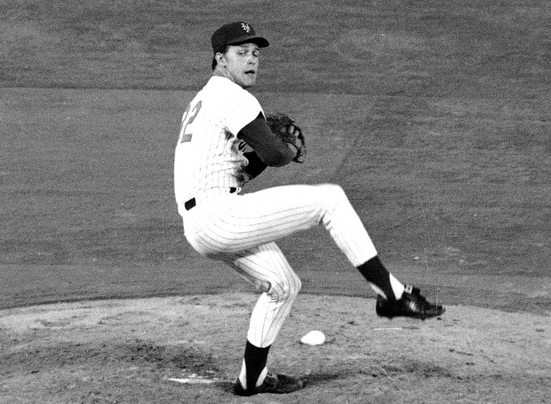
Today I chatted with former Mets pitcher Jon Matlack about his fine career, what it was like pitching alongside Tom Seaver and Jerry Koosman, what he’s doing now, and his thoughts about the Mets’ young aces today.
Here’s the podcast, and as always, I appreciate your comments.
Noah: So you pitched for the Mets for seven years, made a World Series and several All-Star appearances. Looking back on it all, what was your finest moment while on the team?
Jon: Oh boy, I don’t know how you pick one, there were several that were qualified to be in that realm. I guess I would say game two of the championship series against Cincinnati would probably be a highlight.
Noah: Speaking of that game, you shutout the Big Red Machine on two hits. You were a young pitcher then who had been roughed up by them twice earlier in the season. Were you at all nervous going into that game?
Jon: Probably more like scared to death. I had charted Seaver’s game the day before where we were beaten 2-1 on two solo home runs, one by (Johnny) Bench, one by (Pete) Rose. Tommy struck out 14 or 15 guys and just did a phenomenal job. And I’m looking at that chart thinking “what in the world have I got to do to beat these guys?”
Noah: Who were you most scared to face?
Jon: Well the irony was the typical fastball hitters weren’t the guys that I was most afraid of. It was probably Dave Concepcion and Tony Perez that I was a little leery of because of their ability to hit the breaking ball, especially the breaking ball that wasn’t a really good one.
Noah: And how did you maintain your composure?
Jon: I don’t know. I was just trying to do the best I could do to help us win a ball game. You get locked in on what you’re trying to do, stay ahead of the hitters and throw a lot of strikes. Keep the first guy off base. You get so involved with the job at hand that you don’t necessarily think about pressure and what else is going on around you.
Noah: As I mentioned earlier, you played on the Mets for seven years. Played alongside some great guys. Played under some really legendary managers. Can you pinpoint any one of them that shaped you as a player or as an individual?
Jon: Well I think Gil)Hodges, not because I played for such a long time under him as much as the type of individual he was and the atmosphere that he created in the clubhouse and in the dugout. Because I really didn’t spend much time there, I made the club full time in the spring that he died. And then beyond that, Yogi was most influential for completely different reasons. He was the type of manager that just said “here’s the bats and balls boys, go do your thing and let’s win some ball games.”
Noah: What was the craziest thing he ever said to you?

Jon: I don’t know if there was anything particularly crazy, but I do remember having a difficult time understanding him when he came to the mound. During games for mound visits, and I finally asked Seaver, “How do you handle him?” And he said it’s really easy. “Whenever he’s done talking, if he doesn’t put his hand out, you say okay and he’ll go back to the dugout. If he puts his hand out, you put the ball in it and you go back to the dugout.” That’s about as basic as it gets. (laughs) It was pretty easy.
Noah: In 1973, you struck out 205 batters, which was a Mets record for a left-hander that stood for 35 years. How did you go about attacking hitters and finishing them off?
Jon: I don’t know if there was anything different from one year to the next. Except when I had my contract negotiation the previous year, one of the things the club pointed out to me was that they felt I didn’t strike out enough guys. So it became an emphasis for me to try and do that more so whenever I was in a situation where the strikeout was possible, I tried to pay more attention to how to get it. (My approach to) each hitter would have been different, how they approached an at bat would have given me some information as to what weapon to use best against them.
Noah: So you had a successful career overall, a career ERA of 3.18, 318 quality starts, however, you were only one game over .500 for your career record. Do you regret not having more opportunities to win, considering how well you pitched?
Jon: Well I think that the opportunities were there, I just would have had to have been better. In those circumstances, it’s just the way that the chips fell. My job, as I looked at it, was to keep our club in the game for as long as I was in the ballgame. That to me was (whether we were) ahead, tied, possibly one or two down, and that was me doing my job. I felt that I did that for the largest percentage of the time. So the win loss thing wasn’t something that I was really centered on as much as I wanted us to have a chance to win every time I took the field.
Noah: Switching gears now, what have you done since moving on from professional baseball, and as the title of the series says, where are you now?
Jon: Well now I am in River Ranch, Florida in a fifth wheel trailer, staying out of the snow of upstate New York where I live.
Noah: I totally sympathize with that up here in Syracuse.
Jon: (Laughs) As far as what I’ve done, when I stopped playing, I was in commercial real estate and raising horses for four or five years. I decided I wanted to get back into coaching and in 1988 started back as a stationary coach for the Padres. After a couple years with them, I went to the White Sox for a couple years, all in the minor leagues. Then back to the Padres, in 1996 I was the Tigers’ major league pitching coach. I didn’t make it the whole year, that September I got fired, but they hired me to be the minor league pitching coordinator and I did that for 16 years. Again, the ax fell, I went to Houston and did the same job for one more year, and since then, I’ve been out. From 2012 on, I have been a retired character.
Noah: Now the 2016 Mets were very similar to the 1973 Mets, just in the way that they’re built around strong young pitching. So do you see any similarities between the Mets young aces today and your rotation mates of Seaver and Koosman in 1973?
Jon: Yeah, I think there’s a lot of talent similarities, but the way the game is played is different. When you look at the six potential starters they have -Wheeler wasn’t in there because of injury- but you got deGrom, Harvey, Matz, and Syndergaard. Wheeler’s going to be back this year as far as I know and Colon’s still in the mix as a spot starter, a double header guy, or however they choose to use him. That’s a pretty strong rotation. The thing that stood out to me watching the series was the fact that it seemed like the staff in general tried to outstuff the opposition as opposed to pitch to what they saw and exploit a weakness. I don’t think they did nearly as well as they could have had they maybe used some of the aggressiveness of the Kansas City hitters against them.
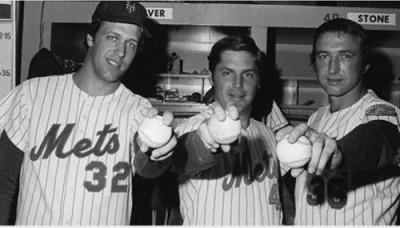
Noah: So how are these guys today different from you, Seaver, and Koosman?
Jon: In our day, we were given information about the opposition and then told “go use it how you want to and keep us in the ballgame, give us a chance to win.” And that was pretty much what an advance scouting report was all about. In today’s game -and I can’t say that the Mets do this exactly, but a lot of clubs do- they’re pretty much given a chart or a plan to follow. “This is how you pitch this guy, do not throw this guy a first pitch fastball…” They’ve got it down to if it’s 2:15 on a Tuesday afternoon and the sun is shining, you throw a breaking ball to so and so, the odds are really good at getting a ground ball. The game has become more computerized -fantasy baseball on the field- if you will, and I think it takes a lot out of the personality and the player’s ability to trust their gut out of it.
Noah: It’s been well documented today that the Mets pitchers are very competitive with each other. Did you have that same dynamic with Seaver and Koosman?
Jon: Absolutely. We had contests of various types going on all year long. It usually had to do with somebody buying dinner for the other two. Ironically, it all sort of went around. Koosy would win once in a while, Tommy once in a while, and me once in a while.
Noah: And specifically, what were those competitions?
Jon: Some of them had to do with who would be the first guy to not give the team a chance to win or put us in a spot where we would lose. Which guy would have the best batting average for the month, who had more base hits or an extra base hit. Something like that, it was all competitive driven.
Noah: So is there any one Mets pitcher today that you see some of yourself in?
Jon: There’s been a lot of comparisons drawn between me and Steven Matz. Whether or not they really hold to be true, I can’t tell you. From looking at him, he seems to have similar stuff, but what makes the difference to me is how you use that stuff, your ability to deal with adversity, your ability to feel the right decision at the right time, and a fearless approach to whatever adversary you may be facing. And I can’t tell you without having a sit down or being closer to him, whether he possesses any of that stuff.
Noah: Now if you could give any message to Mets fans, what would it be?
Jon: Oh man… Thanks for a great time when I was there. Mets fans are known to be tough, but I think if you give them an honest effort and give them the time of day -which I tried to most of the time- they’ll treat you real fairly, and that’s the way I felt.
Noah: And lastly, you gave up Roberto Clemente’s 3,000th hit. Can you just take me through that at-bat? And at the time were you really aware of the gravity of the situation?
Jon: I had no knowledge whatsoever that it was his 3,000th hit. I was just a young rookie trying to win another ball game, and having a tough day. We were behind, I think I ended up losing the game five to nothing. I was making a pitch that I was upset about, it was a breaking ball and I was trying to get it to the outside corner. When it left my hand, I was pretty certain it was going to be a ball so I was upset from that point, that dammit, that was a ball that was supposed to be a strike. He managed to keep his hands back, which he generally did very well, took that great big stride he was known for, and reached out across the plate and laced it into left center field for a double. I’m like damn, that’s pretty good hitting. He managed to hit a ball that’s not even a strike. But now the place erupts, there were not a whole lot of people there, but it gets very loud and I’m thinking it’s a double what’s the deal? They were giving him the ball at second base and at that point I noticed the scoreboard flashing 3000. That’s the first inclination that I had that it was a momentous occasion for Clemente.
Noah: Thanks so much for your time Jon. Really appreciate it.
Jon: No problem. Have a good one.
Noah: That does it for us on Where Are They Now, I’m Noah Wolfe. Check back in a few days to hear what a member of the Miracle Mets had to say about that amazin’ year and his life today.